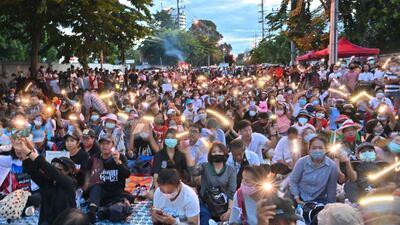

The waves of protests in Thailand's capital have not ebbed since they broke in July. On the contrary, a report in the Bangkok Post suggests that they will only rise further over October. If such news seems vaguely familiar, that is because for over a decade after 2006 – when then Thai prime minister Thaksin Shinawatra was forced from office – the world grew used to hearing of demonstrations and counter demonstrations between Mr Thaksin's supporters, known as the "red shirts", and the yellow-shirted royalist supporters of the armed forces that had removed him from power and their parliamentary allies.
This time, however, the mass gatherings have not just the military-dominated government of former general Prayut Chan-o-cha in their sights; they have also been calling explicitly for reforms to the monarchy and implicitly to what the political analyst Duncan McCargo referred to as the “network monarchy”, a wider web of patronage and the establishment in the country.
In the past, under the long reign of King Bhumibol Adulyadej (1946-2016), this subject was taboo. Quite apart from Thailand’s strict lese-majeste laws, which bar criticism of the monarchy, very few would have wanted to say anything at all against the universally popular king. A man of genuine and wide-ranging talents, he held several scientific patents as well as being a capable saxophonist who once jammed with the “king of swing” Benny Goodman.
More importantly, over his decades on the throne he came to be seen as a 'dhammaraja', whose rule accorded to Buddhist principles and demonstrated his superior virtue, as well as an heir to the tradition of the 'devaraja' Hindu god-kings of the ancient Khmer Angkor kingdom. His were unique shoes that any heir would have had trouble filling. It is no wonder that his son and successor King Maha Vajiralongkorn has yet to achieve the same status and invulnerability.


But there is another difference. The red shirts were usually characterised in the international media as being pro-democracy and the yellow shirts as the opposite. This view, though, was widely contested within Thailand. After Mr Thaksin’s allies failed to win the last general election in 2019, Thitinan Pongsudhirak, a highly respected political scientist at Chulalongkorn University in Bangkok, criticised the former prime minister’s “ambition and manipulation”.
He said that when in power he had “ruled with an iron fist” and that “protests against Thaksin's abuse of power and conflicts of interest” had been “fuelled by his hubris”. Rather than a great democrat, Professor Thitinan thought that Mr Thaksin was a busted flush, a bane on the country’s politics and that Thailand should be glad to see the back of him.
The current demonstrations are, on the other hand, quite clearly about rejuvenating Thai democracy and making quite radical demands for limits on the monarchy. It would be wise not to deal with the protesters by ignoring them as it is becoming clear that many of the younger demonstrators come from the middle and upper class establishment that could be counted on to oppose Mr Thaksin and support royalist and military rule in the past.

Some history: without going into too much detail, Thailand has had 19 attempted armed coups since the establishment of a constitutional monarchy in 1932, 12 of them successful. While democracy has always been restored, a shifting faction including (at various times) the armed forces, royalists, and the urban middle classes and elites have been happy to set it aside when they feel threatened by what they perceive as irresponsible populist actors – such as the succession of parties that were the vehicles for the exiled Mr Thaksin and his sister Yingluck, which won every election between 2001 and 2014.
If a split is developing in that faction – what the Kyoto University academic Pavin Chachavalpongpun calls a “contingent class” that “only lends its support to democracy on its own conditional terms” – there is a problem that a crackdown would only paper over, not solve.
Sooner or later some constitutional accommodation must be found to end the cycle of elections and interventions whose perpetrators, I am quite happy to accept, see themselves as saving the country from misrule.
Provisions would have to be agreed so that all interests, classes and regions felt properly protected, perhaps by reserved nominated seating in the upper chamber, for instance.
This could be aided by the clarification of the position of a constitutional monarchy that has arguably never been properly defined. It is important to realise that in the regional context the spectre of bicycling, powerless Scandinavian royals the term “constitutional monarchy” raises in European minds is quite incorrect.
In fact, according to Michael Vatikiotis, author of Blood and Silk: Power and Conflict in Modern Southeast Asia: "In all cases, the surviving monarchies of Southeast Asia have power and influence that potentially, or in reality, exceed that described in constitutional terms."

Mr Vatikiotis rightly refers to the importance of “the sacred and cultural symbolism” attached to their thrones, which earns them an ingrained respect regardless of whatever safeguards they are provided by law. By placing clearer demarcations around the Thai monarchy, the king would sacrifice no influence, but could better serve its long-term future by dispelling the fog that has allowed supposed “royalists” to insinuate they were acting on behalf of the throne when they working on their own behalves instead.
This is at least in part what the protesters have been complaining about. Royalists, the military and democrats: all are patriots. It is to be hoped they can recognise each other as such and one day bring an end to the political instability that has troubled Thailand for too long.
Sholto Byrnes is an East Asian affairs columnist for The National

