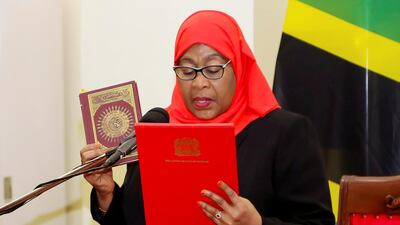

“I am a polite lady who talks politely but firmly. I don’t bang tables or threaten people but I have steel in my veins.” Samia Suluhu Hassan, Tanzania’s new president and currently Africa’s only female leader, will need that steel. While she is no “Bulldozer”, as her late predecessor John Pombe Magafuli was known, she is a savvy, experienced and competent politician who is not afraid to take a stand when it matters. She is respected in Tanzania as a thoughtful and considerate consensus builder, calm under fire and a firm believer in due process.
Tanzania’s first female president, however, is navigating uncharted waters. She takes office amid a raging and unchecked Covid-19 pandemic that is devastating her nation. President Hassan will also have to contend with a private sector that is increasingly losing its confidence, and the difficulty of governing a country that is largely alienated from the international community.
She has an important opportunity to turn Tanzania around. But to do so she quickly will need to win over a “deep state” that is staffed largely by the appointees of her dictatorial predecessor, a leader who tolerated no dissent and counted personal loyalty to himself as the deciding qualification for any appointments to high office.
On the upside, however, President Hassan has courted a great deal of optimism and goodwill both inside and outside the country. She needs swiftly to consolidate her power and get a few strong wins under her belt with a 100-day plan that addresses the Covid-19 health crisis and brings Tanzania back into the global and regional fold. It must also give business and investors a reason to get excited again.
She’s made some good gestures so far. On the virus front, she is putting together a special coronavirus task force to advise her on which steps the government should take based on the latest scientific data and findings. It is a bold and much-needed move that marks an about turn from the Covid-19-denying antics of Tanzania’s former president, who banned daily reports on the number of infections and only endorsed traditional herbal remedies to counter the virus.

Explicit and enforceable rules such as simply asking all Tanzanians to wear a mask would go a long way in curbing the pandemic. Reporting the country’s infection and death rates would help not only its people, but the region and the world. And while Tanzania would be a latecomer in acquiring vaccines, Ms Hassan should launch a nation-wide campaign to explain the reasons behind this change in policy and why vaccines are essential. This will require effective government communication, something that up until now has been severely lacking.
As she works to save lives, she must also address the need to protect livelihoods. She must change Tanzania’s economic and business environment, as well as the global perception of its markets. Investors, both domestic and international, have been put off by issues to do with governance, excessive red tape, the difficulty of obtaining work permits, arbitrary taxation laws and even the capricious interference of certain members of the country’s elite.
Ms Hassan needs to give powerful signals to the private sector that she is committed to pro-business legislation and dedicated to creating a level playing field for all. She could start by setting up a credible private sector advisory council to restore trust, repair the broken relationship between government and business and start building a strong public-private partnership to grow the economy.
This will require deep structural reforms, which could face opposition from those with vested interests in the current system, including her predecessor’s allies.
On the international relations front, she has charged Liberta Mulamula, a skilled career diplomat who has vast experience in foreign missions, with reaching out to international capitals. Tanzania historically has been respected in the Pan-African community, having supported many countries before and after their independence from colonial rule.
Domestically, President Hassan says she will reach out to the opposition and has indicated that she wants to restore vibrant and active democracy. She will allow previously banned media outlets to operate once again. These words are a strong start but must be followed up by action. The jury is still out on how far she will really go in addressing these issues.
Kenyan Cabinet Secretary Amina Mohammed speaks for all us East African women when she says of Ms Hassan that “the glass ceiling has been broken in our region by a gracious, knowledgeable, experienced and distinguished leader that we all admire and respect”.
She may not be a bulldozer, but President Hassan’s steel fist in a velvet glove will come in handy, as she charts a new, modern and democratic course for Tanzania.
Zain Verjee is a former CNN anchor and US state department correspondent. Her global media advisory firm builds communications products for emerging markets

