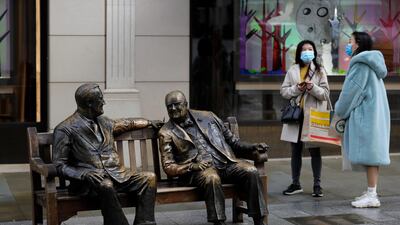

Every nation remembers the glories of the past, battles won, the triumphs of its art and culture. England has a lot to remember but – again like every other nation – there are matters which have been downplayed, conveniently forgotten or overlooked.
Some of these events are now being remembered in ways that do not fit in with the versions of history most British people learnt at school. But history is not fixed. It is a constant re-examining of the past in light of new evidence and as seen from new perspectives.
A new generation of British scholars and writers includes people of colour who have family roots in the old Empire, British India, Africa and the Caribbean. They are re-evaluating British history and the Empire not through the eyes of the colonisers but also from those of the colonised. The results are stories that are either very different or the same but told from very different angles and written in ways which can make uncomfortable reading.
A symposium of academics this month at Churchill College, Cambridge, discussed whether the reputation of Britain’s great war hero, Winston Churchill – the man whose name the college bears – needs a profound historical re-evaluation. That event was billed as a “critical reassessment of Churchill’s life and legacy in light of his views on empire and race".
One contributor spoke of Churchill as contributing to the 1943 Bengal famine. Another said Churchill was a racist, and drew comparisons with the Nazis. Meanwhile a British newspaper revealed that "hard left and foreign activists try to topple Britain's statues". The newspaper detailed how statues to some British philanthropists, commemorated for their good works 200 years ago, are in reality also monuments to men (always men) who made their fortunes through the slave trade. All this has been energised by the Black Lives Matter movement and it has also provoked a political backlash.
Statues of people who most of us have never heard of are being defended as if they are sacred to the well-being of the nation, rather than a legitimate part of the debate around not just who we were, but who we are now. And that is the catch. History is not only about the past. It is about the past interpreted in the present to help guide the future.
I don’t want to see statues vandalised, but I do want to learn more about the human beings who are glorified in public spaces and about the atrocities some committed to earn their fortunes. There have even been claims that challenging the reputations of great figures of the past is somehow “denying our history". It is not denying history. It is adding to history by hearing voices that too often have been silenced.
Winston Churchill remains for me a great British hero, the man who saved Britain and Europe from Nazi domination. But I also want to learn more about the 1943 Bengal famine and other stories modern historians may tell about this colossal figure. As Oliver Cromwell demanded, when he sat for a portrait in the 17th century, we need to see “warts and all".
And what are the reactionary voices afraid of? Is it the fact that heroes are imperfect human beings, like the rest of us? The real fears seem rooted in Britain’s present insecurity. Brexit is, predictably, a failure. The coronavirus vaccination programme is going well, but the British government has botched much of the pandemic.
The UK economy has contracted sharply, and when recent YouGov polls asked voters if they “wish they still had an empire," the UK came top in the imperial nostalgia stakes. Some 27 per cent of Britons admitted to wanting an empire back, ahead of the Netherlands (26 per cent) and Belgium (21 per cent). These statistics are depressing but also revealing.
-
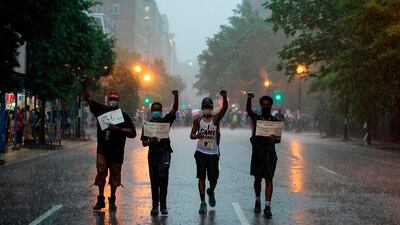
From left, Quacy, Quintan, both 12, Milo, and Quacy Jr, both 16 hold placards as they walk in the rain after attending a Black Lives Matter protest in front of Lafayette Park, near the White House, Washington DC. AFP -
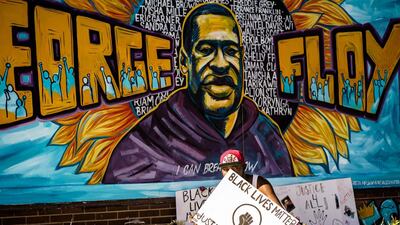
A man reacts at a memorial for George Floyd following a day of demonstration in a call for justice for the black American who died while in custody of the Minneapolis police, on June 5, 2020, in Minneapolis, Minnesota. AFP -
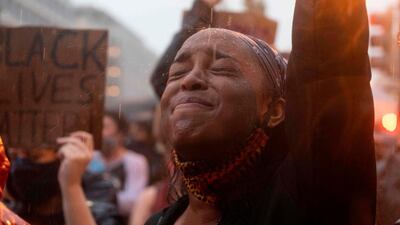
A protester participates in a demonstration during a storm in front of Lafayette Park next to the White House, Washington, DC. AFP -

Demonstrators attend a Black Lives Matter protest to express solidarity with US protestors in Sydney. AFP -
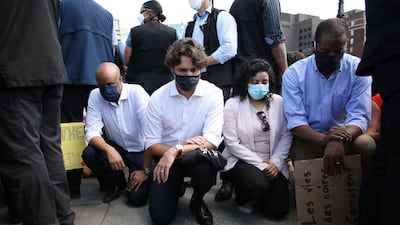
Canadian Prime Minister Justin Trudeau, second left, takes a knee during in a Black Lives Matter protest on Parliament Hill, Ottawa, Canada. AFP -
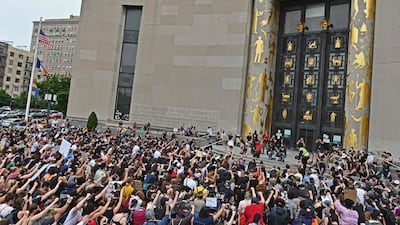
Protesters take a knee and raise their fists during a 'Black Lives Matter' demonstration in front of the Brooklyn Library and Grand Army Plaza in Brooklyn, New York. AFP -
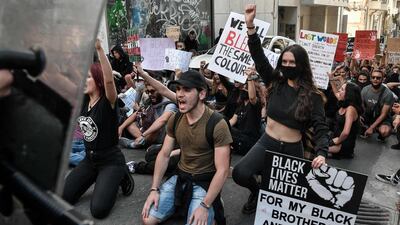
Youths kneel with placards reading 'Black Lives Matter' in front of riot police officers blocking the way in Athens during a rally against racism and police brutality and in support to the protests in US. AFP -
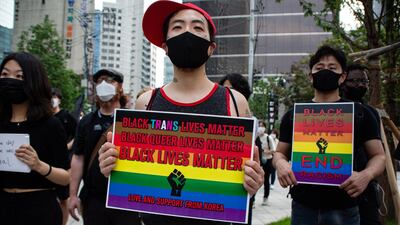
People hold banners during a Black Lives Matter rally in central Seoul, South Korea. EPA -
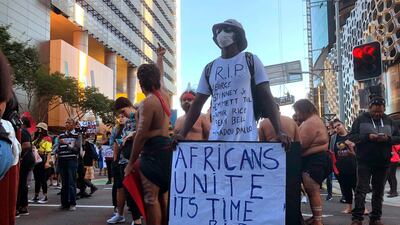
A man holds a placard in solidarity with thousands of people marching during a Black Lives Matter protest in Brisbane. AP -
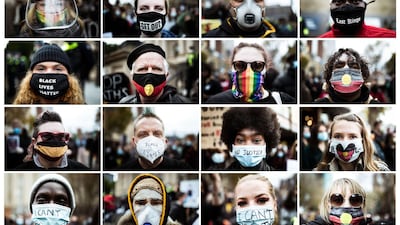
Protesters wear masks during a rally in solidarity with the Black Lives Matter demonstration on June 6, 2020 in Melbourne, Australia. Getty -
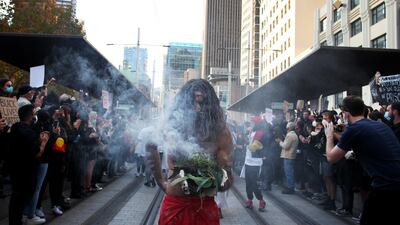
Aboriginal elders conduct a traditional smoking ceremony at Town Hall during a 'Black Lives Matter' protest on June 6, 2020 in Sydney, Australia. Getty -
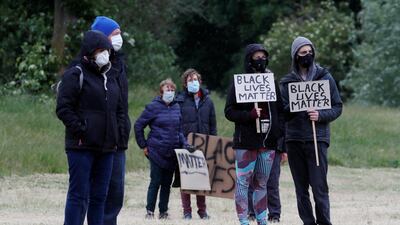
Demonstrators are seen in the rain wearing protective face masks during a Black Lives Matter protest in Verulamium Park, St Albans, Britain, following the death of George Floyd in police custody in Minneapolis, on June 6, 2020. Reuters -
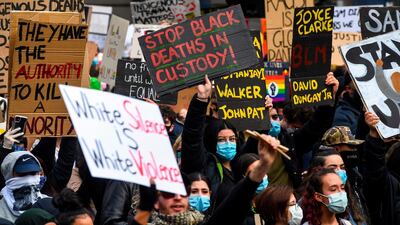
People hold placards at a Black Lives Matter protest to express solidarity with US protesters, in Melbourne on June 6, 2020. AFP -
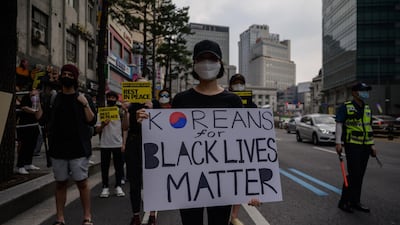
Activists hold placards as they attend a rally in support of the 'Black Lives Matter' demonstrations in the US, during a march in the Myeongdong district of central Seoul on June 6, 2020. AFP -
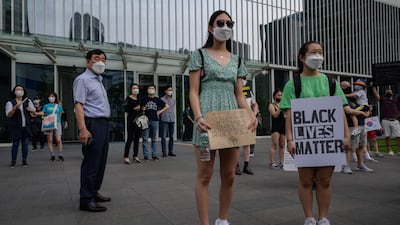
Activists hold placards as they attend a rally in support of the 'Black Lives Matter' protests, during a march in the Myeongdong district of central Seoul on June 6, 2020. AFP -
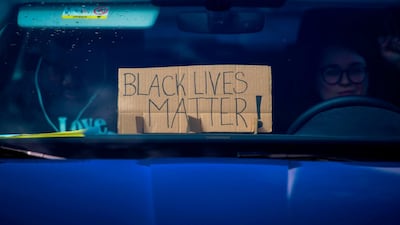
A placard reading "black lives matter" is seen in a car during a communal conference of the Social Democratic Party (SPD) at a drive-in cinema on the site of the former blast furnace Phoenix West in Dortmund, western Germany, on June 6, 2020 amid the novel coronavirus COVID-19 pandemic. The conference aims at preparing the local elections in September. / AFP / Ina FASSBENDER -
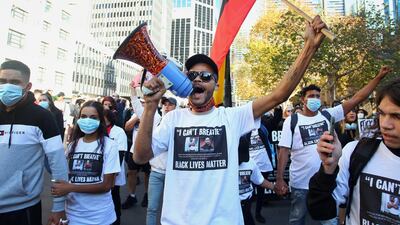
Protesters chant and hold placards during a 'Black Lives Matter' march on June 6, 2020 in Sydney, Australia. Getty -
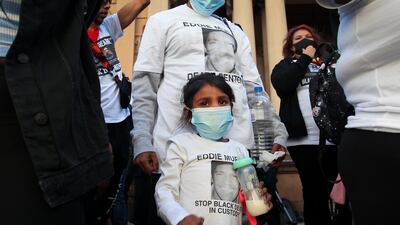
A young child attends the 'Black Lives Matter' march with her family on June 6, 2020 in Sydney, Australia. Getty -
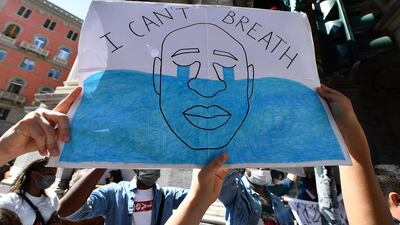
Protesters gather at a Black Lives Matter rally in Genoa, Italy, on June 6, 2020. EPA -
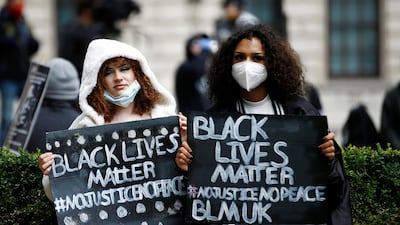
Demonstrators wearing protective face masks attend a Black Lives Matter protest in London's Parliament Square on June 6, 2020, following the death of George Floyd in police custody in Minneapolis. Reuters


A post-imperial backward looking confusion blights British politics. Last year some newspapers confected a ludicrous "row" about the BBC considering not singing "Rule, Britannia" in the Royal Albert Hall, a song written in 1740. The re-evaluation of Churchill and the Empire, plus questioning the characters of those memorialised in statues, are treated in some newspapers almost as acts of treason.
My own historical re-evaluation of empire began when a friend gave me a book called King Leopold's Ghost by Adam Hochschild. It is a disturbing account of the despicable treatment of people in the Congo during Belgium's imperial adventure in west Africa. The book did that most difficult thing – it made me think. Re-thinking prejudices and myths is what history is for. It is not a religion, which demands belief.
No version of history can be an unquestionable truth. Above all, history cannot simply be one perspective, most especially not only the account of the colonisers, ignoring the reality of slavery and abuse. I will be reading the new accounts of Churchill and the empire with interest – and will do so critically.
New wave historians of empire can themselves expect to be questioned rigorously, and they will be. But they must not be shouted down or ignored. Telling inconvenient truths is not a crime. It is a virtue.
Gavin Esler is a broadcaster and UK columnist for The National

