


The greatest achievement of Prince Philip, the longest-serving royal consort in British history, is likely to reside at the intersection of ecology, biodiversity and inter-religious co-operation. Perhaps it was his peripatetic upbringing. Or the royal family’s vast land holdings. Or a combination of formative experiences and his adult interests.
Prince Philip, who died on Friday at the age of 99, has good claims to have raised the importance of defending the planet, paving the way for the campaigners who fight today so doughtily for change. As a countryman, the Duke of Edinburgh appreciated how good husbandry of animals was rewarded with healthy stock. As a member of the Royal Navy, he saw the world from surf to turf and how it was under threat.
Much has been made of his 73 years as consort to Queen Elizabeth II. Whatever his frustrations at not sharing the British throne as an equal with his wife, his life work has left a legacy that will endure after her reign and those of her immediate heirs.
It may be a paradox that in his time Prince Philip went big game hunting in a quest for tigers and elephants. But sporting pursuits and conservation are not a contradiction. A long life produces a balance of effects and his role should be recognised as pioneering.
If Greta Thunberg is honoured for raising the consciousness of the world to climate peril, Prince Philip did much the same thing half a century ago.
The long association of the Prince, who was born a junior member of the Greek and Danish royal families, with the World Wide Fund for Nature (WWF) formed the primary platform for his concern for Planet Earth.
A major initiative of the WWF, pushed by Prince Philip as its international president, sought recognition that “through their philosophy, actions and influence, faiths can have a major impact on the way their followers view the protection of nature”. A major report in 2005 backed by Prince Philip, which involved the WWF and the Alliance of Religions and Conservation, pointed out the spiritual importance of the fight to keep the earth in good health and how that is informed by religions.
A global summit that the royal helped organise in Italy in 1986 produced declarations from Buddhist, Christian, Hindu, Jewish and Muslim leaders. A global pilgrimage network was set up that includes sites in the Middle East.
Efforts such as those by the UAE to champion biodiversity initiatives now fit within a global umbrella of work to save and protect the species. The UN is an important convener and promoter of these efforts. Prince Philip helped drive that aspect of the UN's work with the secretary general as long ago as the 1980s.
Action to bring about change was something that Prince Philip liked to embody. He was an international role model in the way that few others had tried in the middle of the 20th century. Many have since developed or sought to develop this identity. Prince Philip’s impact was ahead of his time.
The Duke of Edinburgh awards scheme for school pupils has programmes in more than 120 countries. Research shows its strong impact on individual lives, social cohesion, lower crime rates and environmental awareness is shared by millions every year.
As Barack Obama noted in his tribute to Prince Philip on Friday, his time in spotlight saw radio succeeded by television and the internet.
Prince Philip was something unusual among the British royals. The instinctively curious modernist wanted to be involved with the new technologies as well as fresh ideas. But he was obviously a traditionalist. He was palpably devoted to the establishment with the monarch at its apex.
That did not mean he could not branch out and seek new interests. It did not preclude his leadership extending into fresh areas, though there were constraints in the end on what he could do and how he framed his contribution.
Soon after the latest series of Netflix series The Crown, conspiracy theorists had a field day when a documentary shot in the 1960s of the royal family at home was leaked on YouTube. Although broadcast nationwide after it was shot, the behind-the-scenes look at the family has never been shown again. This has prompted allegations that the family suppressed the work.
-
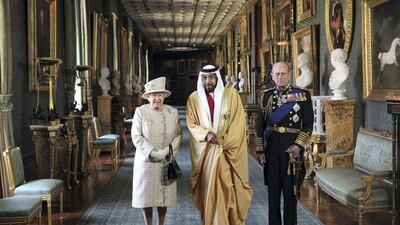
Queen Elizabeth II and Prince Philip greet UAE President Sheikh Khalifa, at Windsor Castle in 2013. Getty Images -
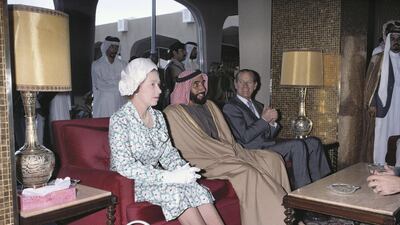
Sheikh Zayed, Queen Elizabeth and Prince Philip seated before lunch at the Hilton Hotel in Abu Dhabi, in 1979. Getty Images -

UAE President Sheikh Khalifa speaks to Queen Elizabeth and Prince Philip during their visit to Abu Dhabi in 2010. Getty Images -

Prince Philip attends a military air display in Abu Dhabi in 2010. Getty Images -
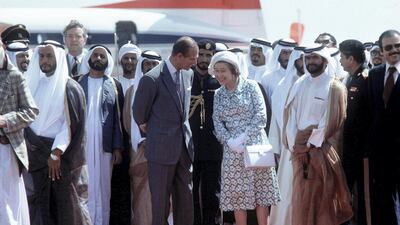
Queen Elizabeth and Prince Philip together during a visit to Abu Dhabi in 1979, which was part of their tour of the Gulf. Getty Images -
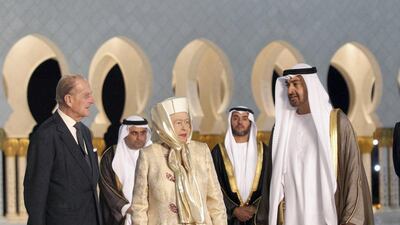
Sheikh Mohamed bin Zayed Al Nahyan, Crown Prince of Abu Dhabi and Deputy Supreme Commander of the UAE Armed Forces, speaks to Queen Elizabeth and Prince Philip during a visit to the Sheikh Zayed Grand Mosque in 2010. Getty Images -
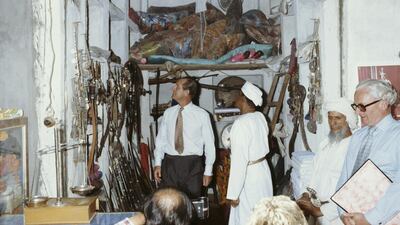
Prince Philip visits a souq in Muscat during a state visit to Oman in 1979. Getty Images -
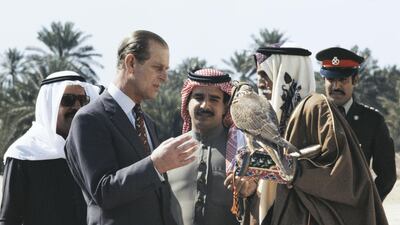
Prince Philip looks at a hawk during a visit to Manama, Bahrain, in 1979. Getty Images -

Queen Elizabeth and Prince Philip disembark the Royal Yacht Britannia in Kuwait, in 1979. Getty Images -
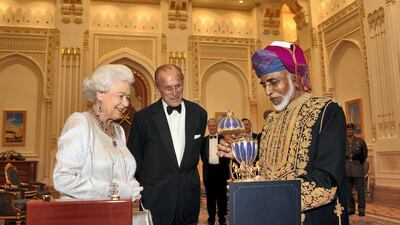
Queen Elizabeth and Prince Philip are presented with a gift by the then-Sultan of Oman, Sultan Qaboos bin Said al Said, before a state banquet in Muscat, Oman, in 2010. Getty Images


Prince Philip pushed the idea of allowing the cameras in and wanted to show that the family was open to changing modern times. Like his work on the environment, youth development and faith it showed he had trust in the future. Appreciation of the powers of change around you is something particularly valuable in a royal family when the pace of advancement is so rapid.
There are plenty of questions that dogged Prince Philip. The comments he would make that pigeon-holed people alienated many. The relationship between the males in Queen Elizabeth’s family are clearly imperfect and often to the detriment of its reputation.
In more recent times, his grandson Prince Harry has likened the oppressive set-up to being trapped in a cage. For Prince Philip there was a lifetime of adaptation. What he saw and thought was only ever in the prism of the institution. His insight was that he could develop leadership roles for the benefit of others in the world.
The natural world is a beneficiary of his long life.
Damien McElroy is the London bureau chief at The National

