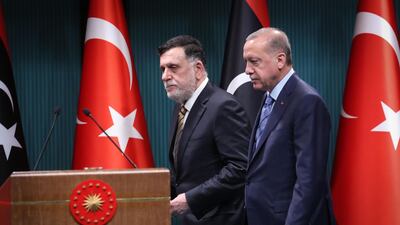

As efforts intensify to negotiate a lasting ceasefire in Libya's long-running civil war, the one country that has most to lose from any cessation of hostilities is Turkey.
Ever since President Recep Tayyip Erdogan took a gamble to intervene in the Libyan conflict in January, Turkey’s involvement has helped to prevent the UN-backed Government of National Accord suffering certain defeat at the hands of the Libyan National Army led by Field Marshal Khalifa Haftar.
At the time the first Turkish reinforcements began to arrive at the start of the year, forces loyal to GNA Prime Minister Fayez Al Sarraj were on the defensive, with the LNA closing in on the capital Tripoli.
Since then, the deployment primarily comprising Syrian mercenaries has succeeded in thwarting the LNA's offensive, with the result being that the conflict has now reached a stalemate.

Moreover, attempts by the GNA and its backers to advance deeper into territory held by Mr Haftar’s forces in eastern Libya have encountered stiff resistance from the LNA, which is backed by a number of international players including Russia and Egypt. There were reports this week that Russian warplanes were in action at the strategically important city of Sirte, once the stronghold of the country’s former dictator Col Muammar Qaddafi. In recent weeks, GNA forces have been attempting to capture Sirte as well as the Jafra military base and oil terminals.
Western diplomats monitoring developments on the ground believe that the GNA and its backers have launched their assault on Sirte, located 500 kilometres to the east of Tripoli, to prevent Russia from pressing ahead with attempts to establish a permanent presence at Al Watiya Air Base.
GNA's move to capture Sirte has been deemed a red line by both Cairo and Moscow, which might explain reports that a Russian MiG-29 fighter, said to have been loaned to Mr Haftar’s forces, was involved in an attack on GNA positions on the outskirts of the city, killing 10 people. In addition, Egyptian forces are reported to have undertaken a massive deployment on the border with Libya, a move designed to send a message to both the GNA and Ankara that Cairo is fully supportive of the LNA cause.
This resistance represents a serious setback for Ankara, as it suggests that, by failing to capture the oil facilities of eastern Libya, Mr Erdogan's military gamble in Libya could end in failure. This might explain why Turkey has so far been reluctant to support the latest ceasefire initiative led by Egyptian President Abdel Fattah El Sisi.
-

A fighters loyal to the internationally recognised Libyan Government of National Accord (GNA) shoots fires a truck-mounted gun during clashes with forces loyal to strongman Khalifa Haftar in the capital Tripoli's suburb of Ain Zara. AFP -

A fighter loyal to the internationally recognised Libyan Government of National Accord (GNA) fires his gun during clashes with forces loyal to strongman Khalifa Haftar in the capital Tripoli's suburb of Ain Zara. AFP -
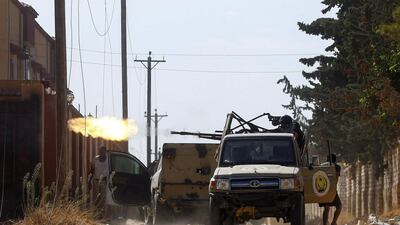
A fighters loyal to the internationally recognised Libyan Government of National Accord (GNA) shoots fires a truck-mounted gun during clashes with forces loyal to strongman Khalifa Haftar in the capital Tripoli's suburb of Ain Zara. AFP -

A fighter loyal to the internationally recognised Libyan Government of National Accord (GNA) fires his gun during clashes with forces loyal to strongman Khalifa Haftar in the capital Tripoli's suburb of Ain Zara. AFP -
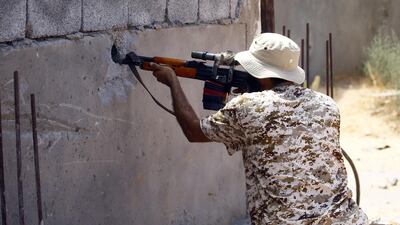
A fighter loyal to the internationally recognised Libyan Government of National Accord (GNA) fires trhough a hole in a wall during clashes with forces loyal to strongman Khalifa Haftar in the capital Tripoli's suburb of Ain Zara. AFP -
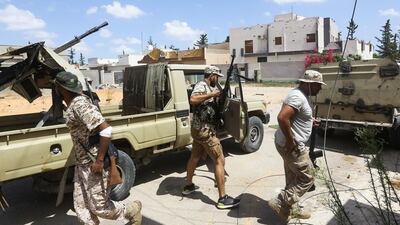
Fighters loyal to the internationally recognised Libyan Government of National Accord (GNA) gather during clashes with forces loyal to strongman Khalifa Haftar in the capital Tripoli's suburb of Ain Zara. AFP -
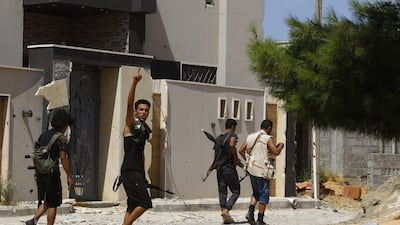
Fighters loyal to the internationally recognised Libyan Government of National Accord (GNA) gather during clashes with forces loyal to strongman Khalifa Haftar in the capital Tripoli's suburb of Ain Zara. AFP -

Fighters loyal to the internationally recognised Libyan Government of National Accord (GNA) gather during clashes with forces loyal to strongman Khalifa Haftar in the capital Tripoli's suburb of Ain Zara. AFP -
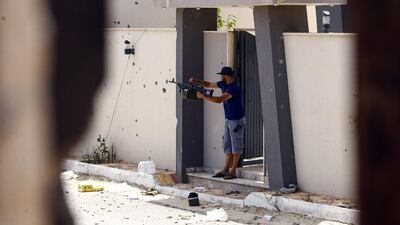
A fighters loyal to the internationally recognised Libyan Government of National Accord (GNA) shoots fires his rifle during clashes with forces loyal to strongman Khalifa Haftar in the capital Tripoli's suburb of Ain Zara. AFP -
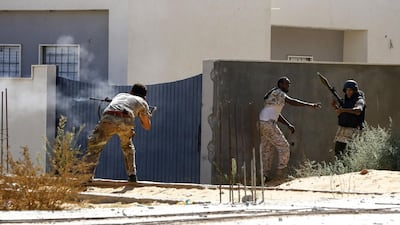
A fighters loyal to the internationally recognised Libyan Government of National Accord (GNA) shoots fires his rifle as others take position behind a wall during clashes with forces loyal to strongman Khalifa Haftar in the capital Tripoli's suburb of Ain Zara. AFP


Mr El Sisi's call, which has resulted in Libya’s warring parties entering their third round of talks overseen by the UN support mission there, has received strong international backing.
US Secretary of State Mike Pompeo has welcomed the resumption of talks and urged swift negotiations to achieve a truce. "The agreement between the GNA and LNA to re-enter UN security talks was a good first step, very positive," Mr Pompeo said. "Quick and good-faith negotiations are now required to implement a ceasefire and relaunch the UN-led intra-Libyan political talks." US President Donald Trump also had a phone call with Mr El Sisi in which he praised the Egyptian leader's efforts to "promote political reconciliation and de-escalation in Libya", and discussed ways to ensure the departure of all foreign forces from Libya.
In addition, Russia and the UAE have welcomed the initiative, while Germany said it was key to achieving peace.
-
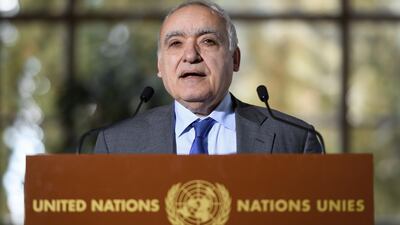
UN Envoy for Libya Ghassan Salame holds a press briefing during UN-brokered military talks. AFP -
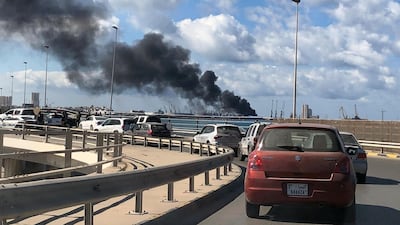
Smoke rises from a port of Tripoli, Libya after being attacked. REUTERS -
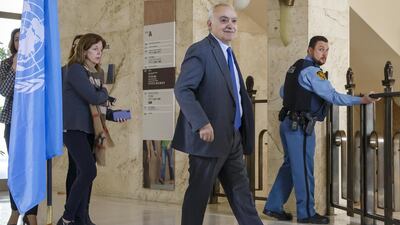
Ghassan Salame (C), special representative of the United Nations Secretary-General and head of the United Nations Support Mission in Libya, leaves a press stakeout after informing the media about new meeting round of the 5+5 Libyan Joint Military Commission, at the European headquarters of the United Nations in Geneva, Switzerland. EPA -
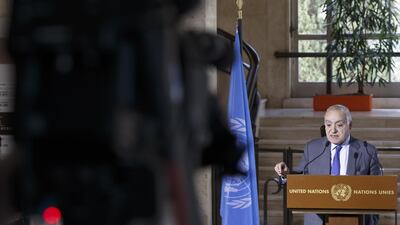
Ghassan Salame, special representative of the United Nations Secretary-General and head of the United Nations Support Mission in Libya, informs the media about a new meeting round of the 5+5 Libyan Joint Military Commission, during a press stakeout, at the European headquarters of the United Nations in Geneva, Switzerland. EPA -

Ghassan Salame, special representative of the United Nations Secretary-General and head of the United Nations Support Mission in Libya, arrives for a press stakeout to inform the media on a new meeting round of the 5+5 Libyan Joint Military Commission, at the European headquarters of the United Nations in Geneva, Switzerland. EPA -
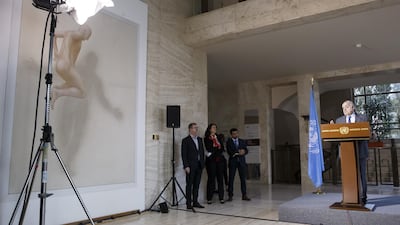
Ghassan Salame (R), special representative of the United Nations Secretary-General and head of the United Nations Support Mission in Libya, informs the media about a new meeting round of the 5+5 Libyan Joint Military Commission, during a press stakeout, at the European headquarters of the United Nations in Geneva, Switzerland. EPA -
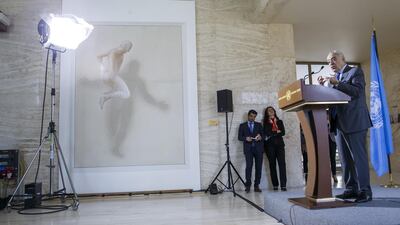
Ghassan Salame, special representative of the United Nations Secretary-General and head of the United Nations Support Mission in Libya, informs the media about a new meeting round of the 5+5 Libyan Joint Military Commission, during a press stakeout, at the European headquarters of the United Nations in Geneva, Switzerland. EPA -
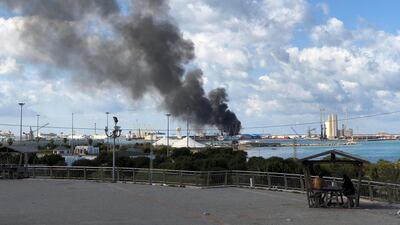
Smoke rises from a port in Tripoli, Libya after being attacked. REUTERS -
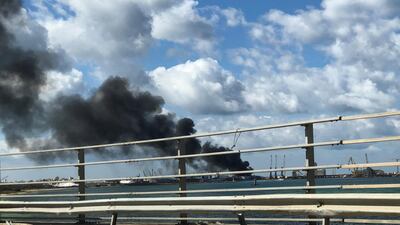
Smoke rises from a port of Tripoli after being attacked in Tripoli, Libya. REUTERS


Consequently, Turkey is the only country that has dismissed the proposal, which suggests Ankara is aware that any lasting agreement could mean that its military intervention has failed to achieve its goals.
Mr Erdogan’s initial justification to intervene was partly his desire to back the Islamist elements in the GNA which, if successful, might lead to the detrimental creation of another Muslim Brotherhood regime on the shores of North Africa – similar to the one Mohammed Morsi headed in Egypt from 2012-13.
Another important factor in Ankara’s decision was to further its claim to vast oil and gas reserves in the Eastern Mediterranean. This week, Ankara announced it had designated seven licensed areas in the disputed region that it intends to use for exploration and drilling under the terms of the recent energy pact negotiated with the GNA. But as has been the case with its military involvement in Syria, Ankara’s attempts to increase its influence in Libya has met with stiff resistance from other powers.
-
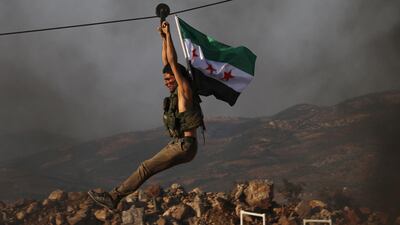
A Turkish-backed fighter from the Free Syrian Army exercises with his group's flag during military training in preparation for an anticipated Turkish incursion targeting Syrian Kurdish fighters, near Azaz, in north Syria. AP Photo -
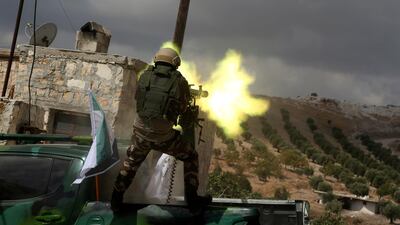
A fighter from Turkish-backed forces of the Free Syrian Army fires a heavy machine gun during military training maneuvers in preparation for an anticipated Turkish incursion targeting Syrian Kurdish fighters, near Azaz, in north Syria. AP Photo -

Turkish-backed Syrian rebel fighters head to an area near the Syrian-Turkish border north of Aleppo. AFP -
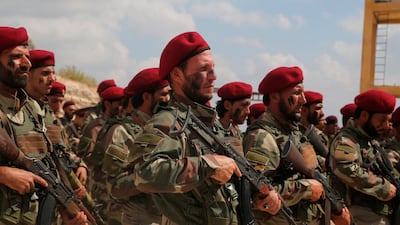
Turkish-backed forces from the Free Syrian Army, stand in formation during military maneuvers in preparation for an anticipated Turkish incursion targeting Syrian Kurdish fighters, near Azaz town, north Syria. AP Photo -
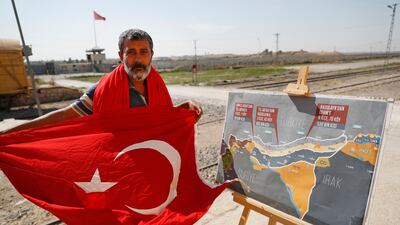
A man holds a Turkish flag as he stands next to a map showing Turkey's suggested operation in Syria, at the border between Turkey and Syria, in Akcakale, Sanliurfa province, southeastern Turkey. AP Photo -
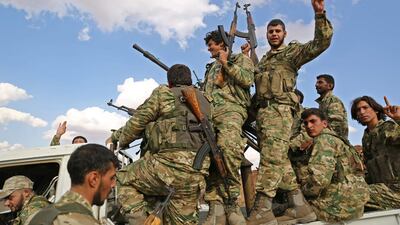
Turkish-backed Syrian rebel fighters gather near the Syrian-Turkish border north of Aleppo. AFP -
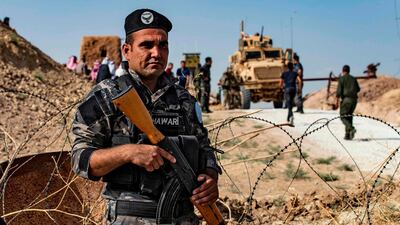
A member of Kurdish security forces stands guard during a demonstration by Syrian Kurds against Turkish threats next to a base for the US-led international coalition on the outskirts of Ras al-Ain town in Syria's Hasakeh province near the Turkish border. AFP -
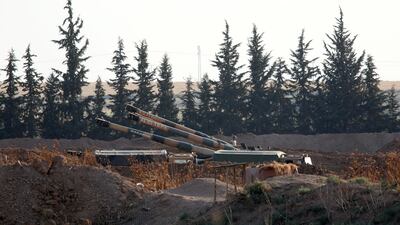
Turkish army howitzers are positioned on the Turkish-Syrian border, near the southeastern town of Akcakale in Sanliurfa province, Turkey. Reuters -
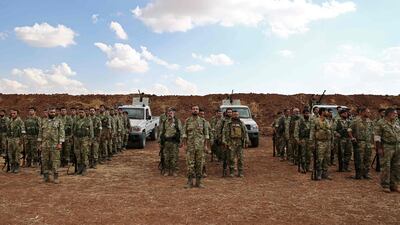
Turkish-backed Syrian fighters gather near the Syrian-Turkish border north of Aleppo. AFP -

Turkish-backed Syrian rebel fighters gather near the Syrian-Turkish border north of Aleppo. AFP -

A fighter from the Syrian Democratic Forces, SDF, flashes the victory sign during a demonstration against possible Turkish military operation on their areas, at the Syrian-Turkish border, in Ras al-Ayn, Syria. AP Photo -
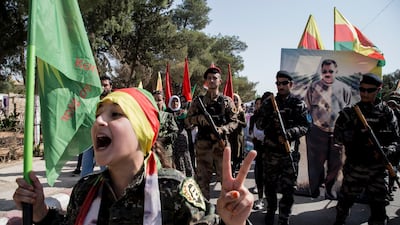
Fighters of the Syrian Democratic Forces, SDF, march during a demonstration against possible Turkish military operation in their areas in Al-Qahtaniya, Syria. AP Photo


In Syria, where Turkey’s primary objective has been to prevent the establishment of autonomous Kurdish regions close to its southern border, Ankara has managed to reach an understanding with Moscow that allows each power to enjoy separate areas of influence.
Whether the two parties can reach a similar accommodation in Libya, though, is another proposition entirely, not least because there are already signs that the GNA is tiring of Turkey’s constant meddling in its affairs. And so long as Turkey refuses to participate in the peace process, the more likely it is that Mr Erdogan will come to rue the day he ever decided to embark on his Libyan adventure.
Con Coughlin is the Telegraph’s defence and foreign affairs editor

