

What just happened in Myanmar? Has its nascent democracy just been upended through a military coup – or has a legal change of power in accordance with the constitution just taken place?
It is not disputed that the country's civilian leader, State Counsellor Aung San Suu Kyi, President Win Myint, and other senior members of their ruling National League for Democracy party (NLD) were detained early on Monday morning; nor that a year-long state of emergency has been proclaimed with power now exercised by the head of the armed forces, Senior General Min Aung Hlaing.
That, according to many countries, constitutes a coup. The US, Japan, the UK, the EU and Turkey were among those calling for a restoration of democracy – on the basis that Ms Suu Kyi and her party had won an overwhelming majority in the November general election. Even Singapore and India – friendly countries not inclined to interfere in the affairs of others – voiced their “concern”.
-
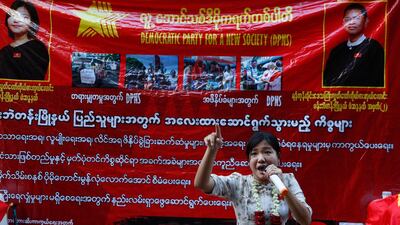
A candidate of Democracy Party for a New Society talks with microphone during an election campaign rally at downtown area in Yangon, Myanmar on Sunday. EPA -
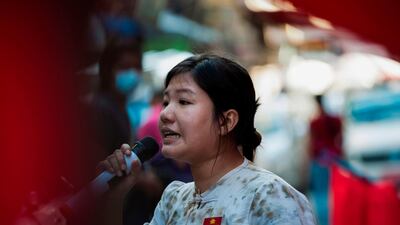
Ei Tinzar Maung speaks during a campaign ahead of the November 8 general election. AFP -
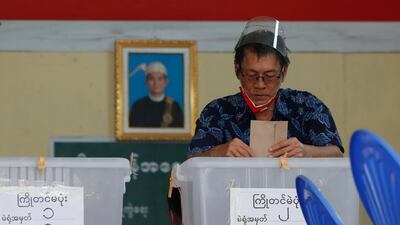
An elderly man casts his ballot during early voting at a polling station in Yangon. EPA -
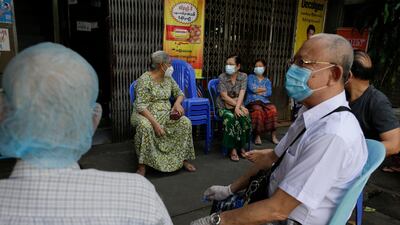
Elderly people wait to cast their ballots during early voting at a polling station in Yangon. EPA -
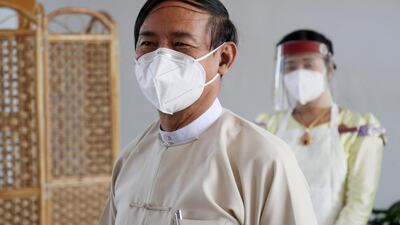
Myanmar President Win Myint greets members of the media after casting his ballot in Naypyitaw. EPA -

Myanmar State Counselor Aung San Suu Kyi casts an advance vote in Naypyitaw. Reuters -
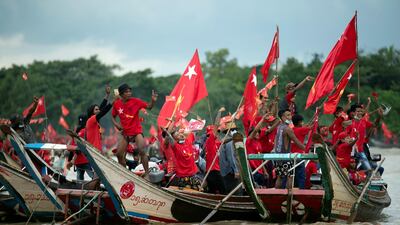
Supporters of National League for Democracy (NLD) take part in a boat rally ahead of a November 8 general election in the Yangon river. Reuters -
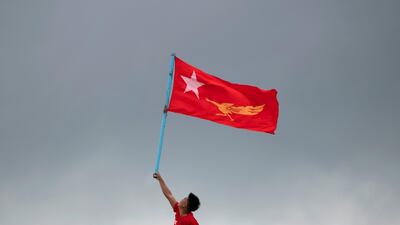
An NLD supporter holds a flag on the top of a boat as he takes part in a rally in the Yangon river. Reuters -
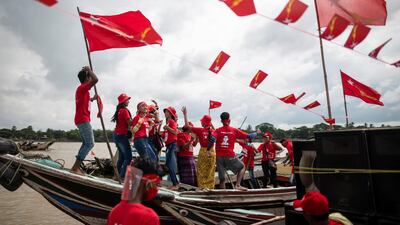
NLD supporters party take part in a boat rally in the Yangon river. Reuters -
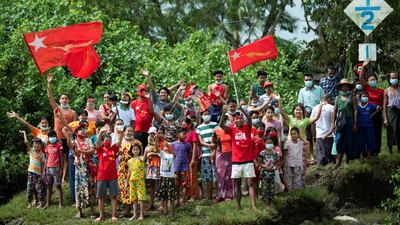
NLD supporters greet to a boat rally. Reuters -
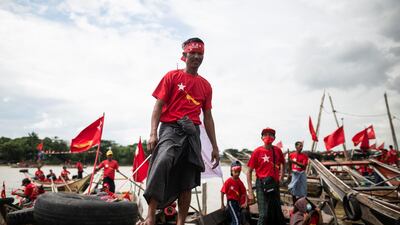
NLD supporters take part in a boat rally in the Yangon river. Reuters -

NLD supporters take part in a boat rally in the Yangon river. Reuters -
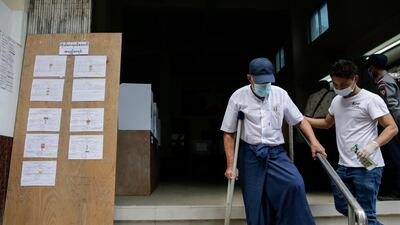
An elderly man leaves after casting his ballot in Yangon. EPA -
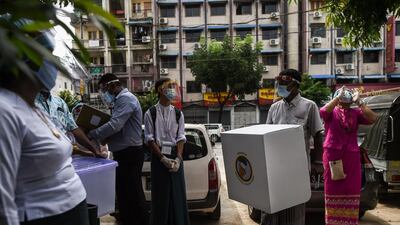
Election staff carry a mobile ballot box in Yangon last week, as advance voting in the country's election began for elderly people. AFP -
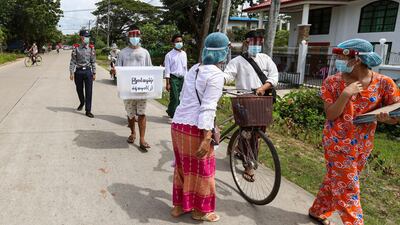
Officers and volunteers from Union Election Commission walk to collect ballots from elderly people who make an early voting on the outskirts of Yangon. AP Photo -
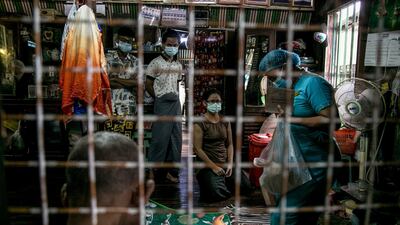
An election official is seen in a residence in Yangon last week, as advance voting in the country's elections began for elderly people. AFP


The generals differ. Their proxy party, the Union Solidarity and Development Party, was humiliated in the same election, which the new government said had been marred by "terrible fraud". (There were definitely some problems, but international observers believe the result was fair.) A statement read out on state television said that the failure to take their complaints seriously by the Union Election Commission – and by extension, Ms Suu Kyi's government – meant that Article 417 of the country's constitution, which refers to "acts or attempts to take over the sovereignty of the Union by… wrongful forcible means", had been triggered.
The following article then grants total authority to the commander-in-chief. To tie up the details, the emergency is supposed to be declared by the president; and with Win Myint under arrest, a former army general, Myint Swe, became acting president – a position that he was constitutionally allowed to take up as a sitting vice president. He is reported to have formally issued the emergency declaration.
So to return to my opening questions: yes, it was a coup. But as the long-time political analyst Maung Zarni says, it was also “constitutional – that is, legal. Myanmar’s constitution of 2008 – drawn up by the military – pre-emptively legalises coups against any elected government … Suu Kyi herself has sworn to uphold that constitution of, for and by the military".
Mr Zarni has never been aligned with the NLD, but he is no regime stooge. Intriguingly, Canada’s ambassador to the UN, Bob Rae, was alone among western commentators who appears to have got it as well. The latest constitution, he tweeted, “was specifically designed to ensure military power was deeply entrenched and protected". He added that they “wrote the constitution this way so they could do this".
-
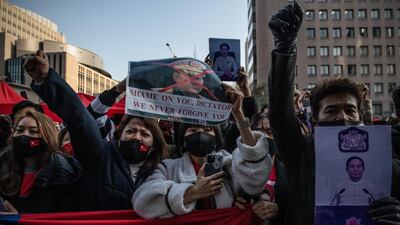
Myanmar nationals in Japan demonstrate against the military coup that took place in their home country on Monday, February 1, 2021. Getty Images -

A Myanmar national in Japan holds up a portrait of Aung San Suu Kyi during a protest held in front of the United Nations University in Tokyo. EPA -
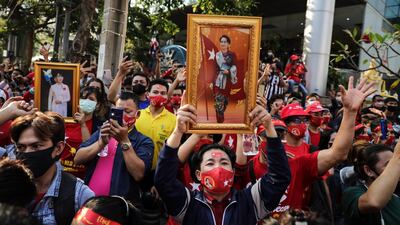
People hold up images of Myanmar's de-facto leader Aung San Suu Kyi at a protest outside Maynmar's embassy in Bangkok, Thailand. Getty Images -
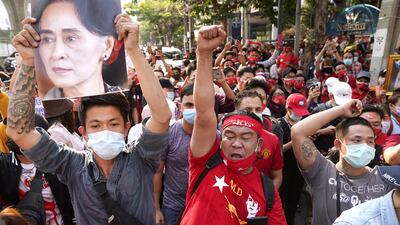
NLD supporters shout slogans outside Myanmar's embassy during a rally after the military seized power from a democratically elected civilian government and arrested its leader Aung San Suu Kyi, in Bangkok, Thailand. Reuters -
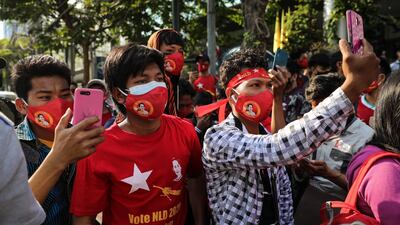
People use their smartphones to live stream a protest outside Myanmar's embassy in Bangkok, Thailand. Getty Images -
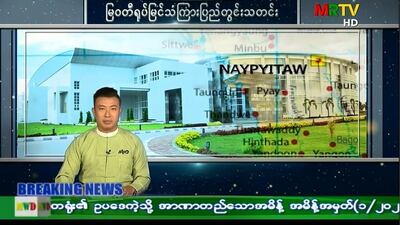
This screengrab provided via AFPTV and taken from a broadcast by Myanmar Radio and Television (MRTV) in Myanmar shows the announcement of a one-year state of emergency in the country. AFP -

A screen grab from Myanmar state television footage shows Myanmar Acting President Myint Swe (R) and General Min Aung Hlaing (L) as they attend a meeting. Reuters -
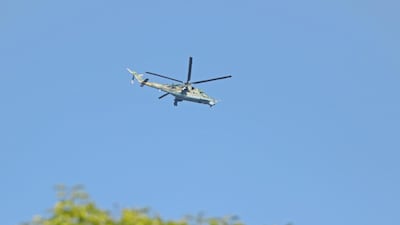
A military helicopter flies in Naypyitaw, Myanmar. EPA -
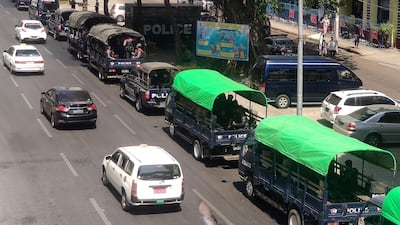
Cars pass police sitting in trucks along a road in Yangon, as Myanmar's military detained the country's de facto leader Aung San Suu Kyi and the country's president in a coup. AFP -
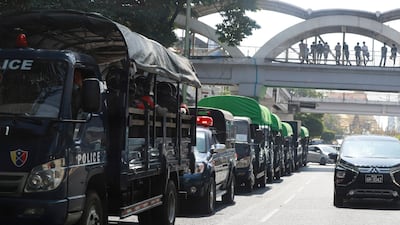
Policemen sit inside trucks parked on a road in the downtown area of Yangon, Myanmar. AP -
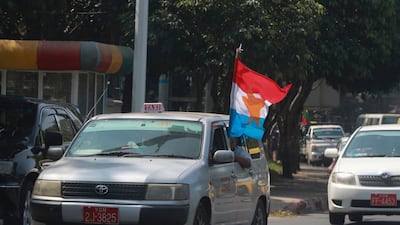
Myanmar military supporters riding a vehicle wave a military flag as they go around Yangon, Myanmar. AP -

People wave flags as they ride on a vehicle in Yangon, Myanmar. Reuters -
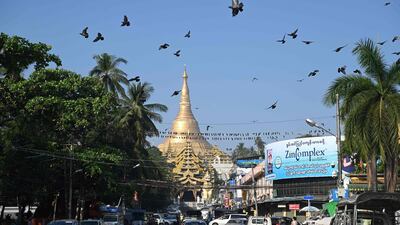
A view of Shwedagon Pagoda, a Buddhist religious landmark in Yangon, as Myanmar's military detained the country's de facto leader Aung San Suu Kyi and the country's president in a coup. AFP -
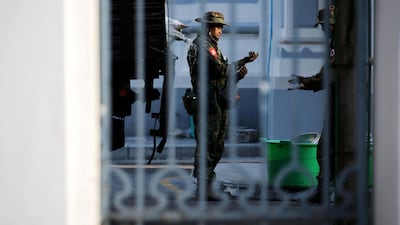
Myanmar soldiers are seen inside City Hall in Yangon, Myanmar. Reuters -

A woman leaves her house while being escorted by soldiers (unseen) at an unidentified location in Myanmar, in this picture obtained from social media. Reuters -
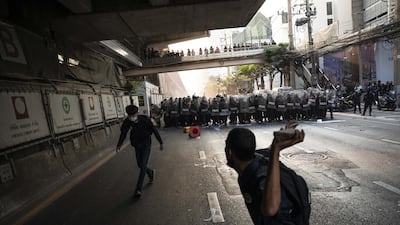
A demonstrator prepares to throw a rock towards riot police during a protest outside the Embassy of Myanmar in Bangkok, Thailand. Andre Malerba/Bloomberg -
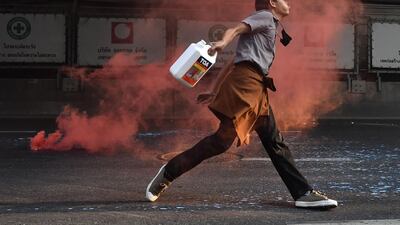
A Thai pro-democracy protestor confronts riot police in Bangkok, in the area where Myanmar migrants were demonstrating after Myanmar's military detained the country's de facto leader Aung San Suu Kyi and the country's president in a coup. AFP -
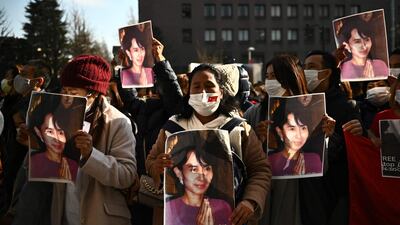
A group of Myanmar activists hold the portrait of Aung San Suu Kyi during a protest outside the United Nation university in Tokyo following a military coup in the country by a general after arresting civilian leader Aung San Suu Kyi and other senior officials. AFP -
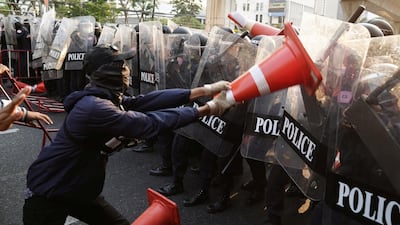
Anti-Thai government protester wields a traffic cone at riot police during a clash at a rally for Myanmar's democracy outside the embassy, in Bangkok, Thailand. Reuters


All of this should serve to reveal that when the former military dictatorship, which ran the country from 1962 to 2010, announced a “roadmap to democracy” in 2003, that didn’t mean they wanted Myanmar to become a fully fledged democracy, as most understand the term.
The army wanted to ensure it could still call the shots. That is why, under the 2008 constitution, 25 per cent of seats in parliament are automatically reserved for military nominees, as are the key ministries of defence, border and home affairs. Ms Suu Kyi is often referred to as Myanmar’s “de facto leader”, because since she is constitutionally barred from the presidency (as her children and late husband were foreign citizens), she became the country’s civilian head as “state counsellor” instead. As some have pointed out, it is now becoming clear that it was Senior General Min Aung Hlaing who was the real “de facto leader” all along – a fact of which Ms Suu Kyi has just been brutally reminded.
Why, though, should the top brass choose to step out of the shadows now? The illusion of a transition to democracy seemed to have suited them well, even though Ms Suu Kyi's reputation has been irredeemably tarnished by her refusal to recognise what most consider to be the acts of genocide inflicted upon Myanmar's Rohingya minority.

Some speculate that Min Aung Hlaing, who was due to retire when he turns 65 this July, wanted to secure his future – not just his influence but also his ability to evade prosecution for the alleged crimes against the Rohingya, which UN investigators have called for. Ms Suu Kyi may have overplayed her hand by not giving the general sufficient guarantees in the negotiations that had been going on between the NLD and the military after the recent general election. If she had been more emollient, what the Burmese historian Thant Myint-U calls “the three-decade contest between the army and the NLD” may not have come to this “critical juncture”.
Mr Zarni puts it a different way, suggesting that the military had had enough, and felt it was time to remind the state counsellor who was boss. “They put Suu Kyi on a long leash. Now they will put her on a shorter lead, if she is ever allowed to play ball with them within the 2008 constitution.”
It is unclear what will happen next, or how Ms Suu Kyi’s millions of devoted followers will react. But Myanmar’s generals may have gambled that they will be able to pull off their “constitutional coup”, so long as dialogue with all parties is seen to take place, and the promise to hold new elections within a year is maintained. After all, if there have been next to no consequences for the ethnic cleansing and the displacement of over 1 million Rohingya refugees to Bangladesh, why would they not get away with a move that they will insist was perfectly legal?
Sholto Byrnes is an East Asian affairs columnist for The National

