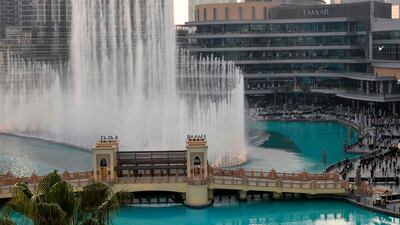
Dubai's fountain show at the Burj Khalifa resumes as the city emerges from a lockdown imposed due to the pandemic, June 5. Karim Sahib/ AFP

Middle Eastern markets will need a post-pandemic 'great reset'


  • English
  • Arabic

Covid-19 does not recognise borders. Contagion has been evident not only in the transmission of the virus across countries but in the global economic propagation of this health shock on production, consumption and the consequent slow down in economic activity.

Countries in the Mena are no exception to this rule. But in addition to their general exposure, the region also has a set of particularities that make response and recovery strategies more strenuous.

Leaders have called for greater public-private collaboration to foster integrated economic and trading systems

First, the impact of the Covid-19 crisis is compounded by the region’s vulnerability vis-a-vis price volatility in energy markets, whose ripple effects disproportionally affect regional economies.

Second, this twin-crisis context has had an impact on the ambitious reform agendas many governments have started to implement. While some of the largest regional economies have significant reserves, certain strategic sectors that are vital to these economies’ diversification – tourism and entertainment, for instance – are directly affected. This adds complexity to the delivery of these reforms.

Third, the crisis has aggravated existing societal and economic fault lines within conflict-afflicted societies such as Yemen and Syria.

Overall, lower levels of societal and economic resilience across the region – due to high youth unemployment, the presence of swelling refugee populations and weakened regional economic integration mechanisms – make the impact of Covid-19 particularly challenging for the region.

Stakeholder Capitalism

Fresh thinking is needed on how the region can become more resilient. In particular, the region’s diverse stakeholders – leaders in government, the private sector, civil society and the academic and scientific community – must adopt a shared vision and language for collaboration.

A key pillar of this new understanding of cooperation is around the role and responsibility of companies in society – encapsulated in the principles and practice of stakeholder capitalism.

Stakeholder capitalism proposes a company consider the interests not only of customers, suppliers, employees and shareholders, but also of the wider community, the environment and society at large. Especially relevant to the societies of Mena, it also puts the emphasis on companies’ responsibility with respect to the most vulnerable segments of the population.

Since its inception in the 1970, the World Economic Forum has advocated for stakeholder capitalism, and its principles were reaffirmed by major private sector leaders in the Davos Manifesto during the Annual Meeting 2020.

Today, as Covid-19 affects health and economic systems globally, these principles have acquired an even greater sense of urgency. Now, they are part of the Forum’s Great Reset initiative to shape a more inclusive and resilient post-Covid world.

A call to action 

Recently, we facilitated a virtual community meeting of the Regional Action Group for the Mena, where a number of leaders from various industries and sectors identified systemic challenges where greater levels of public-private collaboration based on stakeholder capitalism principle are needed. The community decided to work on the following four areas.

Accelerating inclusive economics and societies: With the Covid-19 crisis leading to profound alterations to the nature of work and employment, broader measures are needed to provide for social and economic inclusion of Arab youth populations – particularly women. Government and private sector leaders have called for greater efforts to promote labour market policies stimulating job creation, including re-skilling and up-skilling initiatives; fiscal policies that provide social safety nets in support of the vulnerable and the poor; and targeted private sector development that will reduce youth unemployment and stimulate the integration of women and refugee populations into the Arab workforce.

Shaping a New Vision for Economic Integration: Effective containment of the pandemic and ensuing recovery requires a holistic and integrated regional response, which is currently hindered by low levels of intraregional trade and cross-border collaboration between the region’s diverse economies.

According to McKinsey, intraregional trade of goods in the Mena region accounts for only 16 per cent of total trade, compared to 63 per cent in the EU and 52 per cent in Asia Pacific.

As the resilience of Mena societies and economic development more broadly is hindered by the fragmentation of the region, leaders have called for greater public-private collaboration to foster integrated economic and trading systems.

This includes the development of mutually supportive institutional mechanisms and regulatory environments, including with regard to cross-border data flows and the digital economy overall.

Harnessing the Fourth Industrial Revolution: As the pandemic exemplifies the centrality of advanced technical solutions such as contact tracing and remote work, the future of the region will depend on a tech governance architecture that is able to balance both privacy and efficiency.

Leaders have called for greater collaboration to leverage a number of crucial factors specific to the region, such as available digital infrastructures, high rates of internet penetration and tech-savvy youth populations, in order to connect the region’s digital economies, provide delivery platforms for services and leverage fintech solutions to foster greater financial inclusion through digital payment systems.

Promoting Environmental Stewardship: Finally, the crisis serves as a potent reminder of the extent to which a black-swan-type event can disrupt economic and political life globally. As the region faces a number of acute threats related to desertification, water scarcity and heat waves, a renewed focus on the environment is all the more urgent for climate-related risks to be mitigated and potential future disruptions to be avoided.

In light of the imperative for Mena countries to transition towards greener economy, there is an opportunity for governments to design their fiscal and monetary responses in such a way that national economies are nudged towards environmental sustainability, including supporting innovative green projects within the area of the circular economy, as one example.

While this crisis is a clear public health emergency that requires an urgent and adequate response, it also presents a unique moment for regional decision makers. By endorsing the principles of stakeholder capitalism for the Mena region, they have an opportunity to articulate a response whose outcomes not only addresses existing grievances, but also reshapes societies and economies – allowing them to emerge from the pandemic stronger, more unified and more resilient than before.

Mirek Dusek is the regional head of the World Economic Forum; Rania Al Mashat is Egypt's Minister of International Co-operation; Alain Bejjani is the chief executive of Majid Al Futtaim

Ten tax points to be aware of in 2026

1. Domestic VAT refund amendments: request your refund within five years

If a business does not apply for the refund on time, they lose their credit.

2. E-invoicing in the UAE

Businesses should continue preparing for the implementation of e-invoicing in the UAE, with 2026 a preparation and transition period ahead of phased mandatory adoption. 

3. More tax audits

Tax authorities are increasingly using data already available across multiple filings to identify audit risks. 

4. More beneficial VAT and excise tax penalty regime

Tax disputes are expected to become more frequent and more structured, with clearer administrative objection and appeal processes. The UAE has adopted a new penalty regime for VAT and excise disputes, which now mirrors the penalty regime for corporate tax.

5. Greater emphasis on statutory audit

There is a greater need for the accuracy of financial statements. The International Financial Reporting Standards standards need to be strictly adhered to and, as a result, the quality of the audits will need to increase.

6. Further transfer pricing enforcement

Transfer pricing enforcement, which refers to the practice of establishing prices for internal transactions between related entities, is expected to broaden in scope. The UAE will shortly open the possibility to negotiate advance pricing agreements, or essentially rulings for transfer pricing purposes. 

7. Limited time periods for audits

Recent amendments also introduce a default five-year limitation period for tax audits and assessments, subject to specific statutory exceptions. While the standard audit and assessment period is five years, this may be extended to up to 15 years in cases involving fraud or tax evasion. 

8. Pillar 2 implementation 

Many multinational groups will begin to feel the practical effect of the Domestic Minimum Top-Up Tax (DMTT), the UAE's implementation of the OECD’s global minimum tax under Pillar 2. While the rules apply for financial years starting on or after January 1, 2025, it is 2026 that marks the transition to an operational phase.

9. Reduced compliance obligations for imported goods and services

Businesses that apply the reverse-charge mechanism for VAT purposes in the UAE may benefit from reduced compliance obligations. 

10. Substance and CbC reporting focus

Tax authorities are expected to continue strengthening the enforcement of economic substance and Country-by-Country (CbC) reporting frameworks. In the UAE, these regimes are increasingly being used as risk-assessment tools, providing tax authorities with a comprehensive view of multinational groups’ global footprints and enabling them to assess whether profits are aligned with real economic activity. 

Contributed by Thomas Vanhee and Hend Rashwan, Aurifer

Ain Dubai in numbers

126: The length in metres of the legs supporting the structure

1 football pitch: The length of each permanent spoke is longer than a professional soccer pitch

16 A380 Airbuses: The equivalent weight of the wheel rim.

9,000 tonnes: The amount of steel used to construct the project.

5 tonnes: The weight of each permanent spoke that is holding the wheel rim in place

192: The amount of cable wires used to create the wheel. They measure a distance of 2,4000km in total, the equivalent of the distance between Dubai and Cairo.

Winners

Ballon d’Or (Men’s)
Ousmane Dembélé (Paris Saint-Germain / France)

Ballon d’Or Féminin (Women’s)
Aitana Bonmatí (Barcelona / Spain)

Kopa Trophy (Best player under 21 – Men’s)
Lamine Yamal (Barcelona / Spain)

Best Young Women’s Player
Vicky López (Barcelona / Spain)

Yashin Trophy (Best Goalkeeper – Men’s)
Gianluigi Donnarumma (Paris Saint-Germain and Manchester City / Italy)

Best Women’s Goalkeeper
Hannah Hampton (England / Aston Villa and Chelsea)

Men’s Coach of the Year
Luis Enrique (Paris Saint-Germain)

Women’s Coach of the Year
Sarina Wiegman (England)

Avatar: Fire and Ash

Director: James Cameron

Starring: Sam Worthington, Sigourney Weaver, Zoe Saldana

Rating: 4.5/5

APPLE IPAD MINI (A17 PRO)

Display: 21cm Liquid Retina Display, 2266 x 1488, 326ppi, 500 nits

Chip: Apple A17 Pro, 6-core CPU, 5-core GPU, 16-core Neural Engine

Storage: 128/256/512GB

Main camera: 12MP wide, f/1.8, digital zoom up to 5x, Smart HDR 4

Front camera: 12MP ultra-wide, f/2.4, Smart HDR 4, full-HD @ 25/30/60fps

Biometrics: Touch ID, Face ID

Colours: Blue, purple, space grey, starlight

In the box: iPad mini, USB-C cable, 20W USB-C power adapter

Price: From Dh2,099

Sly%20Cooper%20and%20the%20Thievius%20Raccoonus
%3Cp%3E%3Cstrong%3EDeveloper%3A%3C%2Fstrong%3E%20Sucker%20Punch%20Productions%3Cbr%3E%3Cstrong%3EPublisher%3A%3C%2Fstrong%3E%20Sony%20Computer%20Entertainment%3Cbr%3E%3Cstrong%3EConsole%3A%3C%2Fstrong%3E%20PlayStation%202%20to%205%3Cbr%3E%3Cstrong%3ERating%3A%3C%2Fstrong%3E%205%2F5%3C%2Fp%3E%0A
Results

6.30pm: Mazrat Al Ruwayah – Group 2 (PA) $36,000 (Dirt) 1,600m, Winner: RB Money To Burn, Tadhg O’Shea (jockey), Eric Lemartinel (trainer)

7.05pm: Handicap (TB) $68,000 (Turf) 2,410m, Winner: Star Safari, William Buick, Charlie Appleby

7.40pm: Meydan Trophy – Conditions (TB) $50,000 (T) 1,900m, Winner: Secret Protector, William Buick, Charlie Appleby

8.15pm: Al Maktoum Challenge Round 2 - Group 2 (TB) $293,000 (D) 1,900m, Winner: Salute The Soldier, Adrie de Vries, Fawzi Nass

8.50pm: Al Rashidiya – Group 2 (TB) $163,000 (T) 1,800m, Winner: Zakouski, William Buick, Charlie Appleby

9.25pm: Handicap (TB) $65,000 (T) 1,000m, Winner: Motafaawit, Sam Hitchcock, Doug Watson

Dubai works towards better air quality by 2021

Dubai is on a mission to record good air quality for 90 per cent of the year – up from 86 per cent annually today – by 2021.

The municipality plans to have seven mobile air-monitoring stations by 2020 to capture more accurate data in hourly and daily trends of pollution.

These will be on the Palm Jumeirah, Al Qusais, Muhaisnah, Rashidiyah, Al Wasl, Al Quoz and Dubai Investment Park.

“It will allow real-time responding for emergency cases,” said Khaldoon Al Daraji, first environment safety officer at the municipality.

“We’re in a good position except for the cases that are out of our hands, such as sandstorms.

“Sandstorms are our main concern because the UAE is just a receiver.

“The hotspots are Iran, Saudi Arabia and southern Iraq, but we’re working hard with the region to reduce the cycle of sandstorm generation.”

Mr Al Daraji said monitoring as it stood covered 47 per cent of Dubai.

There are 12 fixed stations in the emirate, but Dubai also receives information from monitors belonging to other entities.

“There are 25 stations in total,” Mr Al Daraji said.

“We added new technology and equipment used for the first time for the detection of heavy metals.

“A hundred parameters can be detected but we want to expand it to make sure that the data captured can allow a baseline study in some areas to ensure they are well positioned.”

Where to buy

Limited-edition art prints of The Sofa Series: Sultani can be acquired from Reem El Mutwalli at www.reemelmutwalli.com

%3Cp%3E%3Cstrong%3EDirector%3A%3C%2Fstrong%3E%20Nag%20Ashwin%3C%2Fp%3E%0A%3Cp%3E%3Cstrong%3EStarring%3A%20%3C%2Fstrong%3EPrabhas%2C%20Saswata%20Chatterjee%2C%20Deepika%20Padukone%2C%20Amitabh%20Bachchan%2C%20Shobhana%3C%2Fp%3E%0A%3Cp%3E%3Cstrong%3ERating%3A%20%3C%2Fstrong%3E%E2%98%85%E2%98%85%E2%98%85%E2%98%85%3C%2Fp%3E%0A
COMPANY PROFILE

Name: Qyubic
Started: October 2023
Founder: Namrata Raina
Based: Dubai
Sector: E-commerce
Current number of staff: 10
Investment stage: Pre-seed
Initial investment: Undisclosed 

Empire of Enchantment: The Story of Indian Magic

John Zubrzycki, Hurst Publishers

Sole survivors
  • Cecelia Crocker was on board Northwest Airlines Flight 255 in 1987 when it crashed in Detroit, killing 154 people, including her parents and brother. The plane had hit a light pole on take off
  • George Lamson Jr, from Minnesota, was on a Galaxy Airlines flight that crashed in Reno in 1985, killing 68 people. His entire seat was launched out of the plane
  • Bahia Bakari, then 12, survived when a Yemenia Airways flight crashed near the Comoros in 2009, killing 152. She was found clinging to wreckage after floating in the ocean for 13 hours.
  • Jim Polehinke was the co-pilot and sole survivor of a 2006 Comair flight that crashed in Lexington, Kentucky, killing 49.
