• A journalist takes a selfie with French President Emmanuel Macron after a news conference at the Pine Residence, the official residence of the French ambassador to Lebanon, in Beirut, Lebanon. Reuters
    A journalist takes a selfie with French President Emmanuel Macron after a news conference at the Pine Residence, the official residence of the French ambassador to Lebanon, in Beirut, Lebanon. Reuters
  • French President Emmanuel Macron speaks during a news conference in Beirut, Lebanon. Bloomberg
    French President Emmanuel Macron speaks during a news conference in Beirut, Lebanon. Bloomberg
  • French President Emmanuel Macron speaks during a news conference in Beirut, Lebanon. Bloomberg
    French President Emmanuel Macron speaks during a news conference in Beirut, Lebanon. Bloomberg
  • French President Emmanuel Macron visits the Rafik Hariri University Hospital in Beirut, Lebanon. EPA
    French President Emmanuel Macron visits the Rafik Hariri University Hospital in Beirut, Lebanon. EPA
  • French President Emmanuel Macron, flanked by French Health Minister Olivier Veran visit the Rafik Hariri University Hospital in Beirut, Lebanon. EPA
    French President Emmanuel Macron, flanked by French Health Minister Olivier Veran visit the Rafik Hariri University Hospital in Beirut, Lebanon. EPA
  • French President Emmanuel Macron meets members of the military mobilised for the reconstruction of the port of Beirut, in Beirut, Lebanon. Reuters
    French President Emmanuel Macron meets members of the military mobilised for the reconstruction of the port of Beirut, in Beirut, Lebanon. Reuters
  • French President Emmanuel Macron meets members of the military mobilised for the reconstruction of the port of Beirut, in Beirut, Lebanon. Reuters
    French President Emmanuel Macron meets members of the military mobilised for the reconstruction of the port of Beirut, in Beirut, Lebanon. Reuters
  • French Foreign Minister Jean-Yves Le Drian and French President Emmanuel Macron meet members of the military mobilised for the reconstruction of the port, in Beirut, Lebanon. Reuters
    French Foreign Minister Jean-Yves Le Drian and French President Emmanuel Macron meet members of the military mobilised for the reconstruction of the port, in Beirut, Lebanon. Reuters
  • French President Emmanuel Macron flanked by French Health Minister Olivier Veran and French Foreign Minister Jean-Yves Le Drian listen to Arnaud Tranchant, commander of the Tonnerre helicopter carrier, off the port of Beirut. AFP
    French President Emmanuel Macron flanked by French Health Minister Olivier Veran and French Foreign Minister Jean-Yves Le Drian listen to Arnaud Tranchant, commander of the Tonnerre helicopter carrier, off the port of Beirut. AFP
  • French President Emmanuel Macron and French Foreign Minister Jean-Yves Le Drian meet with UN representatives and NGOs mobilised for the reconstruction of Beirut port. AFP
    French President Emmanuel Macron and French Foreign Minister Jean-Yves Le Drian meet with UN representatives and NGOs mobilised for the reconstruction of Beirut port. AFP
  • Alpha jets of the Patrouille de France release smoke in the colours of the Lebanese flag while flying over the Mohammad al-Amin mosque in the centre of Lebanon's capital Beirut, as the former French mandate marked its centenary while teetering on the brink of the abyss. AFP
    Alpha jets of the Patrouille de France release smoke in the colours of the Lebanese flag while flying over the Mohammad al-Amin mosque in the centre of Lebanon's capital Beirut, as the former French mandate marked its centenary while teetering on the brink of the abyss. AFP
  • French President Emmanuel Macron plants a cedar next to members of the NGO Jouzour Loubnan in Jaj, Lebanon. EPA
    French President Emmanuel Macron plants a cedar next to members of the NGO Jouzour Loubnan in Jaj, Lebanon. EPA
  • French President Emmanuel Macron hugs a blast victim, Tamara Tayah, while attending a ceremony to mark Lebanon's centenary in Jaj Cedars Reserve Forest, northeast of the capital Beirut. AFP
    French President Emmanuel Macron hugs a blast victim, Tamara Tayah, while attending a ceremony to mark Lebanon's centenary in Jaj Cedars Reserve Forest, northeast of the capital Beirut. AFP
  • French President Emmanuel Macron speaks to victims of the blast as he arrives to a ceremony to plant a cedar next to members of the NGO Jouzour Loubnan in Jaj, near Beirut, Lebanon. EPA
    French President Emmanuel Macron speaks to victims of the blast as he arrives to a ceremony to plant a cedar next to members of the NGO Jouzour Loubnan in Jaj, near Beirut, Lebanon. EPA
  • French President Emmanuel Macron meets former Lebanese prime minister Saad Hariri at the Pine Residence, the official residence of the French ambassador to Lebanon, in Beirut, Lebanon. EPA
    French President Emmanuel Macron meets former Lebanese prime minister Saad Hariri at the Pine Residence, the official residence of the French ambassador to Lebanon, in Beirut, Lebanon. EPA
  • Lebanese President Michel Aoun and French President Emmanuel Macron during a welcome ceremony at Beirut airport. AFP
    Lebanese President Michel Aoun and French President Emmanuel Macron during a welcome ceremony at Beirut airport. AFP
  • Protesters walk outside the home of Fairouz, one of Arab world's most famed singers, as French president Emmanuel Macron visits her, in Rabieh, Lebanon. Reuters
    Protesters walk outside the home of Fairouz, one of Arab world's most famed singers, as French president Emmanuel Macron visits her, in Rabieh, Lebanon. Reuters
  • French President Emmanuel Macron, gives respect sign to anti government protesters as he leaves the house of Lebanon's diva Fairouz, one of the Arab world's most popular singers, in Rabieh, north Beirut, Lebanon. AP Photo
    French President Emmanuel Macron, gives respect sign to anti government protesters as he leaves the house of Lebanon's diva Fairouz, one of the Arab world's most popular singers, in Rabieh, north Beirut, Lebanon. AP Photo
  • French President Emmanuel Macron, center, speaks with an anti government protester after his visit to the Lebanon's diva Fairouz, one of the Arab world's most popular singers, in Rabieh, north Beirut, Lebanon. AP Photo
    French President Emmanuel Macron, center, speaks with an anti government protester after his visit to the Lebanon's diva Fairouz, one of the Arab world's most popular singers, in Rabieh, north Beirut, Lebanon. AP Photo
  • French President Emmanuel Macron talks to journalists as he leaves the home of Fairouz, one of the Arab world's most famed singers, after visiting her in Rabieh, Lebanon. Reuters
    French President Emmanuel Macron talks to journalists as he leaves the home of Fairouz, one of the Arab world's most famed singers, after visiting her in Rabieh, Lebanon. Reuters
  • Lebanese President Michel Aoun and French President Emmanuel Macron, both wearing face masks, during a welcome ceremony at Beirut international airport. AFP
    Lebanese President Michel Aoun and French President Emmanuel Macron, both wearing face masks, during a welcome ceremony at Beirut international airport. AFP
  • French President Emmanuel Macron arrives at Beirut international airport, Lebanon. EPA
    French President Emmanuel Macron arrives at Beirut international airport, Lebanon. EPA
  • French President Emmanuel Macron speaks to reporters after his meeting with Lebanese President Michel Aoun at Beirut international airport. AP
    French President Emmanuel Macron speaks to reporters after his meeting with Lebanese President Michel Aoun at Beirut international airport. AP

Lebanon's Michel Aoun has wasted his presidency


  • English
  • Arabic

On Sunday night, Lebanese President Michel Aoun made a speech on television to mark the establishment by France of Greater Lebanon on September 1, 1920. In the speech, Mr Aoun called for a “civil state”, declaring that Lebanon’s sectarian system “constitutes an obstacle to all progress and reforms and the fight against corruption”.

At any other moment, such radical remarks should have represented a stirring call to arms for change, with broader implications for Lebanese society. However, coming from a largely invisible President, it fell on a mostly indifferent public. It also does not help matters that Mr Aoun is perceived as covering for the corruption of his son-in-law, Gebran Bassil, who is also a politician.

Yet the antagonism directed against Mr Aoun has underlined how the Lebanese understand that their presidents have considerable influence, even if the constitution does not accord them very much formally. They can be the object of significant popular expectations or, alternatively, profound revulsion, despite the fact that they have little real power to implement decisions.

When Greater Lebanon was established in 1920, France put in place a presidential system that it very much controlled as mandatory power in the country. At the time, the competition between two presidential rivals, Bishara  Al Khoury and Emile Eddeh, defined Lebanese politics to a great extent. Ultimately, both men would become presidents, though Al Khoury perhaps ultimately won out by holding the office at the time Lebanon became independent in 1943.

Following independence, the presidency would remain a source of competition between Maronite Christian politicians. According to an agreement known as the "national pact" between Al Khoury and a leading Sunni Muslim politician, Riad Al Solh, the president would always be a Maronite, the prime minister always a Sunni Muslim and the parliament speaker always a Shia Muslim.

At the time, the president had extensive powers, appointing prime ministers, dissolving governments and having a major voice over ministerial appointments. That changed in 1989, when constitutional amendments agreed at Taif, Saudi Arabia, led to a transformation of the system into one where executive power was vested in the council of ministers. The president's role was curtailed, even if he remained head of state "and the symbol of the nation's unity".

Many Christians, including Mr Aoun, regarded the transformation of the president’s role as a defeat for the Maronite community. Mr Aoun for many years was highly critical of Taif, even as he engineered, with the help of Hezbollah, his own ascension to the role in 2016. Evidently, Mr Aoun had grasped that, with or without Taif, in a sectarian system where a president also represents a major Lebanese religious community, he could play a role larger than what the constitution mandated.

A 2011 photo shows a poster in Beirut of Lebanese opposition leaders, Parliament Speaker Nabih Berri, left, then MP Michel Aoun, centre, and Hezbollah chief Hassan Nasrallah. AFP
Michel Aoun could have exploited the implicit powers of his office to his advantage since October 2019, when the Lebanese began denouncing the ineptitude and dishonesty of their political leaders

Yet what Mr Aoun has also shown since then is that he did not have the acumen to consolidate the powers of his office. Instead, the President has completely undermined his position by failing to take the lead in guiding Lebanon out of its profound economic and financial crisis. He is now seen as part of the problem, having used his office largely to benefit the personal and political interests of his family, particularly the widely reviled Mr Bassil.

Things could have been different. Mr Aoun could have exploited the implicit powers of his office to his advantage since October 2019, when hundreds of thousands of Lebanese began denouncing the ineptitude and dishonesty of their political leaders. He could have caught the wave to enhance his authority and speak for a nation united against politicians who had brought about financial collapse.

Instead, when appearing on television at the time, Mr Aoun looked disoriented and out of touch, in part perhaps because Mr Bassil was among those the protesters had denounced most vehemently. The President paid the price for being identified too closely with his son-in-law, when a more competent politician might have used the occasion to garner power at Mr Bassil's expense.

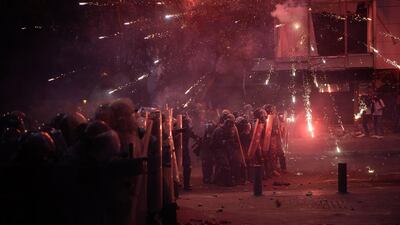
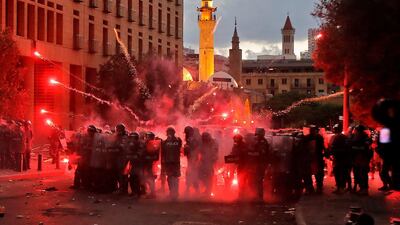
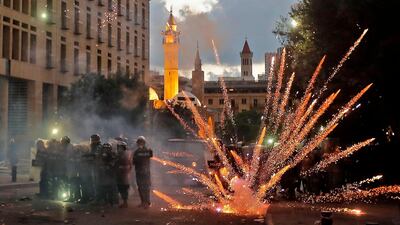
  • Fireworks thrown at riot police by anti-government protesters explode during clashes near the parliament building following last Tuesday's massive explosion in the seaport which devastated Beirut, Lebanon. AP Photo
    Fireworks thrown at riot police by anti-government protesters explode during clashes near the parliament building following last Tuesday's massive explosion in the seaport which devastated Beirut, Lebanon. AP Photo
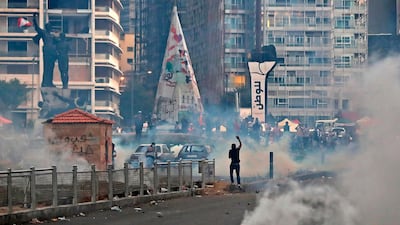
  • Lebanese protesters, enraged by a deadly explosion, clash with security forces at Martyrs' Square in Beirut. Lebanon's Prime Minister Hassan Diab stepped down amid fury within and outside his government over the deadly Beirut port blast he blamed on the incompetence and corruption of a decades-old ruling class. AFP
    Lebanese protesters, enraged by a deadly explosion, clash with security forces at Martyrs' Square in Beirut. Lebanon's Prime Minister Hassan Diab stepped down amid fury within and outside his government over the deadly Beirut port blast he blamed on the incompetence and corruption of a decades-old ruling class. AFP
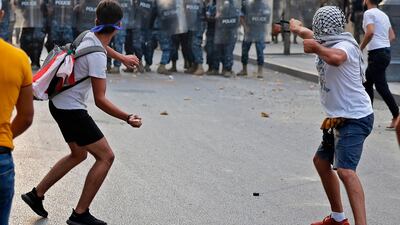
  • Lebanese protesters, enraged by a deadly explosion, hurl stones at security forces amid clashes in central Beirut. Lebanon's Prime Minister Hassan Diab stepped down amid fury within and outside his government over the deadly Beirut port blast he blamed on the incompetence and corruption of a decades-old ruling class. AFP
    Lebanese protesters, enraged by a deadly explosion, hurl stones at security forces amid clashes in central Beirut. Lebanon's Prime Minister Hassan Diab stepped down amid fury within and outside his government over the deadly Beirut port blast he blamed on the incompetence and corruption of a decades-old ruling class. AFP
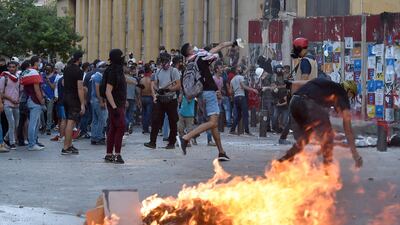
  • Lebanese anti-government protesters throw stones at security forces at one of the roads leading to the parliament building in Beirut, Lebanon. EPA
    Lebanese anti-government protesters throw stones at security forces at one of the roads leading to the parliament building in Beirut, Lebanon. EPA
  • Lebanese security forces clash with protesters near the parliament building in central Beirut following a huge chemical explosion that devastated large parts of the Lebanese capital. AFP
    Lebanese security forces clash with protesters near the parliament building in central Beirut following a huge chemical explosion that devastated large parts of the Lebanese capital. AFP
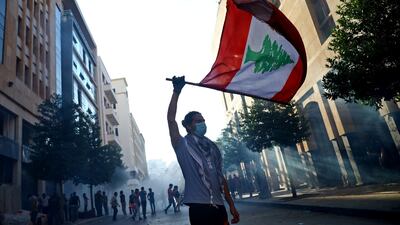
  • A demonstrator waves a Lebanese flag during anti-government protests that have been ignited by a massive explosion in Beirut, Lebanon. Reuters
    A demonstrator waves a Lebanese flag during anti-government protests that have been ignited by a massive explosion in Beirut, Lebanon. Reuters
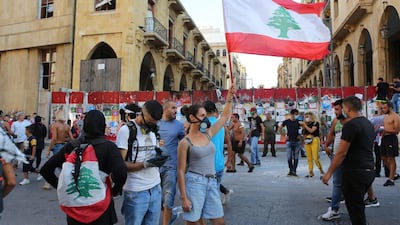
  • Protesters wave a Lebanese flag during demonstrations near the parliament building in Beirut, Lebanon. EPA
    Protesters wave a Lebanese flag during demonstrations near the parliament building in Beirut, Lebanon. EPA
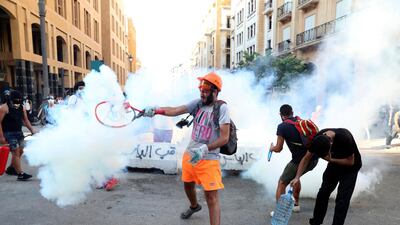
  • An anti-government protester uses a tennis racket to hit back a tear gas canister towards riot policemen during a protest following last Tuesday's massive explosion, which devastated Beirut, Lebanon. AP Photo
    An anti-government protester uses a tennis racket to hit back a tear gas canister towards riot policemen during a protest following last Tuesday's massive explosion, which devastated Beirut, Lebanon. AP Photo
  • Lebanese security forces clash with protesters near the parliament in central Beirut following a huge chemical explosion that devastated large parts of the Lebanese capital. AFP
    Lebanese security forces clash with protesters near the parliament in central Beirut following a huge chemical explosion that devastated large parts of the Lebanese capital. AFP
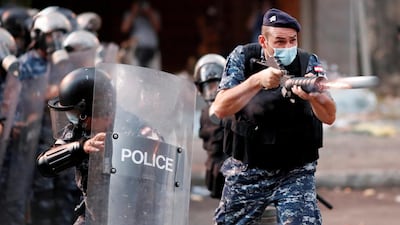
  • A member of Lebanese riot police fires a weapon during anti-government protests that have been ignited by a massive explosion in Beirut, Lebanon. Reuters
    A member of Lebanese riot police fires a weapon during anti-government protests that have been ignited by a massive explosion in Beirut, Lebanon. Reuters
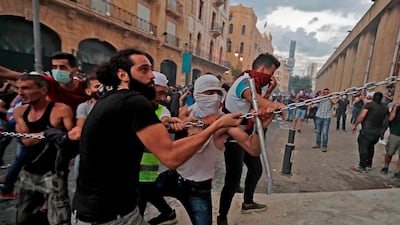
  • Lebanese protesters try to storm the vicinity of the parliament in central Beirut following a huge chemical explosion that devastated large parts of the Lebanese capital. AFP
    Lebanese protesters try to storm the vicinity of the parliament in central Beirut following a huge chemical explosion that devastated large parts of the Lebanese capital. AFP
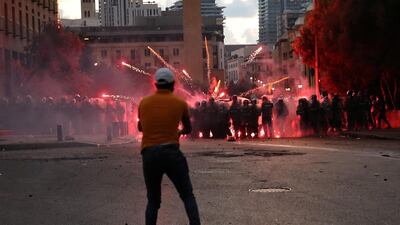
  • A demonstrator throws fireworks at riot police during anti-government protests that have been ignited by a massive explosion in Beirut, Lebanon. Reuters
    A demonstrator throws fireworks at riot police during anti-government protests that have been ignited by a massive explosion in Beirut, Lebanon. Reuters

Similarly, after the massive explosion in Beirut port on August 4, Mr Aoun should have gone down on the evening of the blast to commiserate with those who had just lost their homes and loved ones. However, the President only appeared the next day to survey the blast site, with not a moment wasted on the victims. Here was a golden opportunity to bolster his appeal, and instead, Mr Aoun came across as someone indifferent to those who had suffered terrible trauma.

What is so difficult to grasp is why Mr Aoun, who effectively fought a war to become president in 1988-1990, and who helped create a ruinous presidential vacuum in 2014-2016 in order to take office, has proven to be such an inert, mediocre president. He has not brought a single original idea or programme that he has sought to implement.

If there is one enduring message among many others on Lebanon’s centennial, it is that the country’s political system creates many informal spaces for the exercise of constructive power. Even if the presidency is no longer what it once was, a capable president who wants to make a difference can do so if he tries.

Michael Young is a senior editor at the Carnegie Middle East Centre in Beirut and a columnist for The National


Getting there
Flydubai flies direct from Dubai to Tbilisi from Dh1,025 return including taxes

UAE v Gibraltar

What: International friendly

When: 7pm kick off

Where: Rugby Park, Dubai Sports City

Admission: Free

Online: The match will be broadcast live on Dubai Exiles’ Facebook page

UAE squad: Lucas Waddington (Dubai Exiles), Gio Fourie (Exiles), Craig Nutt (Abu Dhabi Harlequins), Phil Brady (Harlequins), Daniel Perry (Dubai Hurricanes), Esekaia Dranibota (Harlequins), Matt Mills (Exiles), Jaen Botes (Exiles), Kristian Stinson (Exiles), Murray Reason (Abu Dhabi Saracens), Dave Knight (Hurricanes), Ross Samson (Jebel Ali Dragons), DuRandt Gerber (Exiles), Saki Naisau (Dragons), Andrew Powell (Hurricanes), Emosi Vacanau (Harlequins), Niko Volavola (Dragons), Matt Richards (Dragons), Luke Stevenson (Harlequins), Josh Ives (Dubai Sports City Eagles), Sean Stevens (Saracens), Thinus Steyn (Exiles)

TRAP

Starring: Josh Hartnett, Saleka Shyamalan, Ariel Donaghue

Director: M Night Shyamalan

Rating: 3/5

Living in...

This article is part of a guide on where to live in the UAE. Our reporters will profile some of the country’s most desirable districts, provide an estimate of rental prices and introduce you to some of the residents who call each area home.

Call of Duty: Black Ops 6

Developer: Treyarch, Raven Software
Publisher:  Activision
Console: PlayStation 4 & 5, Windows, Xbox One & Series X/S
Rating: 3.5/5

WOMAN AND CHILD

Director: Saeed Roustaee

Starring: Parinaz Izadyar, Payman Maadi

Rating: 4/5

Tips to keep your car cool
  • Place a sun reflector in your windshield when not driving
  • Park in shaded or covered areas
  • Add tint to windows
  • Wrap your car to change the exterior colour
  • Pick light interiors - choose colours such as beige and cream for seats and dashboard furniture
  • Avoid leather interiors as these absorb more heat
COMPANY%20PROFILE
%3Cp%3E%3Cstrong%3ECompany%3A%3C%2Fstrong%3E%20Vault%3Cbr%3E%3Cstrong%3EStarted%3A%20%3C%2Fstrong%3EJune%202023%3Cbr%3E%3Cstrong%3ECo-founders%3A%20%3C%2Fstrong%3EBilal%20Abou-Diab%20and%20Sami%20Abdul%20Hadi%3Cbr%3E%3Cstrong%3EBased%3A%20%3C%2Fstrong%3EAbu%20Dhabi%3Cbr%3E%3Cstrong%3ELicensed%20by%3A%3C%2Fstrong%3E%20Abu%20Dhabi%20Global%20Market%3Cbr%3E%3Cstrong%3EIndustry%3A%20%3C%2Fstrong%3EInvestment%20and%20wealth%20advisory%3Cbr%3E%3Cstrong%3EFunding%3A%20%3C%2Fstrong%3E%241%20million%3Cbr%3E%3Cstrong%3EInvestors%3A%20%3C%2Fstrong%3EOutliers%20VC%20and%20angel%20investors%3Cbr%3E%3Cstrong%3ENumber%20of%20employees%3A%20%3C%2Fstrong%3E14%3Cbr%3E%3C%2Fp%3E%0A