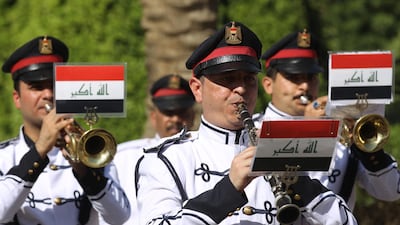

Seventeen years after the fall of Saddam Hussein’s regime and the ensuing American-led occupation of the country, Iraq continues to suffer from the consequences of state collapse.
From dismantling the army and police forces, to redesigning the Iraqi flag, rushed decisions were taken in 2003 to erase the immediate past without much thought for the future. When Iraq's ancient past was under threat, as exemplified by the looting of the Iraqi National Museum and the use of sand from archaeological sites for American army sandbags, once again little thought was given to the wider impact on the country.
Among the decisions that were made by the Coalition Provisional Authority, the American-led civilian authority running Iraq in the immediate aftermath of the invasion, was the abolition of Iraq’s National Day. For decades, National Day was July 17, 1968, marking the coup that brought the Baath party to power. Before that, National Day was July 14, marking the day that Abdulkareem Qassem’s military coup led to the killing of Iraq’s royal family members in 1958 and the declaration of a republic.
Even after the Baathists designated July 17 as the new National Day, July 14 remained a national holiday. Both dates are highly politicised and were hardly symbols of national unity.
In 2003, a number of political parties wanted to declare April 9, the day Saddam Hussein’s regime fell, as the National Day, but that is equally contentious and was rejected by most Iraqis. However, the day is still a national holiday in Iraq’s Kurdistan Region.
Today, Iraq averages more than 12 public holidays per year that are tied to religious occasions. Additional public holidays include New Year’s Day, Army Day, Labour Day and Nowruz, the first day of spring. Since 2017, December 10 has been marked as “Victory Day”, celebrated as the day ISIS was declared “defeated” and no longer in control of any Iraqi territory. However, it is a bittersweet day for those who lost loved ones, homes and livelihoods.
In effect, since 2003, Iraq has not had a national day – an apt metaphor for the targeted attempts to weaken Iraq’s national identity, often by political leaders who could not survive on a nationalist platform. Sectarian and ethnic divides were promoted over an Iraqi national identity.
With those divides came high levels of corruption and the erosion of state institutions. Iraq's Prime Minister, Mustafa Al Kadhimi, recognises the complexity of the problem and the impact of the weakening of Iraq's national identity on the country's fortunes. Speaking to me in an exclusive interview last month, Mr Al Kadhimi said he is working to tackle sectarianism and corruption equally, while promoting nationalism as part of his reform programme. "We will use all the strength we have to push for the principles of patriotism and nationalism," he said.
Last week, Iraq’s Cabinet agreed on a draft law to mark October 3 as Iraq’s National Day, to be celebrated for the first time this year. It is a sensible choice of date, commemorating the day Iraq joined the League of Nations in 1932, independent of the British Mandate.
Iraq's Culture Minister Hassan Nazim explained that "the importance of this day is that it is an official and international recognition of the establishment of the Iraqi state, to be among the first Arab (countries) to gain independence". However, the move still needs parliamentary ratification and is already contested.
The key battle here is that a number of prominent political parties work against the strengthening of Iraqi national identity, which would weaken their party programmes that rest on division and sectarianism.

Some say that other milestones in Iraqi history ought to be marked instead. And while reflecting upon history may bring alternative dates to mind, the declaration of Iraq’s independence as a modern nation-state is the most appropriate. It is a date filled with national pride and does not favour one political party or entity over another.
Countries all over the world cherish their national day as a moment for citizens to rally around what binds them together rather than what divides them. The coronation of a king or queen, the birth of a revolution, the declaration of independence and a coming together of a number of regions under one flag have all been inspirations for different national days.
Mr Al Kadhimi’s move to impose a national day is part of his effort to unite Iraqis – particularly younger ones – in feeling pride in their heritage and their potential future. Declaring a national day and uniting people over national symbols of culture like poetry and art are important steps in helping Iraq heal its wounds and work towards guarding its sovereignty. One measure alone won’t do it, but a concerted effort with measures like these can make the difference between a successful or failed state.
Francis Fukuyama, who has written extensively on identity, says that “national identity has been pivotal to the fortunes of modern states”. And while we must be weary of national identities that are exclusionary or dogmatic, they can be forged on commonalities that bring together diverse communities.
Fukuyama added in an article published in the Journal of Democracy in October 2018: “an inclusive sense of national identity remains critical to maintaining a successful, modern political order. National identity not only enhances physical security, but also inspires good governance; facilitates economic development; fosters trust among citizens; engenders support for strong social safety nets and ultimately makes possible liberal democracy itself.”
All of the characteristics listed by Fukuyama are part of the aspirations of young Iraqis. Perhaps the only contentious one is that tied to “liberal democracy”, as many of the attacks on Iraq’s national identity were carried out under the guise of “democracy”. Good governance, economic development and trust among citizens are the pillars that must be stood up in Iraq in order for a path towards a truly representative liberal democracy to be found.
Mina Al-Oraibi is editor-in-chief at The National

