

Iraqi Prime Minister Mustafa Al Kadhimi has called the sectarian system imposed on Iraq in order to “create national balance … a big lie”.
In an exclusive interview with The National, Mr Al Kadhimi said that sectarianism is one of the main drivers of corruption in the country.
“There are defects in the structure of some state institutions since 2003, as they were wrongly built on sectarian and ethnic divides, leading to political divisions [known as muhasasa].
"It is a big lie to say that a national balance was created by sectarian divisions, rather these are political divisions that lead to the weakening of the state and corrupting its institution”. As part of his reform programme, Mr Al Kadhimi said: “We are working at securing state entities, and at fighting the individuals inside these entities who are not patriotic.”
The Iraqi Prime Minister has vowed to strengthen security forces and bring those behind the killing of Iraqi activists to justice.
Mr Al Kadhimi said “the groups that believe they are above the law will soon see serious moves from our security forces”. He added “our government programme is built on stressing the sovereignty of the state, which includes limiting the use of force to official security forces and prohibiting the use of weapons outside of the law".
"In the past, there was a concerted effort to diminish the state’s security forces and corrupt them," he said. "We are now working on re-establishing these forces, and cleansing them of all corrupt elements. This will take time. But we will hold these individuals to account for the crimes that they have committed”.
Mr Al Kadhimi came to office after protesters took to the streets last October, demanding reforms and the end of corruption and militia rule. Since being tasked with leading the country last April, Mr Al Kadhimi has promised to deliver on these reforms but has faced great challenges, from militias whose interests are at risk and from the impact of Covid-19 and collapsing oil prices.
The majority of parliamentary blocs are not supporting efforts that will ultimately hinder their patronage networks, not to mention curb the continued corruption and mismanagement across all government spending. Mr Al Kadhimi says “everyone has to understand that the strength of the state applies to them all. A prerequisite for any reform process is respecting the decisions of the state and implementing them. There are those who will not accept the sovereignty of the state easily, but we have ways of dealing with them”.
-
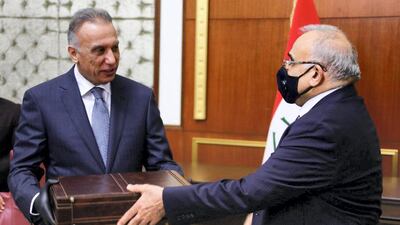
Former Iraqi Prime Minister Adel Abdul Mahdi hands over to new Prime Minister Mustafa Al Kadhimi in Baghdad, Iraq, May 7, 2020. Reuters -
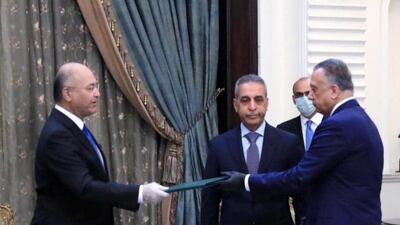
Iraq's President Barham Salih instructs newly appointed Prime Minister Mustafa Al Kadhimi in Baghdad, Iraq April 9, 2020. Reuters -
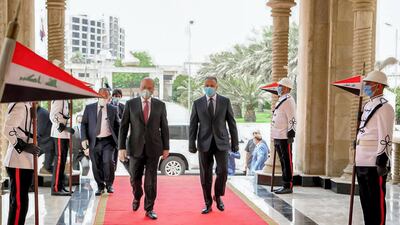
President Barham Salih receiving Prime Minister Mustafa Al Kadhimi at Salam Palace in the capital Baghdad, while both clad in masks due to the Covid-19 pandemic on May 28, 2020. AFP -
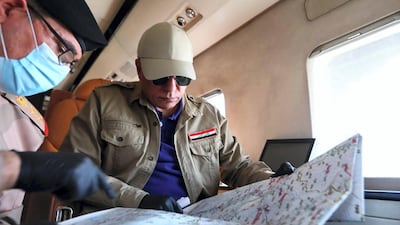
Prime Minister Mustafa Al Kadhimi looks at a map aboard a plane on the way to the northern city of Kirkuk for an official visit on June 2, 2020. AFP -
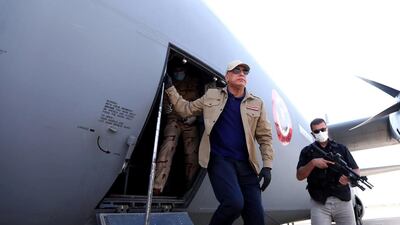
Prime Minister Mustafa Al Kadhimi arriving in Kirkuk for an official visit on June 2, 2020. AFP -
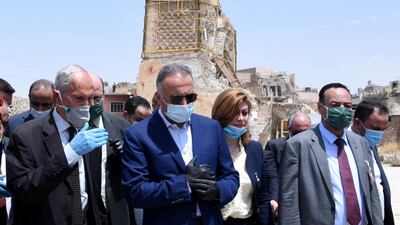
Prime Minister Mustafa Al Kadhimi visits the Great Mosque of al-Nuri in the Old City area, on the west side of Mosul city, northern Iraq, 10 June 2020. EPA -
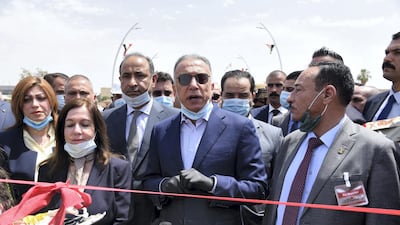
Prime Minister Mustafa Al Kadhimi speaks during the reopening ceremony of a bridge which connects East and West Mosul, northern Iraq, 10 June 2020. EPA -

Iraqi Prime Minister Mustafa Al Kadhimi visits and offers condolences to the family of the late former government advisor and political analyst Hisham al-Hashemi, who was killed by gunmen, in Baghdad, Iraq July 8, 2020. Reuters -

Iraqi Prime Minister Mustafa Al Kadhimi talks to prisoners during his visit in the central investigation prison in Al-Muthana airport in Baghdad, Iraq July 30, 2020. Reuters -
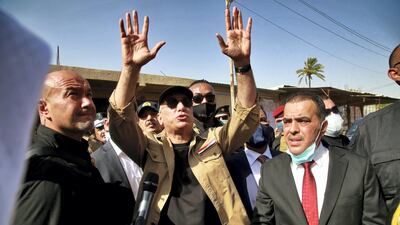
Iraqi Prime Minister Mustafa Al Kadhimi speaks to locals in Tarmiyah, Iraq July 20, 2020. Reuters -
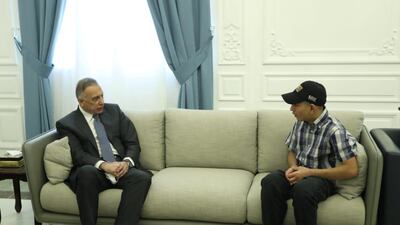
Iraqi Prime Minister Mustafa Al Kadhimi meets with Iraqi teenager Hamid Saeed, who was mistreated by members of security forces, after he was released from jail in Baghdad. Handout via Reuters -
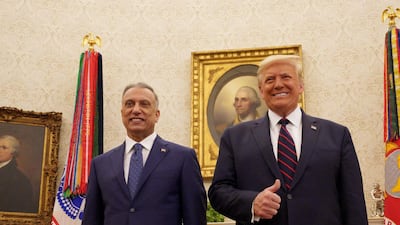
US President Donald Trump receives Iraq's Prime Minister Mustafa Al Kadhimi in the Oval Office at the White House in Washington, August 20, 2020. Reuters -
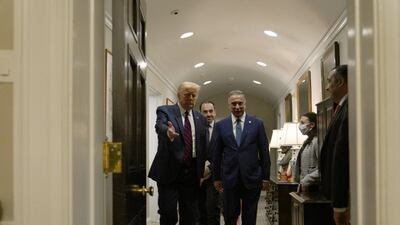
US President Donald Trump receives Iraq's Prime Minister Mustafa Al Kadhimi in the Oval Office at the White House in Washington, August 20, 2020. Reuters -

US President Donald Trump receives Iraq's Prime Minister Mustafa Al Kadhimi in the Oval Office at the White House in Washington, August 20, 2020. Reuters -
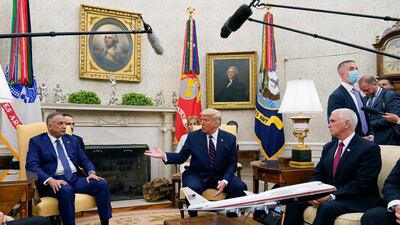
President Donald Trump meets with Iraqi Prime Minister Mustafa Al Kadhimi in the Oval Office of the White House, Thursday, August 20, 2020, in Washington. AP Photo -
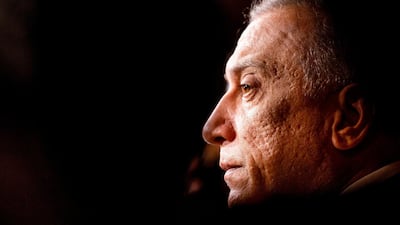
Iraq's Prime Minister Mustafa Al Kadhimi arrives to the southern city of Basra late on August 22, 2020, accompanied by security forces' commanders in a surprise visit. AFP -
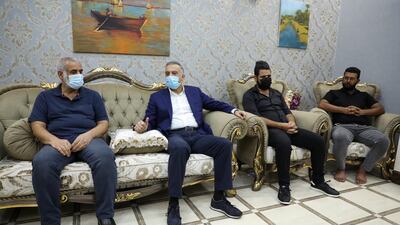
Iraqi Prime Minister Mustafa Al Kadhimi visits and offers condolences to the family of Reham Yacoub, a female activist who was killed by unidentified gunmen, in Basra, Iraq August 22, 2020. Reuters -

Iraqi Prime Minister Mustafa Al Kadhimi, center, speaks to journalists during his visit to Basra, Iraq, Saturday, August 22, 2020. AP Photo -
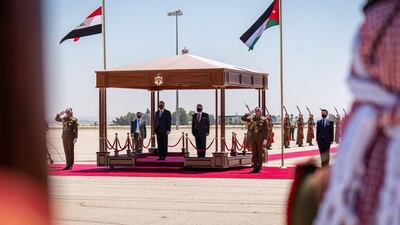
King Abdullah II of Jordan and Iraqi Prime Minister Mustafa Al Kadhimi in the official welcoming ceremony held at Queen Alia International Airport ahead of the trilateral meeting in Amman, Jordan, 25 August 2020. EPA -
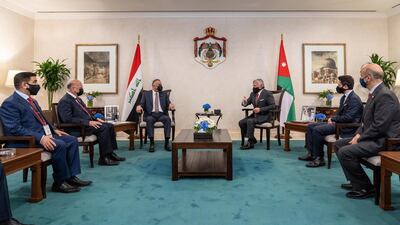
King Abdullah II of Jordan and Iraqi Prime Minister Mustafa Al Kadhimi talking ahead of the trilateral meeting in Amman, Jordan, 25 August 2020. EPA


As the efforts of Mr Al Kadhimi to face off with militias were stepped up, they have been ramping up their attacks on those calling for reforms, including a respected analyst Husham Al Hashemi, who Mr Al Kadhimi knew well and considered a friend.
Asked who stands behind the assassinations, Mr Al Kadhimi referred to "criminal groups that abuse the vulnerabilities in some of our security apparatus".
"For this reason, one of the key goals of my government’s programme is to investigate and reveal the facts regarding the killing of protesters.
"We have placed a plan, which started with the announcement last week of the names of those who have been killed and injured and their families the support they need. We continue to investigate those who have been killed, after the attacks on activists and intellectuals after I came to office”.
Mr Al Kadhimi asked for patience, saying “judicial timeframes are different from political ones, and we cannot be driven by emotions or political stances in dealing with matters that require accuracy and justice. We will follow the assassinations of Dr Reham Al Yacoub, Dr Hisham AlHashemi and Tahseen Oussama. We have some leads but the investigations will require time”.
However, Mr Al Kadhimi was confident that the killers would be caught, stating “we will get the offenders for sure”.
“We will be transparent in announcing the results of the investigations so that everyone can be privy to them.”
On a regular basis, armed groups launch rockets into security areas. “We continue to arrest those behind these attacks, and their aim is clear, that is to embarrass the government. The assassination attempts against young people are also part of that effort. They want the government to appear weak, these reckless rocket attacks hurt Iraqis also.”
Unlike his predecessors, Mr Al Kadhimi has been keen to hear from regular Iraqis frequently, meeting with those who do not enjoy the security of 24-hour electricity of the fortified Green Zone in Baghdad. On the first day of Eid Al Fitr in May, he spend the day visiting Baghdad’s largest hospital, Medical City. He has visited a number of state entities, including the pensions authority which is notorious in delaying payments to pensioners.
He has visited provinces such as Kirkuk, Ninevah and Basra, and spent time surveying their problems. One of the key issues raised by Iraqis is the lack of electricity, with some areas getting less than 4 hours of electricity from the national grid a day. Mr Al Kadhimi admits this is a major issue and says “reliable electricity is a priority”.
He added: “The electricity problem from 2003 until now is based on a lack of planning and the lack of a commitment to protect the dignity of the Iraqi people. Consecutive ministries did not work seriously on delivering these services, rather most were interested in benefiting financially and through corrupt means.”
With new contracts signed with GE and efforts under way to connect with regional grids and produce Iraqi gas, Mr Al Kadhimi says "we will put in all our efforts to ensure next summer will be better than this one".

Youth movements in Iraq have been active in organising protests and swaying public opinion, however their members have yet to formulate a strong political bloc, nor find an entry way into the political system. Mr Al Kadhimi said he was committed to providing them every aid possible, including through the ballot box.
Mr Al Kadhimi has called for early elections in June next year.
“Corrupt forces are working at full force to ensure sectarian divisions are maintained, as they can thrive under these circumstances," he said.
"The reform programme will require a long time. We will use all the strength we have to push for the principles of patriotism and nationalism. We will support nationalist forces as much as possible.”
Mr Al Kadhimi has said he will not stand for election, and he explained that his current focus is “allowing Iraqis to vote freely, without fraud or intimidation or the threat of the use of force".
"I am focused on creating the circumstances to allow for free and fair elections and regaining the trust of Iraqis in the electoral process. I am not thinking of anything else at this stage.”
Speaking to The National hours after landing from Amman, Mr Al Kadhimi was optimistic about Iraq's relations with the Arab world. He said that the summit hosted on Tuesday by Jordan's King Abdullah II and attended by Egyptian President Abdel Fattah El Sisi is part of an attempt to create a "New Levant", with economic, social and cultural ties forged to create a stable basin uniting these countries.
The outcomes of the summit include an agreement “to focus on trade, energy and agriculture sectors, with a focus on food security. The world is enduring great challenges due to Covid19, so we are working on creating food resources for our people but also the people of the wider region”.
He explained: “This summit is a continuation of long work with previous summits being held between Iraq, Jordan and Egypt, but at the same time it is the start of a new era to strengthen co-operation between these three countries. The societal, economic and historical circumstances of the three countries are similar, much binds them. We also face similar challenges and can face them together.”
“Our region is in need of a new vision, outside the polarised state today. We need to make economic and social development a priority in our relations, bringing to a halt the conflicts [in the region], while respecting the sovereignty of each country and ensuring non-interference in their internal affairs”.
He added: “We have to stand against the sectarian and ethnic divisions that have spread in the by region.
"On the other hand, we are facing another challenge and that is the global crises caused by Covid19 and the collapse of oil prices and its economic impact. We want this summit to become a framework for our three countries to work together and to be broadened to include other countries in the future.”
He was quick to add “this is not an effort against a particular party, rather working together to face our collective challenges, based on economic co-operation”.
Thirty years after the invasion of Kuwait, Iraq’s ties with Arab Gulf countries are improving but still in need of development.
“We have to learn lessons from the invasion of Kuwait. Without a doubt, the invasion of Kuwait was an unjustified attack by Saddam Hussein on a neighbour. The Gulf countries represent our strategic depth and we seek to develop our ties to the best possible level, as this will serve stability in the region, and will put a stop to the divisions and sectarianism that tore us apart in wars, and this is the desire of most Iraqis. Most Iraqis seek ties with the Gulf and believe in the need for these relations”.
A cornerstone in these ties is the possibility of investment opportunities in Iraq, including a GCC-Iraq electricity project supported by the US, but which has faced extensive delays. Asked about these delays, Mr Al Kadhimi said: “This is a new government and it is the first time that there is a serious step between Gulf countries and Iraq to face joint challenges.
"The joint electricity project was delayed due to past mismanagement in Iraq, due to corruption and political interference in Iraq.” However, he explained that “today, there is a serious commitment to make this project a reality”.
Mr Al Kadhimi was due to visit Saudi Arabia last month but the visit was delayed due to King Salman requiring surgery. “There will be a visit soon to Saudi Arabia and we stress the brotherly ties there.”
Of course relations with the US remain of paramount importance to Iraq and last week Mr Al Kadhimi was received by US President Donald Trump. Mr Al Kadhimi said that "the visit was a success … the most important outcome was the economic partnership between the two sides".
He added: “Our relationship has entered a new phase that does not rest solely on security co-operation, rather on economic co-operation and attracting American companies to Iraq and launching long term co-operation, especially in the areas of energy, technology, education and health.”
The US also provides vital support through backing credit lines from international financial organisations.
Asked about the withdrawal of American troops from Iraq, Mr Al Kadhimi insisted that a “redeployment” was taking place and that “combat troops” were no longer needed in the country.
“I personally sensed an American commitment to developing our partnership”.

The presence of US troops in Iraq is a contentious topic. The Iraqi Parliament held a vote in January on demanding American troops leave the country. Although no official count was made of the vote, the Speaker of Parliament Mohammed Al Halbousi announced that a majority had voted to demand US troops leave the country.
Asked whether he personally feels Iraq would be better off without American troops on the ground, Mr Al Kadhimi said: “We have moved into a new phase, we do not need combat troops on the ground as Iraqi forces are capable of fighting ISIS militants. However, they need logistical and technical support, in addition to training.” So support continues for an American presence in Iraq, with a lighter footprint.
When asked about Iran and Turkey, Iraq’s two neighbours who have extensively interfered in its affairs, his responses are brief and diplomatic. Mr Al Kadhimi faces a challenge primarily from political parties and militant groups supported by Iran. However, he had been careful to maintain good relations with Tehran, where he visited in July.
Asked about Tehran’s interference, Mr Al Kadhimi said: “We believe two principles should guide our relations. First, non-interference in the domestic affairs of each country and rejecting the use of the territories of either country to launch an attack on the other, and the second principle being that relations with Iran should be state-to-state based on mutual interests”.
Implicitly, he is referring to the need for Tehran to go through official channels, rather than proxies. The issue of non-interference was raised during the Prime Minister’s visit to Iran, and he said that “it is clear that there is a reassessment there towards relations with Iraq. It is in Iran’s interest that Iraq is stable”.
As for Turkey, which continuously carries out military actions in Iraq, Mr Al Kadhimi said: “Of course we reject the Turkish incursion in the Kurdistan region of Iraq. At the same time, we can understand Turkish concerns about [militant Kurdish group] PKK actions emerging from Iraq and which target Turkey… We need to remove the concerns of both sides so we can stabilise relations”.

