

With the world facing ever greater challenges, there is a pressing need for the Western alliance to demonstrate unity. Yet, the speed with which European states have been willing to isolate Britain over the sudden rise in coronavirus infections has laid bare the deep divisions that currently lie within the European comity of nations.
The official explanation for the decision by the overwhelming majority of European governments, beginning with France, to ban British residents earlier in the week from entry was that the discovery by British scientists of a new, more virulent strain of the Covid-19 virus poised a clear and present danger to their nations’ well-being. France has now re-opened its border with the UK under strict conditions, but it is worth reflecting on what the events of this week really meant.
Despite calls from the WHO and other international bodies, including the EU secretariat, for European leaders to work together to overcome the coronavirus pandemic, the decision by so many of them to respond unilaterally demonstrated that, when faced with the choice between fostering co-operation and protecting their own national interests, they opted for the latter without, apparently, a moment’s hesitation.
-
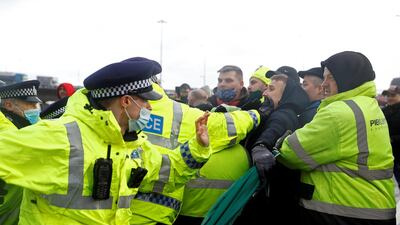
Police officers scuffle with drivers trying to stop trucks leaving the port and keep it closed until they are allowed to travel to Europe, at the Port of Dover, as EU countries impose a travel ban from the UK following the coronavirus disease (COVID-19) outbreak, in Dover, Britain, December 23, 2020. REUTERS/John Sibley -
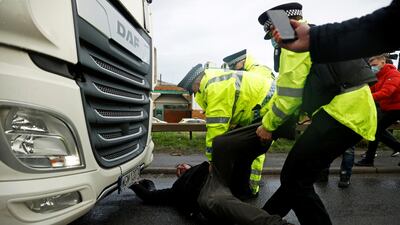
Police officers drag a person lying down in front of a lorry at the Port of Dover, as EU countries impose a travel ban from the UK following the coronavirus disease (COVID-19) outbreak, in Dover, Britain, December 23, 2020. REUTERS/John Sibley TPX IMAGES OF THE DAY -

epa08900880 Police stand at the entrance of the Port of Dover after freight lorries cannot cross by sea or through the Eurotunnel and the Port of Dover has closed to outbound traffic in Dover, Britain, 23 December 2020. France closed its border with the UK for 48 hours over concerns about the new coronavirus variant. Lorry drivers must now obtain negative coronavirus tests before they will be allowed to cross by sea and the Port of Dover remains closed to outbound traffic on the morning of 23 December 2020. EPA/FACUNDO ARRIZABALAGA -
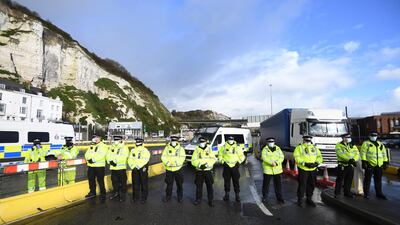
epa08900874 Police stand at the entrance of the Port of Dover after freight lorries cannot cross by sea or through the Eurotunnel and the Port of Dover has closed to outbound traffic in Dover, Britain, 23 December 2020. France closed its border with the UK for 48 hours over concerns about the new coronavirus variant. Lorry drivers must now obtain negative coronavirus tests before they will be allowed to cross by sea and the Port of Dover remains closed to outbound traffic on the morning of 23 December 2020. EPA/FACUNDO ARRIZABALAGA -

DOVER, ENGLAND - DECEMBER 23: Police officers attend to a man at the Port of Dover on December 23, 2020 in Dover, United Kingdom. Nearly 3,000 lorries were stranded around Kent after France banned all travel from the UK on Sunday, citing concerns over a new variant of covid-19. Late Tuesday, the countries reached a deal to restart freight travel for drivers with a recent negative covid-19 test. (Photo by Dan Kitwood/Getty Images) -

A person lies down in front of a lorry to stop it from leaving the Port of Dover, as EU countries impose a travel ban from the UK following the coronavirus disease (COVID-19) outbreak, in Dover, Britain, December 23, 2020. REUTERS/John Sibley -
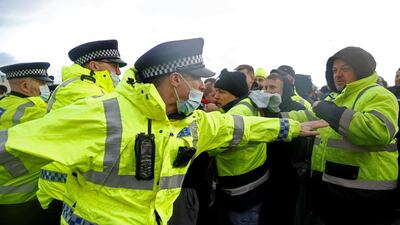
Police officers scuffle with drivers trying to stop trucks leaving the port and keep it closed until they are allowed to travel to Europe, at the Port of Dover, as EU countries impose a travel ban from the UK following the coronavirus disease (COVID-19) outbreak, in Dover, Britain, December 23, 2020. REUTERS/John Sibley -
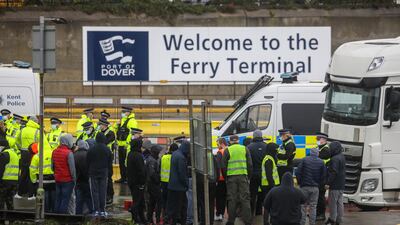
Police officers speak with truck drivers at the Port of Dover Ltd. in Dover, U.K. The European Commission called on member states to reopen critical trade and passenger transport links to the U.K. while discouraging non-essential travel, a step toward ending the chaos at Britain's busiest port. Bloomberg -
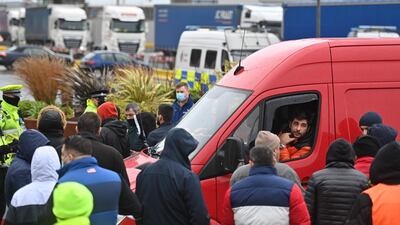
Drivers discuss by their vehicles in the road as they queue trying to enter the port of Dover in Kent, south east England, that is still cordoned after the UK and France agreed a protocol to reopen the border to accompanied freight arriving in France from the UK requiring all lorry drivers to show a negative Covid-19 test. France and Britain reopened cross-border travel after a snap 48-hour ban to curb the spread of a new coronavirus variant threatened UK supply chains. Accompanied frieght will now be allowed to cross the channel from the port of Dover but all lorry drivers will require a lateral flow test and a negative Covid-19 result before the travel. AFP -
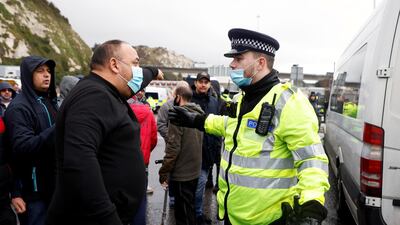
A driver talks with a police officer at the entrance of the Port of Dover, as EU countries impose a travel ban from the UK following the coronavirus disease (COVID-19) outbreak, in Dover, Britain, December 23, 2020. REUTERS/John Sibley -

Drivers talk with police officers at the entrance of the Port of Dover, as EU countries impose a travel ban from the UK following the coronavirus disease (COVID-19) outbreak, in Dover, Britain. REUTERS -
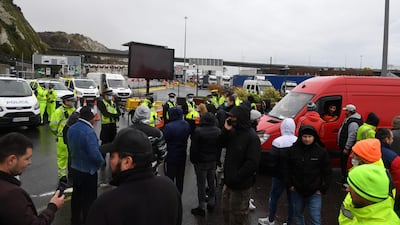
Drivers and their vehicles trying to enter the port of Dover, in Kent, south east England, block the road access as they not allowed to enter after the UK and France agreed a protocol to reopen the border to accompanied freight arriving in France from the UK. France and Britain reopened cross-border travel after a snap 48-hour ban to curb the spread of a new coronavirus variant threatened UK supply chains. Accompanied frieght will now be allowed to cross the channel from the port of Dover but all lorry drivers will require a lateral flow test and a negative Covid-19 result before the travel. AFP -
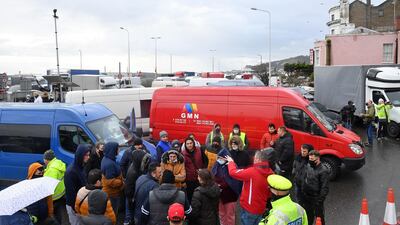
Drivers block the road by the entrance to the Port in Dover, in Kent, south east England on December 23, 2020, as they await lateral flow COVID-19 tests to arrive, before being allowed to enter, following an agreement between the UK and France to reopen the border to accompanied freight arriving in France from the UK. France and Britain reopened cross-Channel travel on Wednesday after a 48-hour ban to curb the spread of a new coronavirus variant but London has warned it could take days for thousands of trucks blocked around the port of Dover to get moving. / AFP / JUSTIN TALLIS -
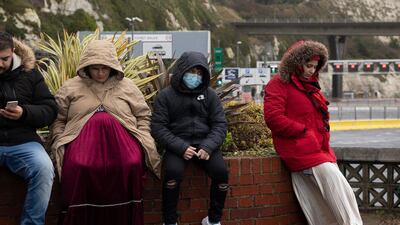
DOVER, ENGLAND - DECEMBER 23: Travellers to Europe wait at the Port of Dover on December 23, 2020 in Dover, United Kingdom. Nearly 3,000 lorries were stranded around Kent after France banned all travel from the UK on Sunday, citing concerns over a new variant of covid-19. Late Tuesday, the countries reached a deal to restart freight travel for drivers with a recent negative covid-19 test. (Photo by Dan Kitwood/Getty Images) -
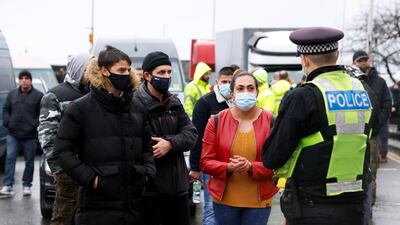
People wearing protective masks talk with a police officer at the entrance of the Port of Dover, as EU countries impose a travel ban from the UK following the coronavirus disease (COVID-19) outbreak, in Dover, Britain. REUTERS -

Police officers form a cordon at the entrance to the port in Dover, in Kent, south east England, after the UK and France agreed a protocol to reopen the border to accompanied freight arriving in France from the UK. France and Britain reopened cross-border travel after a snap 48-hour ban to curb the spread of a new coronavirus variant threatened UK supply chains. Accompanied frieght will now be allowed to cross the channel from the port of Dover but all lorry drivers will require a lateral flow test and a negative Covid-19 result before the travel. AFP -

Travellers to Europe are stopped by police officers at the Port of Dover in Dover, United Kingdom. Nearly 3,000 lorries were stranded around Kent after France banned all travel from the UK on Sunday, citing concerns over a new variant of covid-19. Late Tuesday, the countries reached a deal to restart freight travel for drivers with a recent negative covid-19 test. Getty Images -
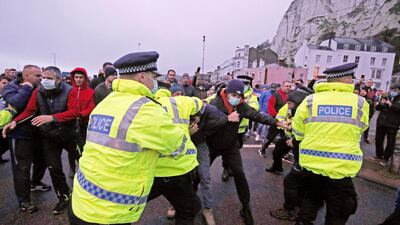
Truck drivers scuffle with police trying to hold them back at the entrance to the Port of Dover, in Kent, England. Freight from Britain and passengers with a negative virus test began arriving on French shores Wednesday, after France relaxed a two-day blockade over a new virus variant that had isolated Britain, stranded thousands of drivers and raised fears of shortages. AP -

Truck drivers discuss with police holding them back at the entrance to the Port of Dover, in Kent, England. Freight from Britain and passengers with a negative virus test began arriving on French shores Wednesday, after France relaxed a two-day blockade over a new virus variant that had isolated Britain, stranded thousands of drivers and raised fears of shortages. AP -

A woman and child stand in front of police officers at the Port of Dover on December 23, 2020 in Dover, United Kingdom. Nearly 3,000 lorries were stranded around Kent after France banned all travel from the UK on Sunday, citing concerns over a new variant of covid-19. Late Tuesday, the countries reached a deal to restart freight travel for drivers with a recent negative covid-19 test. Getty Images -
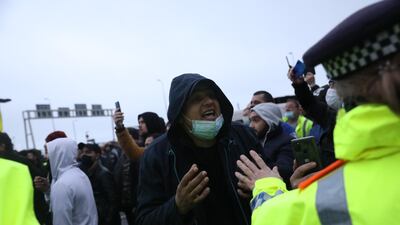
A man speaks to a police officer at the Port of Dover on December 23, 2020 in Dover, United Kingdom. Nearly 3,000 lorries were stranded around Kent after France banned all travel from the UK on Sunday, citing concerns over a new variant of covid-19. Late Tuesday, the countries reached a deal to restart freight travel for drivers with a recent negative covid-19 test. Getty Images -
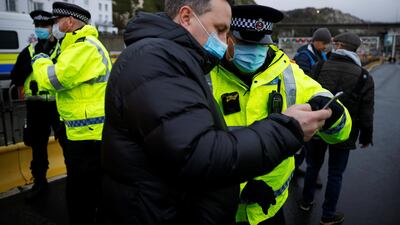
A driver talks with a police officer next the exit of the Port of Dover, as EU countries impose a travel ban from the UK following the coronavirus disease (COVID-19) outbreak, in Dover, Britain, December 23, 2020. REUTERS -

Truck drivers argue with police holding them back at the entrance to the Port of Dover, in Kent, England,. Freight from Britain and passengers with a negative virus test began arriving on French shores Wednesday, after France relaxed a two-day blockade over a new virus variant that had isolated Britain, stranded thousands of drivers and raised fears of shortages. AP -
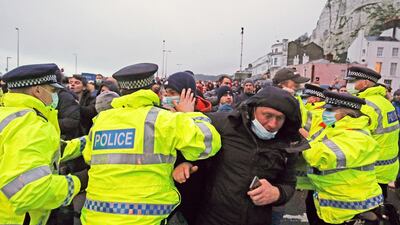
Truck drivers argue with police holding them back at the entrance to the Port of Dover, in Kent, England. Freight from Britain and passengers with a negative virus test began arriving on French shores Wednesday, after France relaxed a two-day blockade over a new virus variant that had isolated Britain, stranded thousands of drivers and raised fears of shortages. AP


The willingness of individual EU member states to subordinate the well-being of Europe as a whole is not a new phenomenon. From the Balkans conflicts of the 1990s to the Iraq war in 2003, European leaders have displayed a dismaying propensity to go their own way. The inclination of EU member states to pressure less fortunate members of the alliance was also very much in evidence during the Greek financial crisis, when wealthier nations like Germany insisted upon implementing punitive financial terms on Athens in return for an EU bail-out.
So, the willingness of so many of these countries to abandon Britain in its hour of need with the closure of its ports in the Strait of Dover – one of the UK’s main trading routes with Europe – once again makes a mockery of the concept of European unity.
Perhaps the most significant political feature of the border closures, imposed mere hours after the new strain of the virus was announced, was that they were done unilaterally by individual governments without consultation with the EU commission. Indeed, it was only after the EU intervened that France was reluctantly persuaded to reach an agreement to reopen the border with the mass testing of lorry drivers stuck on either side.
The timing certainly made life for ordinary Britons, who are already struggling with a dramatic rise in coronavirus cases and nationwide lockdowns, a great deal more difficult. It ended, without any notice, any chance Britons with ties across the Channel may have had of joining family and friends for the festive break. It also raised the possibility of food shortages, as much-needed supplies for major supermarkets were stuck on the French side of the border.
And while the deal agreed between Paris and London now paves the way for a gradual relaxation of controls, the requirement that all travellers from the UK – including EU citizens – must first prove they are not carrying the virus means that further delays will be inevitable, given the scarcity of tests available to the general public. Supermarket bosses are predicting shortages of certain foods, particularly fresh fruit and vegetables, well into next month.

European leaders have been quick to emphasise that all of this is entirely coronavirus-related, and had nothing to do with the problematic Brexit negotiations, the conclusion of which was days overdue. But there are suspicions in London that part of the motivation among at least some European leaders for closing borders with such haste so close to the Brexit deadline was to increase the pressure on UK Prime Minister Boris Johnson. And, at the same time, they were demonstrating to the British people the difficulties they are likely to encounter if the negotiations were to end without agreement on a new trade deal.
These suspicions appeared to be confirmed by Guy Verhofstadt, the anti-Brexit Belgian politician, who tweeted about Britain’s predicament: “They will now start to understand what leaving the EU really means…”
With EU President Ursula von der Leyen now calling upon member states to end the travel ban with Britain, the hardline position adopted by the likes of Mr Verhofstadt is unlikely to be maintained for long. Nevertheless, the conduct of so many of these countries towards their British neighbour has exposed the divisions and rivalries that continue to affect relations between some of Europe’s major powers, with all that means for the future of Western co-operation.
This makes for particularly troubling for US President-elect Joe Biden, who has said that he intends to make reviving the Western alliance one of his main priorities after he assumes office next month. After the divisions that have appeared within the transatlantic alliance over incumbent President Donald Trump’s confrontational attitude with key European figures, such as German Chancellor Angela Merkel, Mr Biden says he wants to restore a sense of unity and purpose so that the West can present a credible counterweight to the emerging power of China and the longstanding rivalry with Russia.
For this to happen, Mr Biden needs Washington’s European allies to present a united front and work together towards a common goal. But, as the events on the British border of the past few days have demonstrated, solidarity is running short in Europe. The continent’s ability to play a role in supporting the kind of kinship and united vision on the world stage that Mr Biden hopes for is not something that can be taken for granted.
Con Coughlin is a defence and foreign affairs columnist for The National

