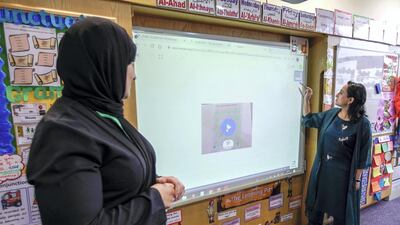
In Emirati society, teachers have always played a key role in shaping lives. In the past, local academics were looked upon solely as intellectuals. Teaching was not a profession too many young Emiratis veered towards, as they looked at it as a career lacking in corporate charms.
Gradually, that perception has been shifting, although that shift gained impetus only in the aftermath of Covid-19. Teachers' roles have evolved in response to digitised classrooms. And the very perception of a teacher has undergone a transformation. It is time we talked about how educators have embraced a blend of the corporate and the pedagogical.
As I deliver lectures to students in addition to my administrative responsibilities, I am aware that in the field of education, unlike perhaps most other fields, one needs a vision and a philosophy to inspire today’s students who are digital natives – that is, they are young enough to never not have had a cell phone or the internet at their disposal.

In today’s hyper-connected world, a plethora of learning resources are available that, unlike earlier, has immense bearing on the future of educational administrators. The relationship between teacher and pupil has changed. A seasoned academic now finds a balance between the role of a teacher and an administrator.
There is a common unattributed saying: “Those who can’t do, teach." Ideally one wouldn’t dignify such a statement with a response. But being a representative of both, the corporate and academic worlds, I would make it: “Those who can’t do, teach them.”
At first, it was unsettling to find myself in a virtual class speaking to a screen. I could not easily see many expressions or talk in person to the students to gauge their understanding.
However, through practice and a range of new techniques offered by Learning Management Systems such as Blackboard Ultra, others in the teaching community and I have adapted and learnt how to manage virtual classrooms.
So much so, I now prefer this mode of teaching to traditional methods. I find nothing more noble than imparting knowledge and contributing to the development of today's youth. The digital campus experience has proven not only to be more interactive but also more immersive and engaging.
Given how quickly online learning became the norm this year, I was curious how this was affecting our ability to communicate with students. To engage with them though, and understand how they are adapting to, this evolving form of education, administrators such as myself first need to understand the challenges faced by the teaching faculty.
From personal experience I can vouch for the merit in what I call the "CEO – Pedagogue" model, which is a management philosophy to support decision making in education.
By virtue of being also tech-savvy administrators, teachers may now be looked at in a different light. Although much of this has to do with the local culture and subjective perception, academics today are equipped to identify and solve issues. In doing so, in their own way, they are help shape the future of education.
Teachers who embrace administrative roles advocate for readiness and agility in the face of disruption. They understand challenges and provide faster resolution to unforeseen problems.
Rest assured, teachers will remain the cornerstone of the educational process, regardless of whether the method of education is traditional or digital, or a combination of both.
His or her role will, however, have to evolve to keep pace with change. Online learning posed a challenge for teachers who were resistant to change. They have not had time to adapt to the transformations sweeping across our industry. But such challenges have also revealed the strength and capabilities of many others, many of whom have excelled in this new environment. Those who cannot change with the times, nor adapt to the new educational landscape, are bound to be left behind and may have no place in the next chapter of our education system.
The world requires from teachers a combination of agility, adaptability and a skill to be able to take on administrative roles. The pedagogue is called on to multi-task as an executive as well as to prove he or she can also teach.
Dr Abdullatif Alshamsi is the president and chief executive of Higher Colleges of Technology

