

US President Joe Biden’s first official foreign trip has provided clear rules of the road for countries looking for how American foreign policy will operate over the next three years.
A number of countries in the Middle East, in particular, are wary of how Washington is going to play its role under Mr Biden.
Those countries that did not welcome the reversion to the status quo ante policies of former president Barack Obama are hoping they can still transact with the US. The countries that did welcome the change Mr Biden brought about remain unsure about the future. Is this a four-year interregnum before policies pursued by the previous Trump administration return? Or will the Biden administration's tilt to the Indo-Pacific mean that the US becomes a de facto marginal player in the region?
If the G7 meeting is anything to go by, the Biden team is laying down frameworks that will strongly influence the Middle East. Its reliance on global mechanisms, however, means that there is not much talk about the region in the policy rollout.
It was telling about America that Russian President Vladimir Putin did not even mention Syria, Iran or Libya at the news conference that followed his summit with Mr Biden in Geneva last week. Mr Biden did discuss Iran but not in any great specifics.
It is not from Geneva but from the G7 summit in the UK that we get a better sense of where the Middle East is headed with Team Biden.
The administration has brought forward many personnel from the Obama White House, but the US is likely to struggle to take up the reins where the old team left off.
The Middle East Peace Process, or the two-state solution between Palestine and Israel, stands formally as a priority. The events on the ground last month were a first test for the Biden administration. But many people in the region now do not see America's role as that of a mediator pushing and supporting the differing actors to come to the negotiating table.
This matters most whenever tensions erupt and open conflict breaks out, as happened in Gaza last month. As such, there is already a pattern of the US managing the situation but not transforming it.

What have been called the region's forever wars – in Iraq, Syria and Yemen, to name but three – are likely to feel the brunt of some of the global policy approaches the Biden team has set out. So, too, is the constant and growing challenge from Iran.
The restoration of the JCPOA nuclear deal only sets a new baseline for the relationship. Once that rollout has been complete, much of the agenda between Washington and Tehran will be opened up.
The G7 backed Mr Biden's Build Back Better World (B3W) agenda. The architects of this policy framed it as a rival to China's Belt and Road Initiative. But the narrative put in that way misses the importance of B3W for the Middle East.
The vulnerability of the region to climate change is well known. Efforts to address and reverse these threats are frankly non-starters in all but a handful of countries such as the UAE.
For instance, the drought ravaging Syria, Iraq, Jordan and other countries is crying out for green development policies. The Biden administration has great potential to engage with policymakers in these countries on that basis.
If a country such as Jordan has real help with resource efficiency and the development of a circular economy, led by the US and its partners, the incentives around Washington’s foreign policy will only grow.
This is also true in the case of Iraq, where aid can help fight problems such as biodiversity loss and increase constructing capacity to develop in areas such as green energy. If that country's economic system is made fairer, greener and more resilient in partnership with the US, another step away from integration with the failing Iranian model can be achieved.
-
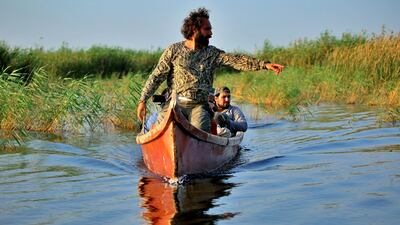
Iraqi environmentalist Omar Al Sheikhly leads a team into the marshes in search of endangered animals, in Chibayish. Without quick action, Mr Al Sheikhly fears the delicate underwater ecology of the Unesco-protected site will be disrupted. AP Photo -

A water buffalo walks on the remnants of an old military road built in the marshes by Saddam Hussein during the Iran-Iraq war, in Chibayish, Iraq. AP Photo -
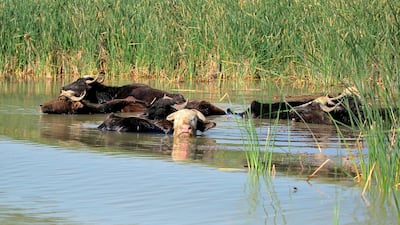
Water buffalos wade in the waters of the marshes after feeding on grass in Chibayish, Iraq. Conservationists issued a stark warning that without quick remedial action, the Unesco-protected site could wither away. AP Photo -
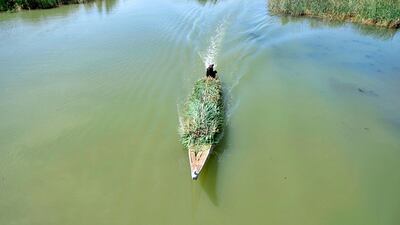
A member of Iraq's marsh communities collects reeds, which are typically sold or used locally in Chibayish, Iraq. Conservationists fear the Unesco-protected site could wither away without timely action. AP Photo -

Pied Kingfisher birds take flight from a marshland where the number of many bird species are on the decline, in Chibayish, Iraq. AP Photo -

Pied Kingfisher birds rest on trees extending from the marshes in Chibayish, Iraq. AP Photo -
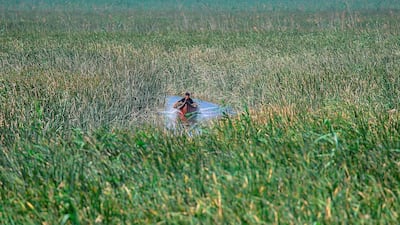
A man collects reeds from the wetlands that will later be sold or used for domestic use, in Chibayish, Iraq. AP Photo -
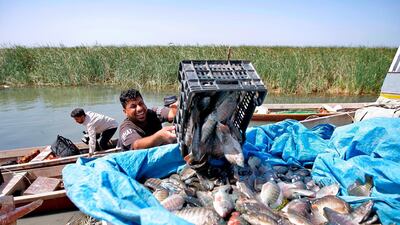
Fishermen unload the day's catch from the marshes on to vehicles in Chibayish, Iraq. AP Photo


After all, Iran itself has few coherent policies in place to protect its land and rivers from natural ravages. Tehran, therefore, has nothing to offer Washington as a partner. Its vulnerabilities from climate change will only grow.
At a time when the EU is in tandem pushing a €1.8 trillion ($2.1tn) green growth plan, the region is looking at how it can be a supplier to this development. A pipeline for hydrogen going across from Saudi Arabia through Jordan, for example, will boost all sides.
One of the most significant Biden appointments is that of Samantha Power as the head of USAID, a development agency with a seat in the White House National Security Council. This is a strong signal for a push to use extra aid as part of the American strategy in Syria, and perhaps Yemen. Establishing the alleviation of human suffering where possible and de-escalation of the conflict should allow for basic stabilisation efforts to follow on.
The stalled UN-led diplomatic process in Syria desperately needs Russian support to move forward. US commitment of resources to Syria, including the freedom of humanitarian shipments, is likely to provide a strong signal to Moscow.
Russia wants to position itself as a leader of reconstruction in Syria, as well as preserve the gains from its intervention in the conflict. The provision of American resources will only have a mobilising effect on Russian readiness to engage. There is little or no room for Iran in this dynamic.
As Mr Biden remarked recently, countries invest in diplomacy in their own self-interest. Global policies can drive a real engagement with the Middle East.
Damien McElroy is the London bureau chief at The National

