
Saad Hariri, a former Lebanese prime minister, could be tasked with forming a government this Thursday, filling a vacuum that has lasted since early August. The dynamics leading to this moment were released in a notable interview with Mr Hariri almost two weeks ago.
In that interview, Mr Hariri sent a number of messages – some blunt, others more subliminal. Many people expected him to say that he would not be a candidate for prime minister, as he had noted on several occasions previously since resigning in the wake of popular protests in October 2019.
This time, however, he insisted that he was the natural candidate for the post.
He did not even bother to confirm formally that he would stand, so obvious did it seem.
Mr Hariri’s announcement appeared to reflect a shift in the attitude of his regional supporters.
For a long time, Saudi Arabia had not been happy that he seemed to be the front man for a system, they believe, is in large measure controlled by Hezbollah.
That said, Saudi Arabian officials in Beirut had noted that there was no objection to Mr Hariri’s candidacy, as long as he returned to office with a clear programme to implement.
-
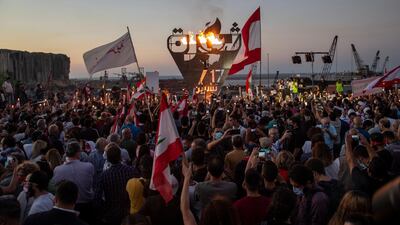
Lebanese anti-government protesters carry placards and hold a torch as they gather in front of a statue, representing the torch of the revolution, to mark the first anniversary of the anti-government protests, near the Beirut port. EPA -
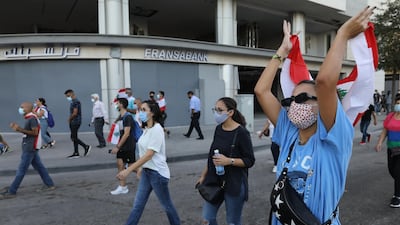
People wave Lebanese flags and chant to mark the first anniversary of anti-government protests in Beirut. Getty Images -
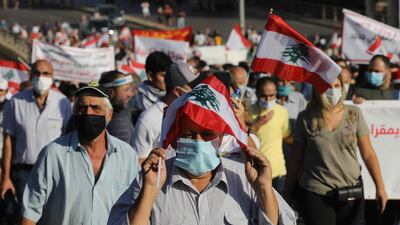
People wave Lebanese flags and chant to mark the first anniversary of anti-government protests. Getty Images -

People walk past a "Hope" graffiti painted on a fenced off entrance of a hotel that was damaged by the August 4 seaport blast on the first anniversary of anti-government protests. Getty Images -

People hold Lebanese flags and lit candles to mark the first anniversary of anti-government protests. Getty Images -
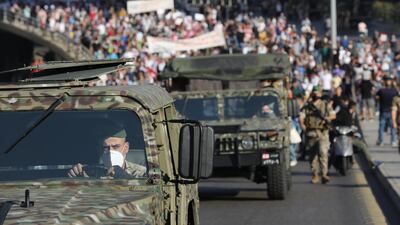
Lebanese army vehicles escort crowds walking over a bridge linking the city on the first anniversary of anti-government protests. Getty Images -
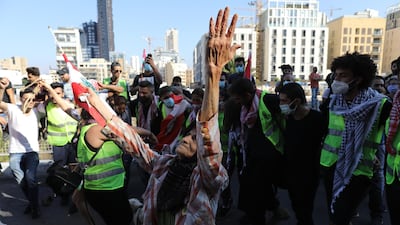
People wave Lebanese flags and chant to mark the first anniversary of anti-government protests. Getty Images -
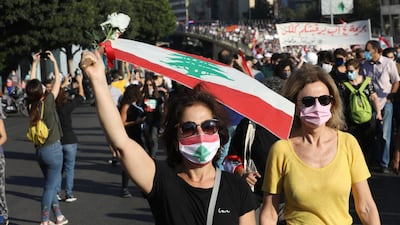
People wave Lebanese flags and chant to mark the first anniversary of anti-government protests. Getty Images -
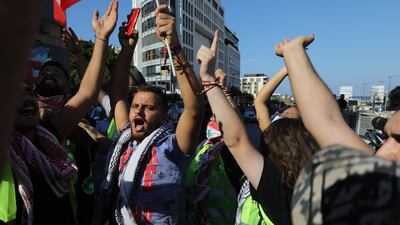
People wave Lebanese flags and chant to mark the first anniversary of anti-government protests. Getty Images -
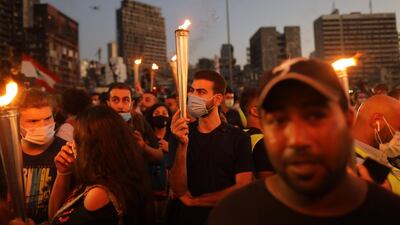
People hold Lebanese flags and lit candles to mark the first anniversary of anti-government protests. Getty Images -
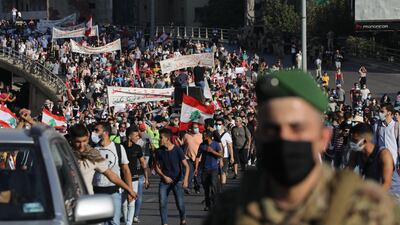
Lebanese army vehicles escort crowds walking over a bridge linking the city on the first anniversary of anti-government protests. Getty Images -
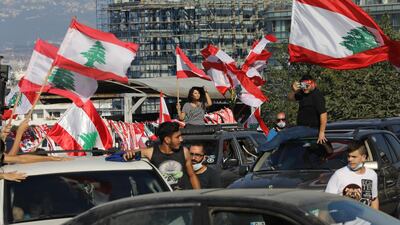
People wave Lebanese flags and chant to mark the first anniversary of anti-government protests. Getty Images -
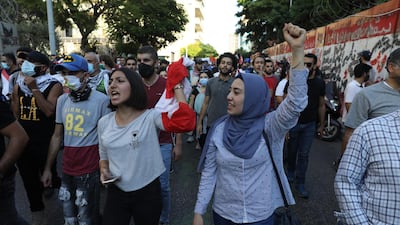
People hold Lebanese flags and chant as they mark the first anniversary of anti-government protests. Getty Images -
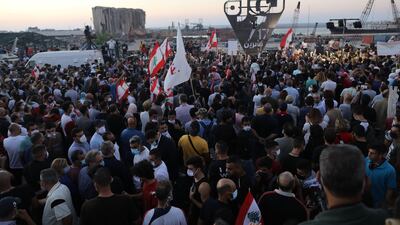
People wave Lebanese flags and chant to mark the first anniversary of anti-government protests with a background of the destroyed silos at Beirut port. Getty Images


Similarly, Mr Hariri’s attitude also signalled a possible shift in Washington. For the same reasons as Riyadh, the Trump administration had not been enthusiastic about Mr Hariri’s return.
Yet in the aftermath of his announcement, US officials declared their support for the quick formation of a Lebanese government, acknowledging that they had not objection to the former prime minister coming back.

What happened? Mr Hariri had strong French backing and He declared that he had a programme to implement: to move forward with the economic reform plan floated by French President Emmanuel Macron last September in Beirut. At the time, Mr Macron had hoped for the quick formation of a technocratic government to implement it, but this was derailed because of a disagreement between Hezbollah and the Amal Movement (the two main Lebanese Shia parties) and Mr Hariri.
In the aftermath of this setback, however, all sides reaffirmed that they wanted the French plan to succeed, which left a door open for Mr Hariri to throw his hat into the ring, with French encouragement.
Hezbollah and Amal welcomed this move, as it could calm sectarian tensions and side-line the possibility of their having to form another failed government opposed by a majority of Lebanese, similar to that of caretaker prime minister Hassan Diab.

There were two implicit messages in Mr Hariri’s interview. The first he directed at the political class, telling all parties that they should accept his return at the head of a government of technocrats in order to avoid the complete disintegration of the Lebanese economy. In other words, Mr Hariri was proposing a solution that would save the politicians from the consequences of such a collapse.
The second, Mr Hariri directed at his sometime allies Walid Jumblatt, the political leader of Lebanon’s Druze community, and the Lebanese Forces, a Christian party. Both had refused to support his comeback in the past, and he was harsh in implying that with or without their support he would form a government with Hezbollah and Amal.
The strong implication was that both of them, representatives of minority groups, had no interest in opposing an agreement between the major Sunni and Shia parties.
On October 16, President Michel Aoun was scheduled to hold parliamentary consultations to name a prime minister.
However, Mr Aoun, realising that Mr Hariri would be anointed and that his son-in-law Gebran Bassil would have no say in the matter, delayed consultations until October 22. In that way he sought to buy time for Mr Bassil to secure his stake in a new Hariri government.
Mr Bassil and Mr Hariri are on bad terms, and one of the conditions the former prime minister had for taking office was that Mr Bassil not control the energy ministry. Mr Bassil’s ambition is to become president, and he could use such control as leverage to secure Mr Hariri’s support for his candidacy. Yet reform of the ministry is also a central aspect of the Macron plan, so Mr Hariri’s priority was always to block a return of Mr Bassil or one of his appointees.
What may have changed is that Hezbollah, which had often supported Mr Bassil against Mr Hariri, appears unwilling to do so this time around. Partly, that’s because the party wants to avoid a complete economic breakdown, which could threaten Lebanon’s stability and therefore its own dominant role in it. Partly, it is because Hezbollah’s priority today is to retain political Shia unity, and therefore to side with Mr Bassil’s bitterest rival, the Parliament Speaker Nabih Berri.
And partly it is because Hezbollah wants to preserve Sunni-Shia relations in Lebanon at a time of regional volatility and on the eve of US elections. Only time will tell whether Mr Hariri’s gamble succeeds and Lebanon can take steps toward a deal with the International Monetary Fund. For now, the political victim of this consensus appears to be Mr Bassil. If reform is the ruling class’s sole path to self-preservation, Lebanon may see more change than had seemed possible.
Michael Young is a senior editor at the Carnegie Middle East Centre in Beirut and a columnist for The National

