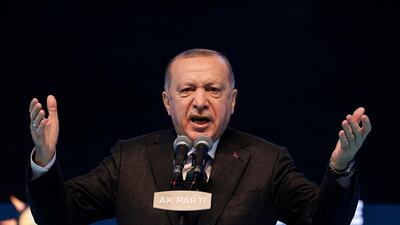
European leaders Charles Michel and Ursula Von der Leyen are set to meet Turkish President Recep Tayyip Erdogan in Ankara on Tuesday as the Turkish government aims to continue to revive ties with the West, which hit a new low last year when Turkey purchased Russian missile defences and came to the brink of war with Greece.
The US and EU have in recent weeks praised Turkey’s efforts to calm tensions in the eastern Mediterranean, where Turkish vessels have stopped drilling in waters claimed by Cyprus and Greece. Turkish and Greek delegations have met twice for diplomatic talks. And following a leaders summit last month, the EU issued a hopeful statement about restarting negotiations with Turkey on issues including migration management, the customs union and visa-free travel.
Yet domestically the momentum appears to be headed in the other direction. In the past few weeks, Turkey has: moved to shut down the third largest party in parliament, the pro-Kurdish People’s Democratic Party (HDP); stripped human rights activist and HDP member Omer Faruk Gergerlioglu of his parliamentary seat, sent him to prison for a 2016 tweet and forcibly taken him from his home; sentenced several journalists to jail; and pulled out of the world’s leading global compact to combat violence against women, the Istanbul Convention.
Finally, last week Devlet Bahceli, the leader of the far-right Nationalist Movement Party (MHP) and the driving force behind the effort to ban the HDP, called for the country’s top court to be shut down. This explains why a group of 20 rights watchdogs, including Human Rights Watch, Article 19 and Reporters Without Borders, penned a letter urging the visiting EU chiefs to prioritise rights and freedoms in their relations with Turkey.
These developments may be a prelude to political jockeying. The ruling Justice and Development Party (AKP) has been in desperate need of its parliamentary partner, the MHP. But in recent weeks the polling numbers of the ruling Nation Alliance have fallen to 45 per cent or less and for Mr Erdogan, the MHP and Mr Bahceli may have become political baggage.
Insiders say Mr Erdogan and the AKP have already begun casting about for a new parliamentary partner
Turkish nationalists had since the Second World War been pro-West and pro-Nato. But today the dominant strain of nationalists, as represented by the MHP, sees the US and EU as implicated in the 2016 failed coup and is no longer wedded to the idea of Turkey in the West. This aligns with Turkey’s Blue Homeland doctrine, which sees Greece and the West as a threat to Turkey’s regional dominance and thus the need for renewed military, and particularly maritime, strength.
The isolated, 73-year-old Mr Bahceli may be increasingly out of touch with Turkey's population, more than half of which is under 30. As mentioned in a recent column, Meral Aksener's Good Party has come to represent a hipper, more worldly and Western-leaning style of Turkish nationalist. Mr Bahceli, on the other hand, hearkens back to the instability and violence of Turkey's 70s and 80s and to the strongman era of Middle East politics.
Appreciating the extent to which Nato-member Turkey needs solid relations with the US and its top trade partner, the EU, Mr Erdogan has begun to shift away from all that, with less assertiveness in the eastern Mediterranean and efforts to improve ties with Western allies like Israel, Saudi Arabia, and the UAE. Later this month, Turkey will host Afghan peace talks and join UN-led talks on resolving Cyprus.
Will Mr Erdogan go one step further and drop the MHP? Thanks to a pandemic-driven increase in poverty and shaky financial markets, Turkey watchers generally agree that, barring more repressive measures or some sort of pivot, the AKP is doomed to fall in the next election, set for mid-2023.
Insiders say Mr Erdogan and the AKP have already begun casting about for a new parliamentary partner. Former HDP co-leader and presidential candidate Selahattin Demirtas, who has been in prison for more than four years, said in an interview last week that the AKP had reached out to several opposition parties about working together to pass a new constitution that would reinstall the parliamentary system.
This would put an end to the executive presidential system installed via a 2017 referendum, which all but negated parliament and put so much power in the hands of Turkey's leader. Might Mr Erdogan willingly give up the power he worked so hard to attain? Would he really choose to reverse Turkey's decade-long authoritarian drift – of which he was the main driver and beneficiary?
He might well go in the opposite direction – double down on the democratic backsliding and become a despot. But let's not forget that in the 2000s Turkey made democratic reforms that put it on the fast-track to EU membership and Mr Erdogan was hailed as the great symbol of hope for Muslim democracy.
“Turkey has defied all analytical assumptions over the past decade,” says Asli Aydintasbas, senior fellow at the European Council on Foreign Relations. “It was the poster child of rising democracy, and today it’s the poster child of rising authoritarianism. Who knows what the story will be.”
Mr Erdogan is desperate to still be president in late 2023, when the Turkish Republic will mark its centennial – an event he has been talking up for years. The pressure applied by the threat of sanctions and other punishments from the US and EU is considerable, and the threat of losing the next vote is real.
After nearly two decades in power, is Mr Erdogan desperate enough to shape-shift yet again and embrace liberal democracy to stay on top? It may sound ludicrous, but nothing is impossible when it comes to Turkish politics.
David Lepeska is a Turkish and Eastern Mediterranean affairs columnist for The National

Three tips from La Perle's performers
1 The kind of water athletes drink is important. Gwilym Hooson, a 28-year-old British performer who is currently recovering from knee surgery, found that out when the company was still in Studio City, training for 12 hours a day. “The physio team was like: ‘Why is everyone getting cramps?’ And then they realised we had to add salt and sugar to the water,” he says.
2 A little chocolate is a good thing. “It’s emergency energy,” says Craig Paul Smith, La Perle’s head coach and former Cirque du Soleil performer, gesturing to an almost-empty open box of mini chocolate bars on his desk backstage.
3 Take chances, says Young, who has worked all over the world, including most recently at Dragone’s show in China. “Every time we go out of our comfort zone, we learn a lot about ourselves,” she says.
GOODBYE%20JULIA
%3Cp%3E%3Cstrong%3EDirector%3A%20%3C%2Fstrong%3EMohamed%20Kordofani%3C%2Fp%3E%0A%3Cp%3E%3Cstrong%3EStarring%3A%20%3C%2Fstrong%3ESiran%20Riak%2C%20Eiman%20Yousif%2C%20Nazar%20Goma%3C%2Fp%3E%0A%3Cp%3E%3Cstrong%3ERating%3A%3C%2Fstrong%3E%205%2F5%3C%2Fp%3E%0A
Islamophobia definition
A widely accepted definition was made by the All Party Parliamentary Group on British Muslims in 2019: “Islamophobia is rooted in racism and is a type of racism that targets expressions of Muslimness or perceived Muslimness.” It further defines it as “inciting hatred or violence against Muslims”.
Mercer, the investment consulting arm of US services company Marsh & McLennan, expects its wealth division to at least double its assets under management (AUM) in the Middle East as wealth in the region continues to grow despite economic headwinds, a company official said.
Mercer Wealth, which globally has $160 billion in AUM, plans to boost its AUM in the region to $2-$3bn in the next 2-3 years from the present $1bn, said Yasir AbuShaban, a Dubai-based principal with Mercer Wealth.
“Within the next two to three years, we are looking at reaching $2 to $3 billion as a conservative estimate and we do see an opportunity to do so,” said Mr AbuShaban.
Mercer does not directly make investments, but allocates clients’ money they have discretion to, to professional asset managers. They also provide advice to clients.
“We have buying power. We can negotiate on their (client’s) behalf with asset managers to provide them lower fees than they otherwise would have to get on their own,” he added.
Mercer Wealth’s clients include sovereign wealth funds, family offices, and insurance companies among others.
From its office in Dubai, Mercer also looks after Africa, India and Turkey, where they also see opportunity for growth.
Wealth creation in Middle East and Africa (MEA) grew 8.5 per cent to $8.1 trillion last year from $7.5tn in 2015, higher than last year’s global average of 6 per cent and the second-highest growth in a region after Asia-Pacific which grew 9.9 per cent, according to consultancy Boston Consulting Group (BCG). In the region, where wealth grew just 1.9 per cent in 2015 compared with 2014, a pickup in oil prices has helped in wealth generation.
BCG is forecasting MEA wealth will rise to $12tn by 2021, growing at an annual average of 8 per cent.
Drivers of wealth generation in the region will be split evenly between new wealth creation and growth of performance of existing assets, according to BCG.
Another general trend in the region is clients’ looking for a comprehensive approach to investing, according to Mr AbuShaban.
“Institutional investors or some of the families are seeing a slowdown in the available capital they have to invest and in that sense they are looking at optimizing the way they manage their portfolios and making sure they are not investing haphazardly and different parts of their investment are working together,” said Mr AbuShaban.
Some clients also have a higher appetite for risk, given the low interest-rate environment that does not provide enough yield for some institutional investors. These clients are keen to invest in illiquid assets, such as private equity and infrastructure.
“What we have seen is a desire for higher returns in what has been a low-return environment specifically in various fixed income or bonds,” he said.
“In this environment, we have seen a de facto increase in the risk that clients are taking in things like illiquid investments, private equity investments, infrastructure and private debt, those kind of investments were higher illiquidity results in incrementally higher returns.”
The Abu Dhabi Investment Authority, one of the largest sovereign wealth funds, said in its 2016 report that has gradually increased its exposure in direct private equity and private credit transactions, mainly in Asian markets and especially in China and India. The authority’s private equity department focused on structured equities owing to “their defensive characteristics.”
Who has lived at The Bishops Avenue?
- George Sainsbury of the supermarket dynasty, sugar magnate William Park Lyle and actress Dame Gracie Fields were residents in the 1930s when the street was only known as ‘Millionaires’ Row’.
- Then came the international super rich, including the last king of Greece, Constantine II, the Sultan of Brunei and Indian steel magnate Lakshmi Mittal who was at one point ranked the third richest person in the world.
- Turkish tycoon Halis Torprak sold his mansion for £50m in 2008 after spending just two days there. The House of Saud sold 10 properties on the road in 2013 for almost £80m.
- Other residents have included Iraqi businessman Nemir Kirdar, singer Ariana Grande, holiday camp impresario Sir Billy Butlin, businessman Asil Nadir, Paul McCartney’s former wife Heather Mills.
Hunting park to luxury living
- Land was originally the Bishop of London's hunting park, hence the name
- The road was laid out in the mid 19th Century, meandering through woodland and farmland
- Its earliest houses at the turn of the 20th Century were substantial detached properties with extensive grounds
10 tips for entry-level job seekers
- Have an up-to-date, professional LinkedIn profile. If you don’t have a LinkedIn account, set one up today. Avoid poor-quality profile pictures with distracting backgrounds. Include a professional summary and begin to grow your network.
- Keep track of the job trends in your sector through the news. Apply for job alerts at your dream organisations and the types of jobs you want – LinkedIn uses AI to share similar relevant jobs based on your selections.
- Double check that you’ve highlighted relevant skills on your resume and LinkedIn profile.
- For most entry-level jobs, your resume will first be filtered by an applicant tracking system for keywords. Look closely at the description of the job you are applying for and mirror the language as much as possible (while being honest and accurate about your skills and experience).
- Keep your CV professional and in a simple format – make sure you tailor your cover letter and application to the company and role.
- Go online and look for details on job specifications for your target position. Make a list of skills required and set yourself some learning goals to tick off all the necessary skills one by one.
- Don’t be afraid to reach outside your immediate friends and family to other acquaintances and let them know you are looking for new opportunities.
- Make sure you’ve set your LinkedIn profile to signal that you are “open to opportunities”. Also be sure to use LinkedIn to search for people who are still actively hiring by searching for those that have the headline “I’m hiring” or “We’re hiring” in their profile.
- Prepare for online interviews using mock interview tools. Even before landing interviews, it can be useful to start practising.
- Be professional and patient. Always be professional with whoever you are interacting with throughout your search process, this will be remembered. You need to be patient, dedicated and not give up on your search. Candidates need to make sure they are following up appropriately for roles they have applied.
Arda Atalay, head of Mena private sector at LinkedIn Talent Solutions, Rudy Bier, managing partner of Kinetic Business Solutions and Ben Kinerman Daltrey, co-founder of KinFitz
Joy%20Ride%20
%3Cp%3E%3Cstrong%3EDirector%3A%3C%2Fstrong%3E%20Adele%20Lim%3Cbr%3E%3Cstrong%3EStars%3A%20%3C%2Fstrong%3EAshley%20Park%2C%20Sherry%20Cola%2C%20Stephanie%20Hsu%2C%20Sabrina%20Wu%3Cbr%3E%3Cstrong%3ERating%3A%20%3C%2Fstrong%3E4%2F5%3C%2Fp%3E%0A
Cinco in numbers
Dh3.7 million
The estimated cost of Victoria Swarovski’s gem-encrusted Michael Cinco wedding gown
46
The number, in kilograms, that Swarovski’s wedding gown weighed.
1,000
The hours it took to create Cinco’s vermillion petal gown, as seen in his atelier [note, is the one he’s playing with in the corner of a room]
50
How many looks Cinco has created in a new collection to celebrate Ballet Philippines’ 50th birthday
3,000
The hours needed to create the butterfly gown worn by Aishwarya Rai to the 2018 Cannes Film Festival.
1.1 million
The number of followers that Michael Cinco’s Instagram account has garnered.
CREW
%3Cp%3E%3Cstrong%3EDirector%3A%20%3C%2Fstrong%3ERajesh%20A%20Krishnan%3C%2Fp%3E%0A%3Cp%3E%3Cstrong%3EStarring%3A%20%3C%2Fstrong%3ETabu%2C%20Kareena%20Kapoor%20Khan%2C%20Kriti%20Sanon%26nbsp%3B%3C%2Fp%3E%0A%3Cp%3E%3Cstrong%3ERating%3A%3C%2Fstrong%3E%203.5%2F5%3C%2Fp%3E%0A
Uefa Nations League: How it works
The Uefa Nations League, introduced last year, has reached its final stage, to be played over five days in northern Portugal. The format of its closing tournament is compact, spread over two semi-finals, with the first, Portugal versus Switzerland in Porto on Wednesday evening, and the second, England against the Netherlands, in Guimaraes, on Thursday.
The winners of each semi will then meet at Porto’s Dragao stadium on Sunday, with the losing semi-finalists contesting a third-place play-off in Guimaraes earlier that day.
Qualifying for the final stage was via League A of the inaugural Nations League, in which the top 12 European countries according to Uefa's co-efficient seeding system were divided into four groups, the teams playing each other twice between September and November. Portugal, who finished above Italy and Poland, successfully bid to host the finals.
RedCrow Intelligence Company Profile
Started: 2016
Founders: Hussein Nasser Eddin, Laila Akel, Tayeb Akel
Based: Ramallah, Palestine
Sector: Technology, Security
# of staff: 13
Investment: $745,000
Investors: Palestine’s Ibtikar Fund, Abu Dhabi’s Gothams and angel investors
Key findings
- Over a period of seven years, a team of scientists analysed dietary data from 50,000 North American adults.
- Eating one or two meals a day was associated with a relative decrease in BMI, compared with three meals. Snacks count as a meal. Likewise, participants who ate more than three meals a day experienced an increase in BMI: the more meals a day, the greater the increase.
- People who ate breakfast experienced a relative decrease in their BMI compared with “breakfast-skippers”.
- Those who turned the eating day on its head to make breakfast the biggest meal of the day, did even better.
- But scrapping dinner altogether gave the best results. The study found that the BMI of subjects who had a long overnight fast (of 18 hours or more) decreased when compared even with those who had a medium overnight fast, of between 12 and 17 hours.
Emergency phone numbers in the UAE
Estijaba – 8001717 – number to call to request coronavirus testing
Ministry of Health and Prevention – 80011111
Dubai Health Authority – 800342 – The number to book a free video or voice consultation with a doctor or connect to a local health centre
Emirates airline – 600555555
Etihad Airways – 600555666
Ambulance – 998
Knowledge and Human Development Authority – 8005432 ext. 4 for Covid-19 queries
More on Quran memorisation:
