
Only weeks ago, Benjamin Netanyahu was a hair's breadth from being ousted from the Israeli Prime Minister's Office in disgrace, after 11 years of continuous rule. But after a dramatic turnaround in fortunes last week – that saw him signing a pact with Benny Gantz, his chief political rival – Mr Netanyahu has begun to rapidly consolidate his power.
In what many critics fear amounts to a power grab, he began pushing through changes on Thursday to Israel’s basic laws, the equivalent of a constitution. The move was described as “terrifying” by Elyakim Rubinstein, a conservative former supreme court judge.
Another commentator warned that, under cover of forming an "emergency government" to deal with the coronavirus epidemic, Mr Netanyahu had driven Israel into the early stages of totalitarianism.

What has especially alarmed observers is the apparent ease with which Mr Netanyahu has manoeuvred Mr Gantz, a former general, into rubber-stamping the new arrangements.
Mr Gantz led a bloc of parties whose anti-corruption platform expressly promised to bring down Mr Netanyahu, who is due to stand trial on bribery, fraud and breach of trust charges in a month's time. After an election in March, the third in a year, Mr Gantz vowed to use his bloc's 62-seat majority to pass a law making it impossible for a criminal defendant to serve as prime minister.
Mr Netanyahu was on the backfoot, too, fearful of a fourth election in the late summer when he risks being blamed for the expected collapse of the Israeli economy after more than a month of lockdowns.
Instead, Mr Gantz has caved. He has not only secured Mr Netahyahu at least another 18 months in office but, in the words of one Israeli commentator, has offered to serve as his "bodyguard".
The coalition agreement means Mr Gantz cannot dislodge Mr Netanyahu during the government’s three-year term. The two stand or fall together. That gives Mr Netanyahu a solid advantage in his court proceedings, as he fights the case not only with the authority of a prime minister but with Mr Gantz’s complicit silence.
Even if Mr Netanyahu is found guilty, Mr Gantz’s faction is barred from ousting him or voting to bring down the coalition, leaving Mr Netanyahu free to launch an appeal from within the government. Likewise, under a rotation agreement, Mr Gantz must let Mr Netanyahu serve out the second 18-month period as his deputy. Assuming, that is, that Mr Netanyahu steps back.
Despite some two-thirds of Israelis supporting the emergency government, a poll shows more than 40 per cent doubt Mr Netanyahu will honour his commitment to hand over power. In any case, even as Mr Gantz’s deputy, Mr Netanyahu will have the allegiance of the vast majority of the governing coalition’s legislators. He could still be in the driving seat.
Most expect him to use his position to intensify his long-running campaign to demonise the courts, accusing them of overseeing an undemocratic, “leftist” plot to unseat him.
-
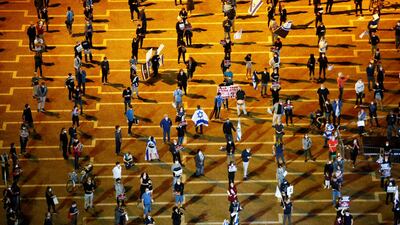
Israelis demonstrate against Israel's Prime Minister Benjamin Netanyahu, under strict restrictions made to slow down the coronavirus spread, on Rabin Square in Tel Aviv, Israel April 19, 2020 REUTERS -
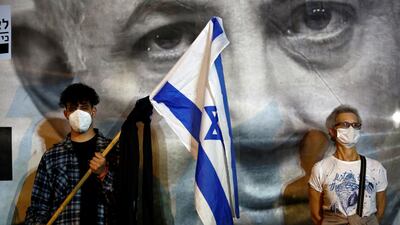
A man wearing a protective face mask holds an Israel's flag as Israelis demonstrate against Israel's Prime Minister Benjamin Netanyahu, under strict restrictions made to slow down the Covid-19 spread, on Rabin Square in Tel Aviv, Israel April 19, 2020 REUTERS -

Israelis hold up their mobile phones as they demonstrate against Israel's Prime Minister Benjamin Netanyahu, under strict restrictions made to slow down the coronavirus spread, on Rabin Square in Tel Aviv, Israel April 19, 2020. REUTERS -
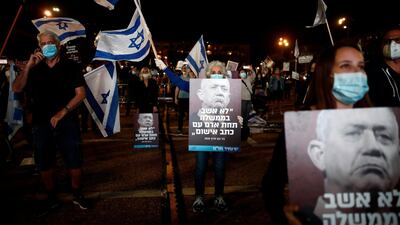
Israelis hold posters with the picture of Benny Gantz, head of the Blue and White party, that read: "I would not sit in a government under a man with criminal indictment", as they protest against Israel's Prime Minister Benjamin Netanyahu, under strict restrictions made to slow down the coronavirus spread, on Rabin Square in Tel Aviv, Israel April 19, 2020. REUTERS -
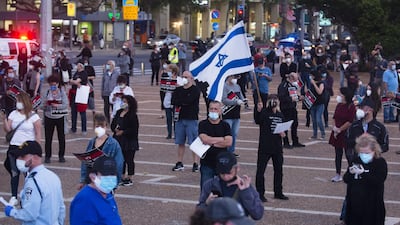
Israelis protest at a rally in Rabin Square on April 19, 2020 in Tel Aviv, Israel. Getty Images -
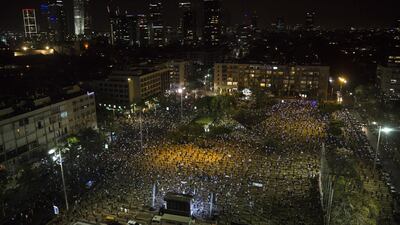
Israelis light flash lights as they protest at a rally in Rabin Square on April 19, 2020 in Tel Aviv, Israel. Getty Images -
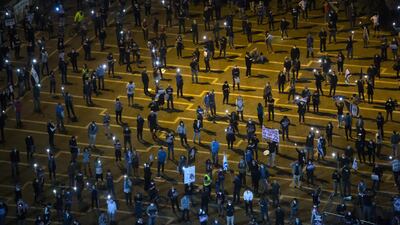
Thousands of Israelis gather at an Anti-Corruption rally under coronavirus restrictions. Getty Images -
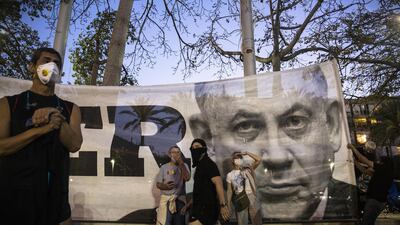
Israelis protest at a rally in Rabin Square on April 19, 2020 in Tel Aviv, Israel. Getty Images -
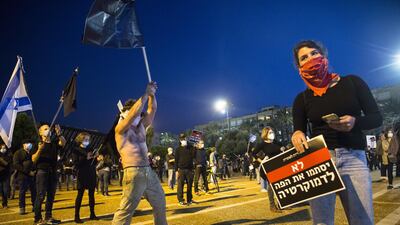
Thousands of Israelis gather at an Anti-Corruption rally under coronavirus restrictions, decries proposed unity government talks between Israeli Prime Minister, Benjamin Netanyahu, and Blue and White Party leader, Benny Gantz. Getty Images


To an increasing number of Israelis, the country’s political system looks broken. Several thousand of Mr Gantz’s former supporters defied Israel’s lockdown at the weekend – as they did the week before – to attend a rally in central Tel Aviv.
Standing on marked positions to maintain two metres' distance, they protested Mr Netanyahu's increasing accumulation of powers. Carmi Gillon, a former head of Israel's domestic spy agency, the Shin Bet, told the crowd the courts were now all that left to "defend Israeli democracy before it is finally crushed".
Critics note that the Shin Bet have already been given an unprecedented right – previously available for use only against Palestinians – to track Israeli citizens.
Combined with anti-coronavirus restrictions, opponents fear Mr Netanyahu is establishing a security regime at home that can be used to oppress dissenters. They point to his imminent trial, noting that most of the charges relate to his alleged efforts to intimidate or bribe major Israeli media outlets into becoming little more than his personal cheerleaders.
-
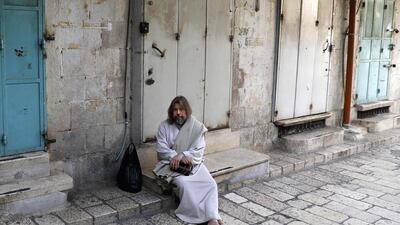
A man sits in front of closed shops in Jerusalem's Old City, amid measures to stem the spread of coronavirus, on March 27, 2020. AFP -
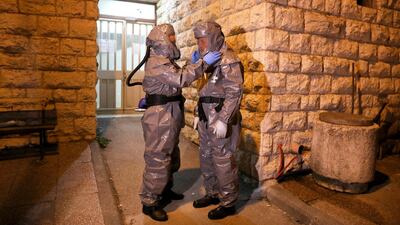
Ultra-orthodox Jewish members of the religious burial organisation Hevra Kadishah wear protective suits as they prepare to carry the coffin of 72-year-old French rabbi Masoud Hamu, who died from Covid-19, at a funeral home in Jerusalem, on March 26, 2020. EPA -
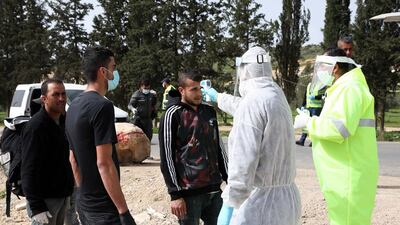
Palestinian health ministry workers check the temperatures of men crossing the Tarqumiya checkpoint, near Hebron, West Bank, on March 27, 2020. EPA -
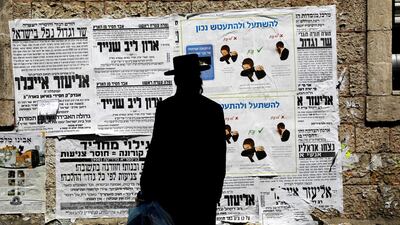
A Jewish ultraorthodox man looks onto a local billboard with instructions related to coronavirus in the Orthodox Jewish neighbourhood of Jerusalem on March 27, 2020. Reuters -
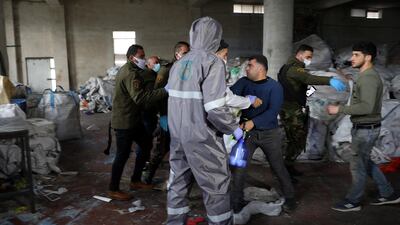
Palestinian security forces attempt to arrest a shop owner who did not abide by a national lockdown, in Hebron, West Bank, on March 28, 2020. EPA -
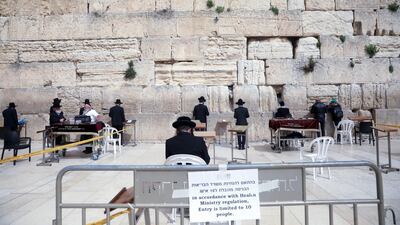
Ultra-orthodox Jews practice social distancing while praying at the Western Wall in Jerusalem. AP Photo -
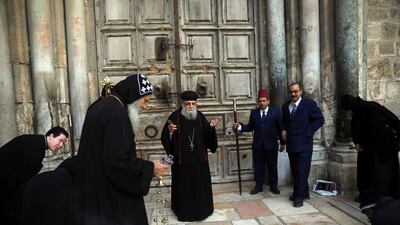
Coptic priests hold a mass outside a closed Church of the Holy Sepulchre, in Jerusalem, on March 28, 2020. AP Photo -

A man feeds pigeons at an empty parking lot in Tel Aviv, Israel, on March 28, 2020, as the country largely shuts down to avoid the spread of coronavirus. AP Photo -

Ultra-orthodox Jews, wearing traditional prayer shawls, pray outside their closed synagogue, following instructions to stop the spread of coronavirus by keeping a distance of two meters from one another, in Jerusalem on March 29, 2020. AFP -
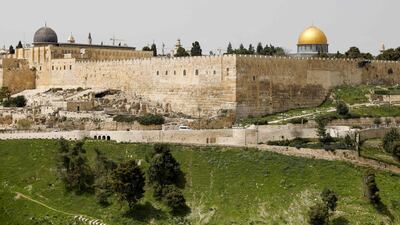
A picture taken on March 27, 2020 shows a view of the Dome of the Rock and Al Aqsa mosque in Jerusalem amid measures to stem the spread of coronavirus. AFP


Meanwhile, other checks on the executive branch he heads are being sacrificed on the altar of the emergency government.
Despite being a criminal defendant, Mr Netanyahu will have a veto on the appointment of the two most senior law-enforcement officials – the state prosecutor and attorney general – who are supposed to oversee the case against him at trial.
Mr Netanyahu has already installed an acting prosecutor considered loyal to him who, according to the coalition agreement, cannot be removed for many months. Israeli commentators have expressed little faith that he will prosecute Mr Netanyahu with full vigour.
Mr Netanyahu will also continue to wield control over the appointment of judges to the Supreme Court, which has been drifting ever further rightwards after more than a decade of Mr Netanyahu’s influence.

In these circumstances, the courts may baulk at the prospect of inflaming a constitutional crisis – and possibly civil war – by trying to remove a sitting prime minister. With the judicial and legal branches increasingly enfeebled, the coalition agreement also strips the Israeli parliament, the Knesset, of any meaningful oversight. The government will be able to strangle legislative proposals at birth, before they can be debated. Unusually the main parliamentary committees will be under the governing parties’ control, too. And again unusually, a Netanyahu loyalist will be the Knesset Speaker.
But the coalition agreement does allow for one emergency legislative move unrelated to tackling the virus: annexation of swaths of the West Bank in violation of international law but under licence from the "vision for peace" published earlier in the year by US President Donald Trump.
The government can set forth an annexation plan from July – well before Mr Trump faces a re-election contest in the US in November. Mike Pompeo, his Secretary of State, offered what appeared to be Washington's blessing for fast-track annexation last week.
While Mr Gantz headed the opposition bloc, he refused to rule out annexation, expressing concern only that it would prove unpalatable to some western allies.
But aside from formulaic denunciations from a few European states, Israel fears little in the way of repercussions. And Mr Gantz now appears on board.
As defence minister, he will be responsible for crushing any Palestinian resistance to Israel’s annexation moves, while Gabi Ashkenazi, his political ally and another former general, will be responsible as foreign minister for putting a respectable face on the annexation drive in overseas capitals.
Mr Netanyahu appears to have the wind behind him, and three more years in which to meddle in ways that could see him maintaining his grip on the Israeli Prime Minister’s Office well beyond that.
Jonathan Cook is a freelance journalist in Nazareth

