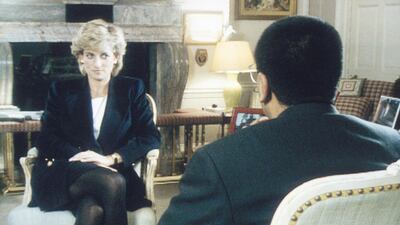
Martin Bashir interviews Princess Diana in Kensington Palace for the BBC's 'Panorama' programme. Getty Images

Diana interview: The world needs the BBC to reform


  • English
  • Arabic

The BBC is hardly a stranger to crises of various kinds and rows with powerful political figures. Former prime minister Margaret Thatcher was furious when the BBC interviewed IRA terrorists in Northern Ireland and gave them – as she put it – the “oxygen of publicity".

Over the years when I presented what was billed as the BBC's "flagship" TV news and current affairs programme, Newsnight, our editors made two catastrophic errors. One editor halted an investigation into the popular BBC TV personality Jimmy Savile because – in that editor's view – the researchers had not found enough evidence that Savile was a sexual predator. When that evidence did emerge, the BBC's failures were brutally exposed. Then the BBC ran a report wrongly claiming a leading Conservative member of the House of Lords was himself a sexual predator. He wasn't. The accusations were utterly false, and after this shameful episode, George Entwistle, the BBC director general at the time, was forced to quit after only 54 days in the job.

However, none of these crises is as serious as the way in which the BBC's reputation has been damaged by the extraordinary events surrounding the famous interview with the late Princess Diana a generation ago on the BBC's Panorama programme.

The Panorama reporter, Martin Bashir, secured the "scoop of the century" in 1995. It was the first time a serving member of the British royal family had spoken out on television candidly about her unhappy marriage and other usually private matters. Tens of millions of people around the world watched this BBC scoop, but from the start there were rumours about how the interview was obtained.

As we now know for certain, Bashir forged documents to try to persuade Diana to take part. His conduct was despicable. An organisation based on truth and facts cannot conduct its business through deceit.

Bashir left the BBC to work in the US for many years, yet he was re-employed by the BBC as a religious affairs correspondent in 2016 despite some senior figures – including the then BBC director general Tony Hall – knowing of the serious allegations against him.

Following a new inquiry, Diana's son, Prince William, has been justifiably outraged. His mother was failed "by leaders at the BBC who looked the other way rather than asking the tough questions", he said, and the BBC contributed to the "fear, paranoia and isolation" that blighted his mother's life.

This sorry affair has deeply disappointed those who – like me – generally admire the BBC. It has also delighted the corporation’s enemies. These enemies include some British newspapers who are hopeful that the BBC will now be much diminished – even though these same newspaper journalists and editors themselves made Diana’s life a misery. Her story, her beauty and her unhappiness sold their papers to a public hungry for every detail about her life.

A 1995 file photo showing a selection of front pages of most of Britain's national newspapers. AP Photo

This is the worst BBC crisis I can think of, and it comes at the worst possible time.

The very idea of public service broadcasting worldwide is being questioned as never before. From Netflix and podcasts to new privately funded radio and TV channels, the idea of British people paying a licence fee – in effect, a tax – to fund the BBC has been undermined by technology as well as by commercial competitors. In the US, the impact of Fox News and similar outlets has been to downgrade hard, factual journalism and replace it with fact-free and loudmouthed opinions. The result has been the polarisation of American public life, and a loss of trust in truth itself.

This is an existential crisis for an organisation that has been a pillar of British democracy and a beacon to much of the world for a century

All this means that the new director general, Tim Davie, has three urgent tasks to ensure the BBC’s survival.

First, he has to reassure the British public who pay for the corporation, that he will make sure such conduct never happens again. That may mean setting up a new independent supervisory board of some kind.

Second, he has to demonstrate to the government and Parliament that the BBC can produce new regulatory arrangements independent enough to root out bad conduct.

Third, he has to reassure BBC staff that honest and hard-hitting journalism is still possible, because if the BBC is neutered, the best and brightest creative minds will go elsewhere.

None of this will be easy but this is an existential crisis for an organisation that has been a pillar of British democracy and a beacon to much of the world for a century. Politicians are already talking about cutting or freezing the BBC's funding. BBC journalists are worried that a diminished or cowed corporation will be too scared to scrutinise political figures for fear of yet another row and the government's revenge.

Davie has managed – at last – to address the 25 years of rumours and innuendo about Bashir’s conduct, and what seems to me to be the inexplicable decision to re-employ Bashir in 2016. The next few months will decide whether he can build on the BBC’s glorious past and steer it through the troubles of the present to turn public service broadcasting towards a better future.

Gavin Esler is a broadcaster and UK columnist for The National

Tamkeen's offering
  • Option 1: 70% in year 1, 50% in year 2, 30% in year 3
  • Option 2: 50% across three years
  • Option 3: 30% across five years 
The specs

Engine: 2-litre 4-cylinder and 3.6-litre 6-cylinder

Power: 220 and 280 horsepower

Torque: 350 and 360Nm

Transmission: eight-speed automatic

Price: from Dh136,521 VAT and Dh166,464 VAT 

On sale: now

Global state-owned investor ranking by size

1.

United States

2.

China

3.

UAE

4.

Japan

5

Norway

6.

Canada

7.

Singapore

8.

Australia

9.

Saudi Arabia

10.

South Korea

Mercer, the investment consulting arm of US services company Marsh & McLennan, expects its wealth division to at least double its assets under management (AUM) in the Middle East as wealth in the region continues to grow despite economic headwinds, a company official said.

Mercer Wealth, which globally has $160 billion in AUM, plans to boost its AUM in the region to $2-$3bn in the next 2-3 years from the present $1bn, said Yasir AbuShaban, a Dubai-based principal with Mercer Wealth.

Within the next two to three years, we are looking at reaching $2 to $3 billion as a conservative estimate and we do see an opportunity to do so,” said Mr AbuShaban.

Mercer does not directly make investments, but allocates clients’ money they have discretion to, to professional asset managers. They also provide advice to clients.

“We have buying power. We can negotiate on their (client’s) behalf with asset managers to provide them lower fees than they otherwise would have to get on their own,” he added.

Mercer Wealth’s clients include sovereign wealth funds, family offices, and insurance companies among others.

From its office in Dubai, Mercer also looks after Africa, India and Turkey, where they also see opportunity for growth.

Wealth creation in Middle East and Africa (MEA) grew 8.5 per cent to $8.1 trillion last year from $7.5tn in 2015, higher than last year’s global average of 6 per cent and the second-highest growth in a region after Asia-Pacific which grew 9.9 per cent, according to consultancy Boston Consulting Group (BCG). In the region, where wealth grew just 1.9 per cent in 2015 compared with 2014, a pickup in oil prices has helped in wealth generation.

BCG is forecasting MEA wealth will rise to $12tn by 2021, growing at an annual average of 8 per cent.

Drivers of wealth generation in the region will be split evenly between new wealth creation and growth of performance of existing assets, according to BCG.

Another general trend in the region is clients’ looking for a comprehensive approach to investing, according to Mr AbuShaban.

“Institutional investors or some of the families are seeing a slowdown in the available capital they have to invest and in that sense they are looking at optimizing the way they manage their portfolios and making sure they are not investing haphazardly and different parts of their investment are working together,” said Mr AbuShaban.

Some clients also have a higher appetite for risk, given the low interest-rate environment that does not provide enough yield for some institutional investors. These clients are keen to invest in illiquid assets, such as private equity and infrastructure.

“What we have seen is a desire for higher returns in what has been a low-return environment specifically in various fixed income or bonds,” he said.

“In this environment, we have seen a de facto increase in the risk that clients are taking in things like illiquid investments, private equity investments, infrastructure and private debt, those kind of investments were higher illiquidity results in incrementally higher returns.”

The Abu Dhabi Investment Authority, one of the largest sovereign wealth funds, said in its 2016 report that has gradually increased its exposure in direct private equity and private credit transactions, mainly in Asian markets and especially in China and India. The authority’s private equity department focused on structured equities owing to “their defensive characteristics.”

The biog

Name: Sari Al Zubaidi

Occupation: co-founder of Cafe di Rosati

Age: 42

Marital status: single

Favourite drink: drip coffee V60

Favourite destination: Bali, Indonesia 

Favourite book: 100 Years of Solitude
