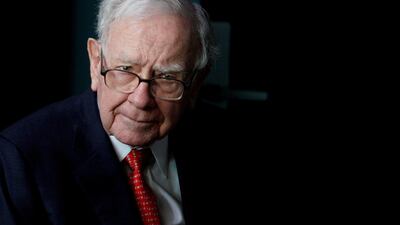
Warren Buffett is being very quiet right now, and this could be a bad omen for the world’s stock markets and wider economies.
Mr Buffett is chief executive of Berkshire Hathaway, which has big stakes in companies such as Amazon, Coca-Cola and Apple, and owns more than 90 businesses, including a railroad, an insurer, an energy provider and retailers.
He is a legendary investor, who is known as the "Oracle of Omaha". His patient, measured approach as well as brilliant track record in deal-making have made him one of the richest men in the world, and earned him a legion of followers. Tens of thousands of them gather every year for Berkshire’s annual shareholder meeting, which is more akin to a pop concert, sports event or religious revival than a typical corporate gathering.
But since the end of February, Mr Buffett has said very little (as of the time of writing). Amid what is foremost a public health crisis that is claiming lives daily, that would appear to be a wise and considered position for someone focused on financial markets. He is also in the highest-risk category personally from the coronavirus.
The 89-year-old, who had prostate cancer in 2012, is working from his home in Omaha, Nebraska – rather than his office only a few kilometres away – and seems to be following physical-distancing advice.
However, his low profile at the moment is in contrast to how he responded during the last great crisis more than a decade ago.
It could be argued that his leadership at the tail end of 2008, after the collapse of the Lehman Brothers investment bank, helped spur a swell of co-operative effort in the US to mitigate the sub-prime crisis’s impact and potential contagion across the world.
Washington, in particular, subsequently showed exemplary bipartisanship as President George W Bush's term in office drew to a close and Barack Obama was poised to enter the White House. A month after Lehman's failure, The New York Times published an op-ed by Mr Buffett.
A keen student of history, he wrote on October 16, 2008: “In the 20th century, the United States endured two world wars and other traumatic and expensive military conflicts; the Depression; a dozen or so recessions and financial panics; oil shocks; a flu epidemic; and the resignation of a disgraced president.”
The article was a rallying cry for those who believed in the American system of capitalism and the country’s ability to ride out any economic hardship. Mr Buffett stood firm and said he would not panic. In fact, he stated his intent to keep investing in US companies and assets. “Today my money and my mouth both say equities,” he wrote.
Mr Buffett then poured billions of dollars into stocks, such as those of investment bank Goldman Sachs and conglomerate General Electric, and these moves earned him billions more.
Last week, Berkshire Hathway said it had sold about 18 per cent of its stake in Delta Air Lines and four per cent of its holdings in Southwest Airlines. AP Photo
As of the end of last year, his portfolio was valued at $248 billion.
Last week, Berkshire said it had sold about 18 per cent of its stake in Delta Air Lines and four per cent of its holdings in Southwest Airlines. This is hardly surprising, given how hard the aviation sector has been hit by global measures to control the outbreak, such as the grounding of flights and shutting of borders. Any other buying or selling activity on Berkshire’s part is not yet public knowledge.
However, Mr Buffett does have about $100bn in cash that could be deployed immediately if he so wishes. That he is not being as vocal about what he is doing could well be his sense of dignity and empathy for the common man showing through; other well-known investors who are talking more could, perhaps, be accused of putting financial gains ahead of the human cost of the pandemic.
In a presidential election year, the passage of a $2 trillion stimulus bill in the US Congress could be the extent to which bipartisanship was achieved in Washington. Reuters
An investor friend of mine, who is a long-time observer of Mr Buffett, believes his last public comments, made in February, indicate an unprecedented level of bearishness on his part. Of course, Mr Buffett could be buying aggressively behind the scenes. But more likely – given an absence of any public deal-making on his part, despite the number of distressed sectors and companies that need a cash injection – there is little out there that he likes the look of at the moment.
There could be more pain to come, particularly as quick government action means banks are very liquid right now. The question is whether that support can continue as the crisis rolls on into the summer months, with the political landscape in the US so fractious.
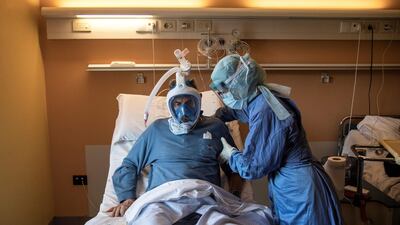
A nurse helps a patient using the Decathlon snorkeling face mask in the Covid-19 ward of the Maria Pia Hospital in Turin. AFP
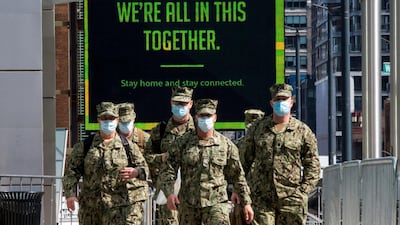
US military personnel wearing face masks arrive at the Jacob K. Javits Convention Center in the Manhattan borough of New York City, New York, US. Reuters
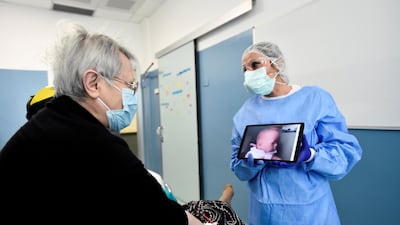
A patient suffering from coronavirus uses a tablet to speak to a relative who is unable to visit, at the Cernusco sul Naviglio hospital in Milan, Italy. Reuters
Members of the cleaning staff disinfect a room at a hotel in Belo Horizonte, Brazil, which continues to operate despite the coronavirus pandemic. AFP
Neighbours celebrate the engagement of Juan Manuel Zamorano, 32, and Elena Gonzalez, 31, after she proposed to him at the balcony of their house in downtown Ronda, southern Spain. Reuters
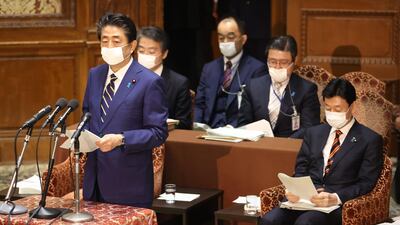
Japan's Prime Minister Shinzo Abe delivers a report to committee members of the Lower House in Tokyo on April 7, 2020 before declaring a state of emergency. AFP
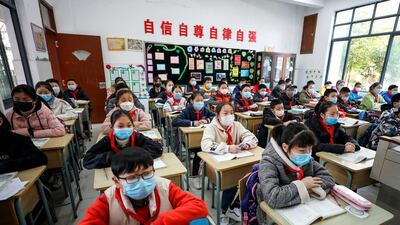
Elementary school students wearing face masks attend a class as they return to school after the start of the term was delayed in Huaian in China's eastern Jiangsu province. AFP
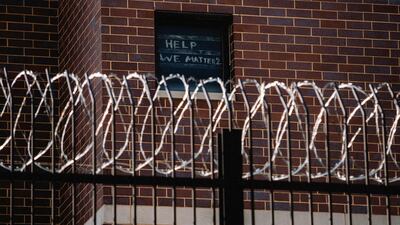
Signs made by prisoners pleading for help are seen on a window of Cook County Jail in Chicago, Illinois, US. Reuters
Giant pandas Ying Ying and Le Le before mating at Ocean Park in Hong Kong. Stuck at home with no visitors and not much else to do, a pair of pandas in Hong Kong finally decided to give mating a go after a decade of dodging the issue. AFP
A woman enters a shopping mall partially closed to combat the spread of coronavirus, in Bangkok. AFP
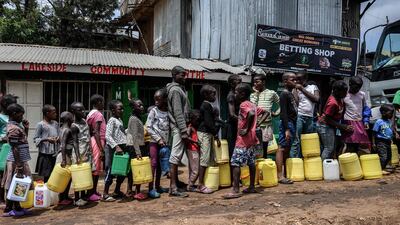
Children queue with their jerrycans to fill them with free water distributed by the Kenyan government at Kibera slum in Nairobi, Kenya. AFP
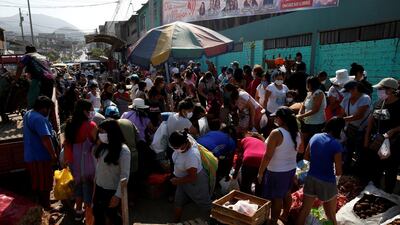
Women shop at a market after the Peruvian government limited men and women to alternate days for leaving their homes, in an attempt to slow the spread of coronavirus, in Lima, Peru. Reuters
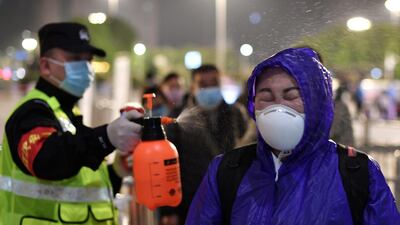
A police officer sprays disinfectant on a traveller outside Hankou Railway Station after travel restrictions to leave Wuhan were lifted. Reuters
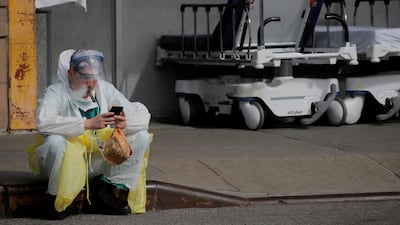
A healthcare worker sits on the curb as he uses a vaping device while taking a break outside Maimonides Medical Center during the outbreak of coronavirus in the Brooklyn borough of New York City, New York, US. Reuters
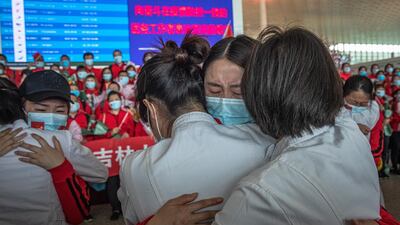
Medical workers from The First Bethune Hospital of Jilin University hug their Wuhan colleagues at the airport as they prepare to leave after the lockdown was lifted, in Wuhan, China. EPA
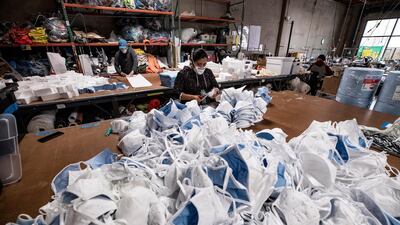
Employees of Suay Sew Shop make face masks amid the coronavirus pandemic in Los Angeles, California, USA. EPA
The consequences of 2008 and 2009 set a course that has brought us to the extreme polarisation that we have witnessed in recent years.
There may already have been a complete erosion of common ground in Washington in a presidential election year. Any will to act together to keep supporting the economy may have been burned up last month with the passage of a $2 trillion stimulus bill in the US Congress.
Still, the current scenario has already matched the scale of the financial crash of 2008, with trillions of dollars in market capitalisation swept away. The sudden-stop and unique nature of the pandemic's impact is already showing through in dire economic forecasts and employment data with millions more Americans now jobless.
A decade ago, the actions of governments and central banks to pump liquidity into the financial system actually precipitated a historic bull-run in equities. Yet, the situation still needed the likes of Mr Buffett in order to act to avert further damage. Perhaps this time around, Mr Buffett is not as confident of a repeat of that level of recovery.
Would he warn investors if he is feeling so pessimistic? He is oft-quoted for his sage advice to think long-term and to be wary of those companies that may not be all that they seem when times are good.
Where is his guidance now during these most troubled times? Should we take his silence as a message in itself?
Next month, Berkshire will hold its annual meeting virtually. Mr Buffett and his erstwhile partner Charlie Munger are likely to offer their views, which may not be quite as comforting as we might hope.
Mustafa Alrawi is an assistant editor-in-chief at The National

In addition to the Emirates and Etihad programmes, there is the Air Miles Middle East card, which offers members the ability to choose any airline, has no black-out dates and no restrictions on seat availability. Air Miles is linked up to HSBC credit cards and can also be earned through retail partners such as Spinneys, Sharaf DG and The Toy Store.
An Emirates Dubai-London round-trip ticket costs 180,000 miles on the Air Miles website. But customers earn these ‘miles’ at a much faster rate than airline miles. Adidas offers two air miles per Dh1 spent. Air Miles has partnerships with websites as well, so booking.com and agoda.com offer three miles per Dh1 spent.
“If you use your HSBC credit card when shopping at our partners, you are able to earn Air Miles twice which will mean you can get that flight reward faster and for less spend,” says Paul Lacey, the managing director for Europe, Middle East and India for Aimia, which owns and operates Air Miles Middle East.
Mercer, the investment consulting arm of US services company Marsh & McLennan, expects its wealth division to at least double its assets under management (AUM) in the Middle East as wealth in the region continues to grow despite economic headwinds, a company official said.
Mercer Wealth, which globally has $160 billion in AUM, plans to boost its AUM in the region to $2-$3bn in the next 2-3 years from the present $1bn, said Yasir AbuShaban, a Dubai-based principal with Mercer Wealth.
“Within the next two to three years, we are looking at reaching $2 to $3 billion as a conservative estimate and we do see an opportunity to do so,” said Mr AbuShaban.
Mercer does not directly make investments, but allocates clients’ money they have discretion to, to professional asset managers. They also provide advice to clients.
“We have buying power. We can negotiate on their (client’s) behalf with asset managers to provide them lower fees than they otherwise would have to get on their own,” he added.
Mercer Wealth’s clients include sovereign wealth funds, family offices, and insurance companies among others.
From its office in Dubai, Mercer also looks after Africa, India and Turkey, where they also see opportunity for growth.
Wealth creation in Middle East and Africa (MEA) grew 8.5 per cent to $8.1 trillion last year from $7.5tn in 2015, higher than last year’s global average of 6 per cent and the second-highest growth in a region after Asia-Pacific which grew 9.9 per cent, according to consultancy Boston Consulting Group (BCG). In the region, where wealth grew just 1.9 per cent in 2015 compared with 2014, a pickup in oil prices has helped in wealth generation.
BCG is forecasting MEA wealth will rise to $12tn by 2021, growing at an annual average of 8 per cent.
Drivers of wealth generation in the region will be split evenly between new wealth creation and growth of performance of existing assets, according to BCG.
Another general trend in the region is clients’ looking for a comprehensive approach to investing, according to Mr AbuShaban.
“Institutional investors or some of the families are seeing a slowdown in the available capital they have to invest and in that sense they are looking at optimizing the way they manage their portfolios and making sure they are not investing haphazardly and different parts of their investment are working together,” said Mr AbuShaban.
Some clients also have a higher appetite for risk, given the low interest-rate environment that does not provide enough yield for some institutional investors. These clients are keen to invest in illiquid assets, such as private equity and infrastructure.
“What we have seen is a desire for higher returns in what has been a low-return environment specifically in various fixed income or bonds,” he said.
“In this environment, we have seen a de facto increase in the risk that clients are taking in things like illiquid investments, private equity investments, infrastructure and private debt, those kind of investments were higher illiquidity results in incrementally higher returns.”
The Abu Dhabi Investment Authority, one of the largest sovereign wealth funds, said in its 2016 report that has gradually increased its exposure in direct private equity and private credit transactions, mainly in Asian markets and especially in China and India. The authority’s private equity department focused on structured equities owing to “their defensive characteristics.”
What are NFTs?
Are non-fungible tokens a currency, asset, or a licensing instrument? Arnab Das, global market strategist EMEA at Invesco, says they are mix of all of three.
You can buy, hold and use NFTs just like US dollars and Bitcoins. “They can appreciate in value and even produce cash flows.”
However, while money is fungible, NFTs are not. “One Bitcoin, dollar, euro or dirham is largely indistinguishable from the next. Nothing ties a dollar bill to a particular owner, for example. Nor does it tie you to to any goods, services or assets you bought with that currency. In contrast, NFTs confer specific ownership,” Mr Das says.
This makes NFTs closer to a piece of intellectual property such as a work of art or licence, as you can claim royalties or profit by exchanging it at a higher value later, Mr Das says. “They could provide a sustainable income stream.”
This income will depend on future demand and use, which makes NFTs difficult to value. “However, there is a credible use case for many forms of intellectual property, notably art, songs, videos,” Mr Das says.
One in nine do not have enough to eat
Created in 1961, the World Food Programme is pledged to fight hunger worldwide as well as providing emergency food assistance in a crisis.
One of the organisation’s goals is the Zero Hunger Pledge, adopted by the international community in 2015 as one of the 17 Sustainable Goals for Sustainable Development, to end world hunger by 2030.
The WFP, a branch of the United Nations, is funded by voluntary donations from governments, businesses and private donations.
Almost two thirds of its operations currently take place in conflict zones, where it is calculated that people are more than three times likely to suffer from malnutrition than in peaceful countries.
It is currently estimated that one in nine people globally do not have enough to eat.
On any one day, the WFP estimates that it has 5,000 lorries, 20 ships and 70 aircraft on the move.
Outside emergencies, the WFP provides school meals to up to 25 million children in 63 countries, while working with communities to improve nutrition. Where possible, it buys supplies from developing countries to cut down transport cost and boost local economies.
RESULT
Al Hilal 4 Persepolis 0
Khribin (31', 54', 89'), Al Shahrani 40'
Red card: Otayf (Al Hilal, 49')
Starring: Taron Egerton, Richard Madden, Jamie Bell
Rating: 3 out of 5 stars
Specs
Engine: Duel electric motors Power: 659hp Torque: 1075Nm On sale: Available for pre-order now Price: On request
Who's who in Yemen conflict
Houthis: Iran-backed rebels who occupy Sanaa and run unrecognised government
Yemeni government: Exiled government in Aden led by eight-member Presidential Leadership Council
Southern Transitional Council: Faction in Yemeni government that seeks autonomy for the south
Habrish 'rebels': Tribal-backed forces feuding with STC over control of oil in government territory
Wicked: For Good
Director: Jon M Chu
Starring: Ariana Grande, Cynthia Erivo, Jonathan Bailey, Jeff Goldblum, Michelle Yeoh, Ethan Slater
Rating: 4/5
What is blockchain?
Blockchain is a form of distributed ledger technology, a digital system in which data is recorded across multiple places at the same time. Unlike traditional databases, DLTs have no central administrator or centralised data storage. They are transparent because the data is visible and, because they are automatically replicated and impossible to be tampered with, they are secure.
The main difference between blockchain and other forms of DLT is the way data is stored as ‘blocks’ – new transactions are added to the existing ‘chain’ of past transactions, hence the name ‘blockchain’. It is impossible to delete or modify information on the chain due to the replication of blocks across various locations.
Blockchain is mostly associated with cryptocurrency Bitcoin. Due to the inability to tamper with transactions, advocates say this makes the currency more secure and safer than traditional systems. It is maintained by a network of people referred to as ‘miners’, who receive rewards for solving complex mathematical equations that enable transactions to go through.
However, one of the major problems that has come to light has been the presence of illicit material buried in the Bitcoin blockchain, linking it to the dark web.
Other blockchain platforms can offer things like smart contracts, which are automatically implemented when specific conditions from all interested parties are reached, cutting the time involved and the risk of mistakes. Another use could be storing medical records, as patients can be confident their information cannot be changed. The technology can also be used in supply chains, voting and has the potential to used for storing property records.
The Vile
Starring: Bdoor Mohammad, Jasem Alkharraz, Iman Tarik, Sarah Taibah
Fewer criminals put behind bars and more to serve sentences in the community, with short sentences scrapped and many inmates released earlier.
Greater use of curfews and exclusion zones to deliver tougher supervision than ever on criminals.
Explore wider powers for judges to punish offenders by blocking them from attending football matches, banning them from driving or travelling abroad through an expansion of ‘ancillary orders’.
More Intensive Supervision Courts to tackle the root causes of crime such as alcohol and drug abuse – forcing repeat offenders to take part in tough treatment programmes or face prison.
UAE currency: the story behind the money in your pockets