


The "Stay Home" campaign may be slowly unwinding, but its impact will not just moderate behaviour for the month of April but for years to come.
The least contentious aspect of the coronavirus lockdown has been just how compliant the general population has been in accepting the extraordinary conditions.
Official advisers planning the conditions for stay-home orders – which vary in almost every country in the world – had worried about the timing, scope, durability and even feasibility of the regime.
Expert panels in some countries worried so much about the potential reaction that they misjudged when to put clamps on population movements. The assumptions that now need to be made about future behavioural changes must be modified and reflect how much life could alter.

Surveys and polling show that there is immense backing globally for the current situation. In many cases, people seem to take comfort in the draconian conditions. There appears to be a far larger resistance, active and passive, to resume normal activity than anyone would have guessed. If the trends are borne out in future surveys, the early months of 2020 are also likely to be a pivot point for the rest of the decade.
Germany's Robert Koch Institute, responsible for disease control and prevention, looked ahead to the resumption of activity in the country with a clear warning against assuming that the measures will disappear as quickly the rules were imposed. Chancellor Angela Merkel spoke of the need for citizens not to rush into the streets for relaxation. The all-important consideration is to release some of the lockdown pressure, not to allow a free-for-all.
A poll for Germany’s national broadcaster has found that 55 per cent backed a gradual lift of coronavirus measures, 30 per cent did not want to end lockdown and some 13 per cent wanted an immediate opening.
Thinking back to the pre-shutdown period, it is hard to conceive that people would be sticking with the curtailment. How gimmicky some of the responses then now seem: the elbow bumps of politicians; the videos of hipsters standing in circles touching the arches of their court shoes; the half-namaste, half-hand-on-heart gestures.
In a poll of 27 countries conducted by the UK-based market research company Ipsos/Mori, the lowest figure for avoiding touching an object in a public space was now 68 per cent. Most responses were clustered around 90 per cent.
The crisis is, meanwhile, intensifying strongly held opinions about state-led spending and leadership. It is also increasing sentiments towards living life to the full while it is there for the taking.
The lockdown has allowed a digital portal to open up the world to those staring at four walls. Living with the virus will require a circumspect approach to daily life. As medicine and science banish the immediate danger to life, people will start to build out their lives.
For some, the knowledge or visual impressions acquired online will be rolled into new personal experiences. Having undergone a lockdown, the appetite for living at the same controlled tempo will be cast aside. The psychological dynamic will require many to make real the scenes viewed over recent weeks. Others will want to roam free, just because the space is there.
-
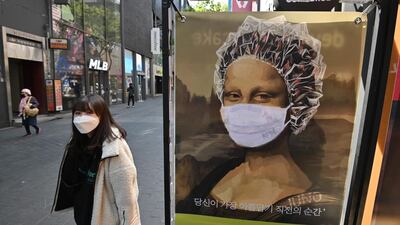
A woman wearing a face mask walks past an advertisement of a hair shop at a shopping district in Seoul. AFP -

Pacific Park's solar-powered Ferris wheel lights show a green "Earth" logo at sunset on Santa Monica Pier for Earth Day, in Santa Monica, California. AP -

A water police boat is seen as the Ruby Princess cruise ship docks at Port Kembla in Wollongong, Australia. Getty -
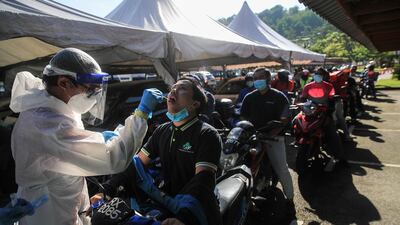
A health worker collects a sample from a man at a free coronavirus community screening service in Kuala Lumpur, Malaysia. EPA -
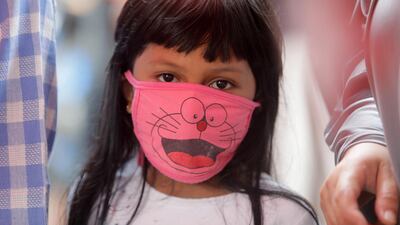
An Indonesian child wears a hand made protective mask at a temporary meat market, ahead of Ramadan in Banda Aceh, Indonesia. EPA -

A pedestrian is reflected in the window of a nail salon during a nationwide social distancing and stay-at-home order imposed due to coronavirus in Ho Chi Minh city, Vietnam. Bloomberg -

Visitors wearing protective face masks walk on a sightseeing spot on Enoshima Island after government asked citizens to be more diligent on social distancing under the state of emergency in Fujisawa, south of Tokyo, Japan. Reuters -
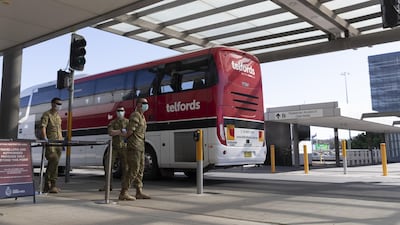
Army personnel watch as a charter bus that unloaded crew from the Ruby Princess Cruise ship departs Sydney Airport in Sydney, Australia. Getty -
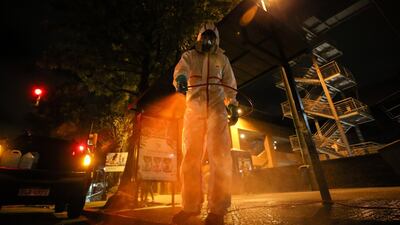
A municipality worker sprays disinfectant at a bus stop as a preventive measure against coronavirus in Montevideo, Uruguay. EPA -
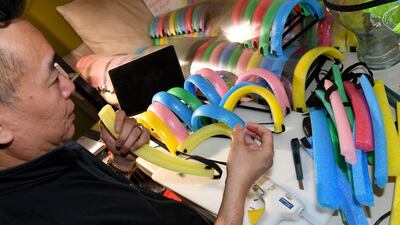
School of Nursing assistant professor Dr Rhigel Jay Tan, a licensed nurse practitioner in psychiatric mental health, makes custom-made face shields called "iCareFaceShields" at his home for health care workers amid the coronavirus pandemic in Las Vegas, Nevada. AFP -
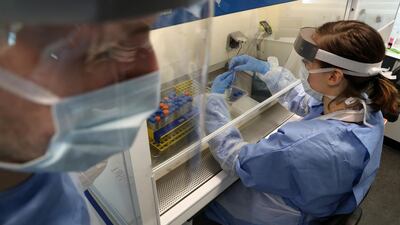
Technicians carry out a sample transfer during the opening of the new Covid-19 testing lab at Queen Elizabeth University Hospital in Glasgow, Scotland. Getty -
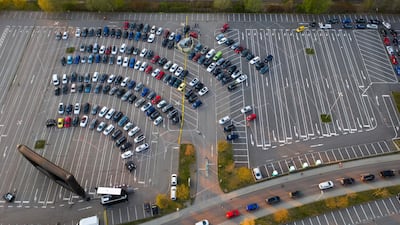
Visitors gather for a drive-in cinema event in Chemnitz, Germany. AP -

The Italian-operated cruise ship the Costa Atlantica is anchored at a port in Nagasaki, southern Japan. AP


That is not to say that the situation will not be controlled. Three steps forward will inevitably be accompanied by reverses.
Planning for what might be is already under way. What is certain is that the world will be offered new experiences. For example, Abu Dhabi Cricket would be willing to host matches if it helped complete the cricket season for the English counties. If the tie-up happens, it will be a novel event that can open up new audiences for a game that has struggled to define its structures.
The historical perspective is that pandemics are a gateway to a new era. From the ashes comes the energy of a reborn phoenix.
One example of the impact of a health crisis in the television era should guide thinking about what comes next. The television campaign that turned the tide in the Aids crisis was initially condemned as scare-mongering and sensationalist. The British government had declared in 1987: "Don't die of ignorance."
A large tombstone dropped onto blackened dried ground. A stentorian voice intoned prohibitions and doom-laden warnings. The television advertisement warned about HIV, a new deadly virus. People changed their behaviours to avoid infection.
With hindsight, Britain in the 1980s had one of the most effective public information campaigns ever mounted. Few knew at the time but the lesson was clear. Against the backdrop of a deadly threat to the way of life, the state can exercise immense power over everyday life for decades to come.
Norman Fowler, the politician who commissioned the campaign, is now Speaker of the House of Lords. In March, he declared that his age of 82 made him vulnerable to the coronavirus, so he was secluding in his home. Last week, he was back on the job chairing the first viral sessions.
The long game is that human beings are changed – but they adapt.
Damien McElroy is the London bureau chief of The National

