
There has been plenty of controversy globally and regionally about some of the preventive measures enacted to curtail the spread of coronavirus. The utility of school closures, in particular, has been a contested topic of debate; as of today, nine countries in the Middle East have taken this measure.
Those in support of school closures have rightly argued that educational institutions are major infection amplification points in society, and that it would be prudent to do away with them in light of the current outbreak. Notwithstanding the differences in this analogy, it would be akin to shutting down a computer network infected by a virus in order to stop its spread.

Opponents of this policy contend that unlike the analogy, school closures will not stop the spread of the virus altogether. They are correct. School-going children are unlikely to stay behind closed doors, and some might even relish the opportunity to socialise and interact with their peers outside school.
The problem with this argument is two-fold: one, governments have a moral responsibility to do what is in their power to limit the spread and cannot necessarily control what their citizens choose to do in their private lives; more importantly, governments recognise that school closures will not stop the spread of the virus but they might, at least, limit it.
-
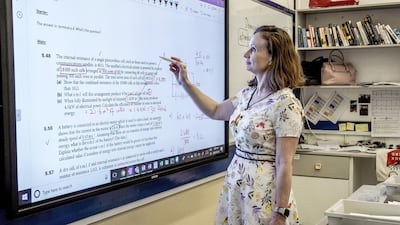
Physics teacher Regina O'Dwyer demonstrates how Dubai College's remote learning system works. Using Microsoft 365 and Cisco Webex - a Skype-style conference call tool - she can take pupils through live lessons as they sit at home. Victor Besa / The National -

Instead of returning to school after the spring break, pupils will login from home for two weeks and watch teachers at Dubai College for each lesson. The school will remain empty except for teachers. Victor Besa / The National -

Dubai College principal Michael Lambert said the teachers are preparing to use the remote system for two weeks. Victor Besa / The National -

People disembarking from a UAE military transport plane, used to transport medical equipment and coronavirus testing kits provided by the World Health Organisation, upon their arrival in Iran. AFP -

Workers clean the Grand Mosque, during the pilgrimage known as Umrah, in the Muslim holy city of Makkah, Saudi Arabia. AP Photo -

Labourers unloading medical equipment and coronavirus testing kits provided by the World Health Organisation, from a UAE military transport plane upon their arrival in Iran. AFP -

Tonnes of medical equipment and coronavirus testing kits provided by the World Health Organisation are pictured at the Al Maktoum International airport in Dubai as it is prepared to be delivered to Iran by a UAE plane. AFP -
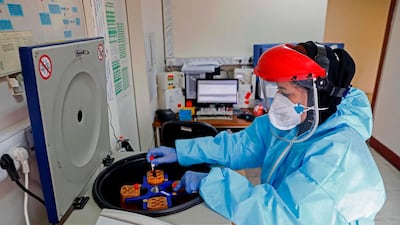
An Iranian lab technician loads a centrifuge with blood samples, taken from patients suspected of being infected with COVID-19 virus, at a hospital in Tehran. AFP -
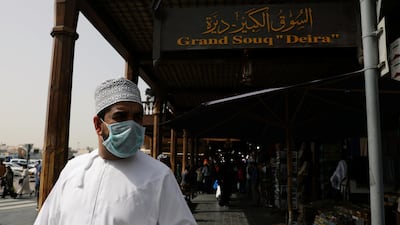
A man wears a protective face mask, following the outbreak of the new coronavirus, as he walks at the Grand Souq in old Dubai, UAE. Reuters -

A worker splashes disinfectant in a classroom as part of sterilisation campaign against the new coronavirus, at the Evangelical School, in Loueizeh, east of Beirut, Lebanon. AP Photo -

Lebanese workers spray disinfectant in classrooms and halls of a school in the coastal town of Rmeileh, 35km south of the capital Beirut in an effort to prevent a novel coronavirus outbreak in the country. AFP -
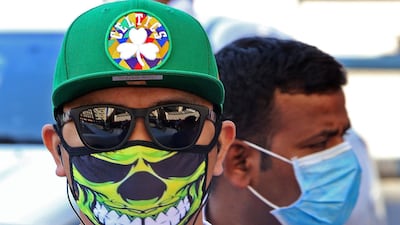
People wearing protective masks are seen on a street in Kuwait City, amid a global outbreak of the novel Coronavirus. AFP -
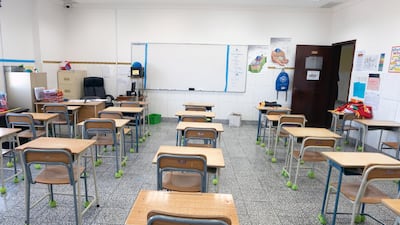
An empty classroom is seen in a private school in Hawally, after the Ministry of Edudution suspended schools and universities due to the coronavirus outbreak, in Kuwait city. Reuters -

A health worker is pictured inside a newly erected coronavirus quarantine centre in Sanaa, Yemen. Reuters -
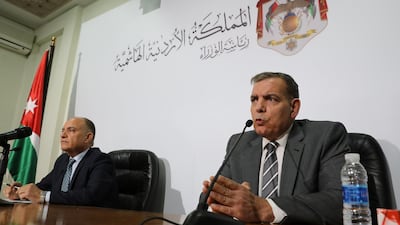
Jordanian Health Minister Saad Jaber and Minister for Media Affairs Amjad al-Adaileh attend a news conference after the country's first case of the coronavirus was confirmed, at the headquarters of the Prime Minister in Amman, Jordan. Reuters -

Hong Kong Chief Executive Carrie Lam (left) and Secretary for Food and Health Sophia Chan attend a press conference at the Central Government Offices in Hong Kong, China. EPA -
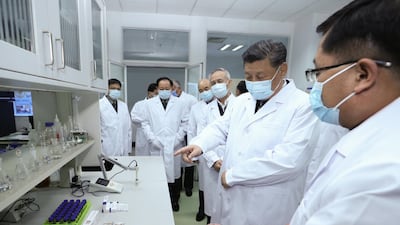
Chinese President Xi Jinping learning about the progress on the vaccine and anti-body during his visit to the Academy of Military Medical Sciences in Beijing, capital of China. EPA


The latter point is critical because it buys crucial time for the health sector to prepare for a peak in the outbreak where acute demand for critical care could easily overwhelm the healthcare system. Furthermore, arguments that children under a certain age appear immune are largely misplaced. It is simply unclear whether children are being infected and are handling the infections well, or if they are immune from infection.
Without being too alarmist, the number of cases is likely to increase in recent weeks, and this possibility should not be renounced or downplayed in any way.
While the exact rate of transmission cannot be ascertained, some experts are suggesting that each infected person could be responsible for infecting more than 30 others within just a few weeks.
This is quite significant, especially when considering that cases could be mild or undetected. Given the relatively low number of confirmed cases across the Arab world, we might only really know the extent of the problem a few months from now.
China's success has taught us that stringent control measures can reduce the spread of a major outbreak, but not every country in the region or elsewhere has the ability to impose such tough measures. One question that sceptics rightly ask is where do these social distancing preventative measures end? The UAE has barred fans from attending national league football matches; Saudi Arabia has suspended pilgrimage to Makkah; Jordan has banned major conferences.
Governments could find it challenging – if not altogether impossible – to impose other bans on public gathering such as weddings and Friday prayer sermons. It is of equal difficultly to determine what happens to businesses, and if they are well-positioned to allow their employees to work remotely. This not only refers to the technical capacities required to realise this, but also the administrative and legal aspects.
What about employees that opt to work from home for fear of infection or those who are not ill but under self-imposed quarantine? Will their employers be able to offer them paid-sick leave in the event of self-quarantine? More importantly, what happens if an outbreak only peaks once schools have resumed? Would parents and authorities want the closures to be extended further and threaten the completion of the academic year altogether?
-

Muslim worshippers circumambulate the sacred Kaaba in Mecca's Grand Mosque, Islam's holiest site. Saudi Arabia reopened today the area around the sacred Kaaba, reversing one of a series of measures introduced to combat the coronavirus outbreak. AFP -

A Muslim worshipper prays near the sacred Kaaba in Mecca's Grand Mosque. AFP -

Muslim worshippers circumambulate the sacred Kaaba in Mecca's Grand Mosque. AFP -

Muslim worshippers circumambulate the sacred Kaaba in Mecca's Grand Mosque, Islam's holiest site, on March 7, 2020. Saudi Arabia reopened today the area around the sacred Kaaba, reversing one of a series of measures introduced to combat the coronavirus outbreak. Saudi authorities this week suspended the year-round umrah pilgrimage, during which worshippers circle the Kaaba seven times, and also announced the temporary closure of the area around the cube structure. / AFP / Abdel Ghani BASHIR -

This combination of pictures created on March 07, 2020 shows a small crowd of worshippers around the sacred Kaaba in Mecca's Grand Mosque on March 7, 2020 and a large crowd of worshippers around the Kaaba (Tawaf al-Wadaa) during pilgrimage on August 13, 2019. AFP -

Workers disinfect the ground around the Kaaba, the cubic building at the Grand Mosque, in the Muslim holy city of Mecca, Saudi Arabia. Saudi Arabia emptied Islam's holiest site for what they say sterilization over fears of the new coronavirus. AP Photo -

An aerial view shows an empty white-tiled area surrounding the Kaaba in Mecca's Grand Mosque. An eerie emptiness enveloped the sacred Kaaba in Mecca's Grand Mosque, Islam's holiest site, where attendance at Friday prayers was hit by measures to protect against the deadly new coronavirus. AFP -
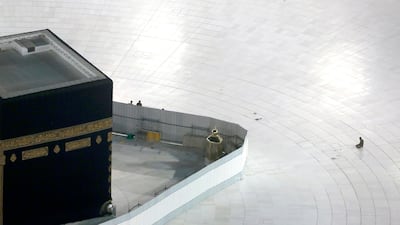
A Saudi policeman prays in front of the Kaaba, the cubic building at the Grand Mosque, in the Muslim holy city of Mecca, Saudi Arabia. AP Photo -

A pilgrim poses for a picture as in front of the Kaaba, the cubic building at the Grand Mosque, during the minor pilgrimage, known as Umrah, in the Muslim holy city of Mecca, Saudi Arabia. At Islam’s holiest site in Mecca, restrictions put in place by Saudi Arabia to halt the spread of the new coronavirus saw far smaller crowds than usual on Monday. AP Photo -

A small number of pilgrims circumambulate around the Kaaba, the cubic building at the Grand Mosque, during the minor pilgrimage, known as Umrah, in the Muslim holy city of Mecca, Saudi Arabia. At Islam’s holiest site in Mecca, restrictions put in place by Saudi Arabia to halt the spread of the new coronavirus saw far smaller crowds than usual on Monday. AP Photo -
Workers clean the Grand Mosque, during the minor pilgrimage, known as Umrah, in the Muslim holy city of Mecca, Saudi Arabia. At Islam’s holiest site in Mecca, restrictions put in place by Saudi Arabia to halt the spread of the new coronavirus saw far smaller crowds than usual on Monday. AP Photo -

A pilgrim, who entered Saudi Arabia before the country halted travel to the holiest sites, takes a rest on a praying carpet at the roof of the Grand Mosque in the Muslim holy city of Mecca, Saudi Arabia. AP Photo -

A muslim pilgrim wears a protective face mask to prevent contracting coronavirus, as he prays at the Grand mosque in the holy city of Mecca, Saudi Arabia. REUTERS -

Muslim pilgrims wear protective face masks to prevent contracting coronavirus, as they arrive at the Grand mosque in the holy city of Mecca, Saudi Arabia. REUTERS -

Muslim pilgrims wear protective face masks to prevent contracting coronavirus, as they arrive at the Grand mosque in the holy city of Mecca, Saudi Arabia. REUTERS -

A travel agency officer tidies up suitcases owned by Umrah pilgrims, after the cancellation of the departure to Mecca following the Saudi government's temporary ban to keep the country safe because of coronavirus outbreak, in Makassar, Sulawesi Selatan, Indonesia. REUTERS -

Umrah pilgrims leave after the cancellation of the departure to Mecca following the Saudi government's temporary ban announced on Thursday to keep the country safe because of coronavirus outbreak, at Soekarno Hatta International Airport, Tangerang, near Jakarta, Indonesia. REUTERS -

Umrah pilgrims are seen after the cancellation of the departure to Mecca following the Saudi government's temporary ban announced on Thursday to keep the country safe because of coronavirus outbreak, at Soekarno Hatta International Airport, Tangerang, near Jakarta, Indonesia. REUTERS


Many sceptics might say that these are doomsday scenarios, and this would not be an overstatement. Society cannot come to a complete halt. Nevertheless, it is important to be proactive in raising these concerns and considering their implications. What is clear is that we are in unprecedented times, and it is better to prepare for the worst rather than find ourselves under-prepared if these extreme scenarios end up being our reality.
The greatest challenge for authorities in our region and elsewhere, is that they will need to walk a fine line between raising awareness among their publics and stoking public fear.
Nasser bin Nasser is the managing director of the Middle East Scientific Institute for Security and the founder of the strategic consultancy firm, InfoSynth

