

Russia is seeking to pre-empt the US in the Arab world by developing policies that capitalise on President Joe Biden's new administration still trying to find its footing and an eagerness among Washington's Arab allies to maintain a balance in their relationships with the West, Moscow and Beijing.
So far, Mr Biden has hinted at his desire for a reset with Gulf states, Egypt and others in the context of reconfiguring US-Iranian relations. Moscow sees the current moment, in which US policy remains unclear, as an opportunity to mobilise support for an eastern pivot in the Middle East. Impatience in the region for the Biden administration’s apparent disregard for US-Gulf relations is growing, especially given that it seems to be given less attention than relations with Iran. To be clear, US relations with the Gulf are far from ruptured, but confidence is being shaken. Russia's veteran foreign minister, Sergei Lavrov, must have sensed that when he undertook a visit last week to various Gulf capitals.
Beyond a Russian campaign to bolster bilateral relations – particularly political ties and economic co-operation, including in energy markets – Mr Lavrov’s talks with Gulf officials also addressed Iran and the prospect of renewed nuclear negotiations with it. Moscow, an ally of Iran, favours an unconditional return to the nuclear deal negotiated between Tehran and various world powers, led by then US president Barack Obama, in 2015. "Unconditional" includes separating the issue of Iran’s nuclear programme from other grievances against Tehran, such as its ballistic missile programme and aggressive behaviour throughout the Middle East.
Russia has largely ignored proposals for Arab states' interests to be represented directly in any nuclear negotiations with Iran, suggesting instead on addressing those concerns during a wider regional security conference it proposes holding at an as-yet unknown, future date.
In Saudi Arabia, Mr Lavrov spoke about the need for some kind of accord between the kingdom and Iran, and offered to play a role in facilitating it. However, one flaw in Russia’s diplomatic approach is that, by its own admission, it sees Iran as an ally it must go through greater lengths to accommodate, whereas it considers its Arab partners to be "more flexible", as a former Russian diplomat put it to me. This is why Mr Lavrov's efforts in the Arab world are focused on winning concessions and seeking compromise.

Mr Lavrov's trip was also focused heavily on Syria, where it has helped the Syrian government wage a complicated, bloody and costly war for several years. At this point, Moscow must see no option but to search for a breakthrough in the Syrian crisis.
Russia is resolved not to abandon Syrian President Bashar Al Assad, who has afforded Moscow a major base from which to operate in the Middle East. With that in mind, Mr Lavrov has sought to secure a breakthrough by trying to persuade Arab states to find ways to reintegrate Syria into the Arab League and rehabilitate Al Assad as a recognised ruler in the region.
Russia has also made a case to Arab states that the Caesar Act, a US law that imposes sanctions on the Syrian regime, is ultimately counterproductive. According to Moscow's logic, the fact that it hinders international companies from returning to Syria helps to keep the country's public and private sectors in a state of paralysis. It also obstructs Russian and regional efforts to mobilise financial support for rebuilding Syria. To that end, Russia is also seeking concrete commitments from Arab states and others to help finance the reconstruction of the country without conditions. Russia fears that without this breakthrough in the regional logic on Syria, the country will only continue to be a quagmire.
During Mr Lavrov's visit to Abu Dhabi, UAE Foreign Minister Sheikh Abdullah bin Zayed indicated that there were merits to the argument. He spoke of the "necessity" of Syria returning to its role in the Arab League, and that the Caesar Act posed obstacles that should be "addressed clearly" in dialogue "with our friends in the United States”.
At a virtual panel discussion held by the Beirut Institute in Abu Dhabi, UAE ambassador to Washington Yusuf Al Otaiba stressed: “We’re trying to re-engage Syria [but] how we re-engage, how we do not cross wires on the Caesar Act, is something we are talking to the Americans about now.”
In Saudi Arabia, there has been no public statement made against the Caesar Act, and the government in Riyadh is said to be highly sceptical of any prospects of Iran's presence in Syria diminishing. Nonetheless, in the Saudi leg of his tour, Mr Lavrov encountered a recognition that more work could be done by the US in terms of diplomacy. At the same time, he was also told that any rehabilitation of Al Assad would be contingent upon progress being made in the Syrian political process, especially in the ongoing talks of the Syrian Constitutional Committee. Those talks, held in Geneva between the war's various factions, have taken place for more than a year without much progress. Mr Lavrov acknowledged that the Syrian government’s stubbornness will continue to preclude any such progress.
-
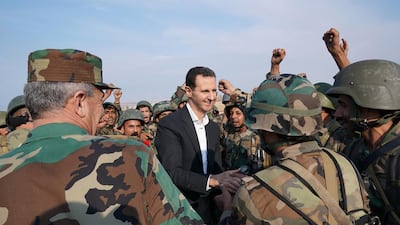
Syrian soldiers are seen cheering President Bashar Al Assad during his visit to Al Habit on the southern edges of the Idlib province, in a picture released on October 22, 2019. AFP / Syrian Presidency Facebook page -
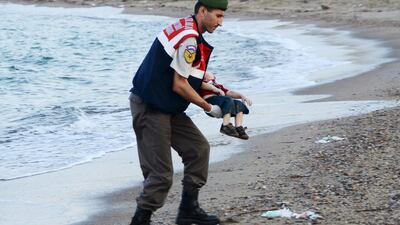
A Turkish gendarme retrieves the body of Syrian refugee Alan Kurdi from a beach in Turkey. Reuters -
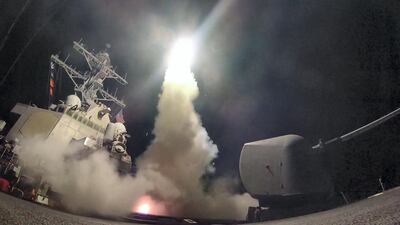
The guided-missile destroyer 'USS Porter' conducts strikes while in the Mediterranean Sea, on April 7, 2017. AFP / US NAVY -
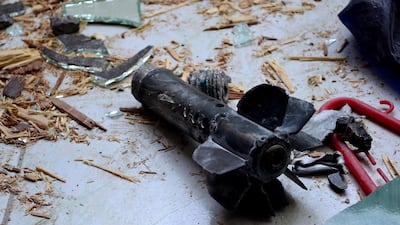
A handout picture released by the official Syrian Arab News Agency on October 31, 2013, shows the remains of a mortar after an alleged mortar attack by rebel fighters on the Damascus mixed Christian-Druze suburb of Jaramana. AFP / Sana -
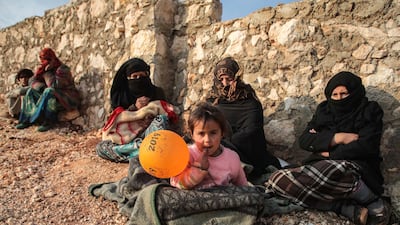
Displaced Syrians from the south of Idlib province sit out in the open in the countryside west of the town of Dana in the north-west Syrian region on December 23, 2019. AFP -
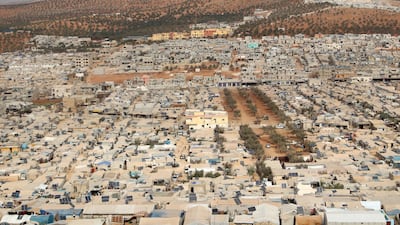
This picture shows a general view of an overcrowded displacement camp near the village of Qah near the Turkish border in Syria's north-west Idlib province, on October 28, 2020, during the coronavirus pandemic crisis. AFP -
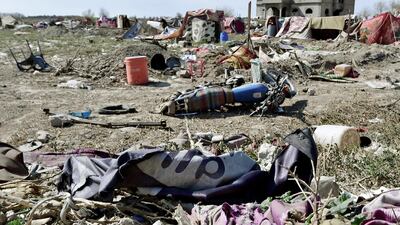
A picture taken on March 23, 2019, shows the last ISIS bastion in the eastern Syrian village of Baghuz after the defeat of the group. The Kurdish-led forces pronounced the end of ISIS regime on March 23, 2019, after flushing out the diehard militants from their very last bastion in eastern Syria. AFP -
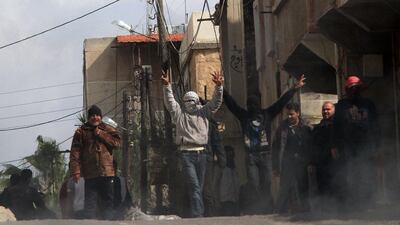
Anti-government activists gesture as they gather on the streets of Daraa, 100 kilometres south of the capital Damascus, on March 23, 2011. AFP -
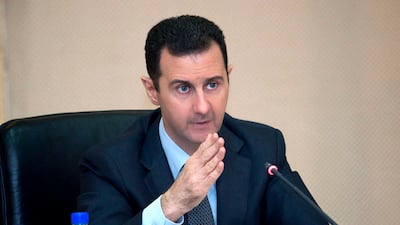
Syria's President Bashar Al Assad heading a cabinet meeting in the presidential palace in Damascus in 2013. Sana / AFP -
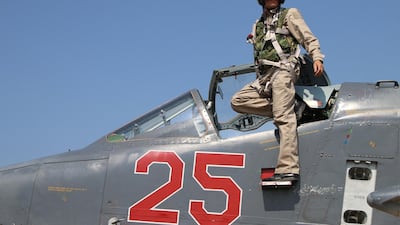
A picture taken on October 3, 2015 shows a Russian army pilot leaving the cockpit of a Russian Sukhoi Su-25 ground attack aircraft at the Hmeimim airbase in the Syrian province of Latakia. AFP -
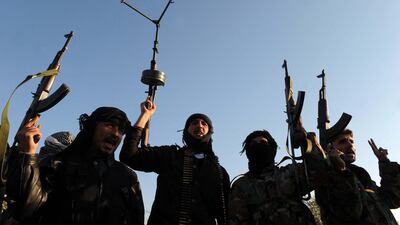
Members of the Free Syrian Army raise their weapons during a patrol in Idlib in north-west Syria on February 18, 2012. AFP -
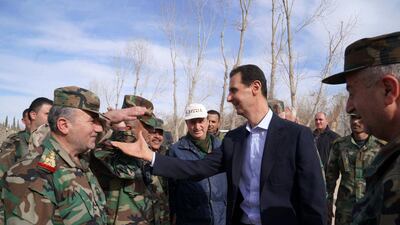
Syrian President Bashar Al Assad is shown shaking hands with government troops in Eastern Ghouta, in the leader's first trip to the former rebel enclave outside Damascus in years, in this handout picture released by the Syrian Presidency on March 18, 2018. Syrian Presidency Facebook page / AFP -
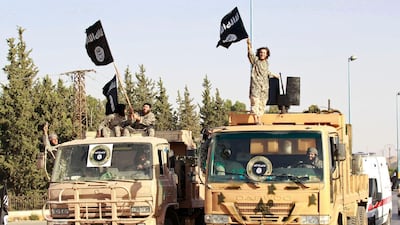
Militant fighters wave flags as they take part in a military parade along the streets of Syria's northern Raqqa province, on June 30, 2014. Reuters


But there is a sense that more pragmatic approaches must be considered, and that sense may even extend to Europe. During the Beirut Institute panel, Sir Mark Lyall Grant, a former British envoy to the UN, said: “We are realists in Europe, and recognise that Bashar Al Assad is there and he's going to stay.”
Even so, Mr Biden's administration will be in no rush to repeal the Caesar Act, not only because it is a law issued with bipartisan support in Congress that directly pursues accountability for crimes against humanity and the protection of Syrian civilians, but also because, in the US view, repealing the law would primarily benefit Russia. It is also unlikely that the Biden administration would advocate for any Russian-sponsored reconstruction process for Syria.
Mr Al Otaiba addressed that perspective head on: “We're 100 per cent committed to this alliance [with the US] but at the same time, we're having this very schizophrenic debate.” The UAE-US security and defence relationship is "unparalleled with any other country," he said, also noting that the strengthening of Gulf relations with Russia and China did not mark a pivot, but rather reflected a new regional dynamic. But the US, he continued, is "basically telling the entire world for years now that the region is less important to you. Fine, that's a healthy debate. It's a healthy but polarising debate. You can't also expect everyone to wait for you as you are telling them they are less important to you."
Raghida Dergham is the founder and executive chairwoman of the Beirut Institute and a columnist for The National

