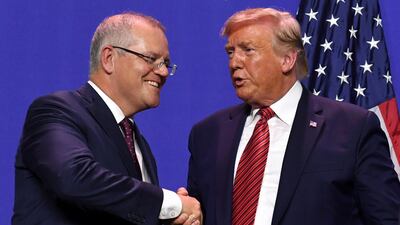

In April, Australia's Prime Minister Scott Morrison had a telephone call with US President Donald Trump, during which the two leaders apparently discussed their shared belief that China must be held responsible for the coronavirus pandemic. Afterwards, Mr Morrison put renewed impetus behind an initiative for Australia to take a lead role in co-ordinating an international inquiry into its origins – a quest viewed in Beijing, with good reason, as having China firmly in its sights.
"Why Morrison decided to pursue such an intervention immediately after a call to the White House remains a mystery," Tony Walker, a professor at La Trobe University in Melbourne, commented in the South China Morning Post newspaper last month. In the annals of Australian foreign policy, he wrote, "this may well go down as one of the more questionable forays into international diplomacy".
The consequences have since been unfolding, with potentially dire results for Australia. Soon after the phone call, China suspended imports from four Australian meat producers, instantly slashing 20 per cent off the country’s beef trade with China. The following month, Beijing announced anti-dumping and anti-subsidy duties of 80.5 per cent on Australian barley. The tariffs are for five years, and could mean Australian farmers losing half a billion US dollars a year.

More recently, China’s Education Ministry issued an advisory notice warning its citizens that it may be unsafe for them to study in Australia, due to what it called insufficient control of the virus and “multiple discriminatory incidents against Asians”. This is serious. Australian universities took in nearly 450,000 foreign students last year, almost 40 per cent of whom came from China. The sector relies on overseas visitors for a quarter of its funding.
There are many other ways in which Beijing can impact Canberra. For as its official Trade and Investment Commission puts it: “China is Australia’s number one export market, our largest source of international students, our most valuable tourism market, a major source of foreign direct investment and our largest agricultural goods market.”
In some sectors the reliance on Chinese markets has been near total; in early 2020, China was buying 95 per cent of all the spiny lobsters Australian fishermen were catching – a figure one might have expected to provide food for thought.
But Mr Morrison is standing firm, saying last week that Australia would “never be intimidated by threats” and that he would not respond to “coercion from wherever it comes”. His countrymen appear to be behind him, with a recent poll showing 79 per cent of voters favouring his calls for an investigation into the origins of the virus, and 59 per cent wanting relations with the US to be prioritised over those with China.
-
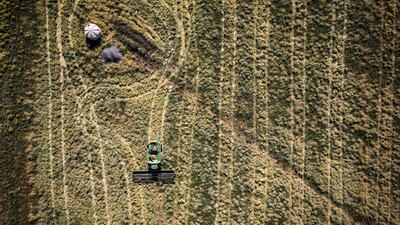
A farmer harvests grass seeds in a field in this aerial photograph taken over a farm near Gunnedah, New South Wales, Australia, on last month. Australia’s call for a probe into the origins of the virus have further strained ties. Beijing has labeled calls for the investigation "politically motivated," warning of a potential consumer boycott of Australian products. Bloomberg -
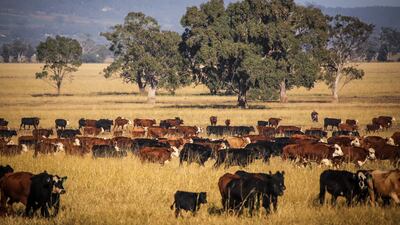
Cows walk through a field during a cattle drive at a farm in Gunnedah, New South Wales, last month. A growing number of Australia's primary producers are mulling the potential for a further tightening of restrictions on Australia's agricultural exports by China. Bloomberg -
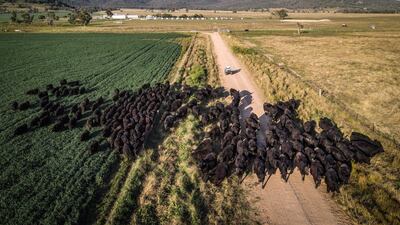
A farmer herds Black Angus cows during a cattle drive in this aerial photograph taken over a farm in Gunnedah. A growing number of Australia's primary producers are mulling the potential for a further tightening of restrictions on Australia's agricultural exports by China. Bloomberg -
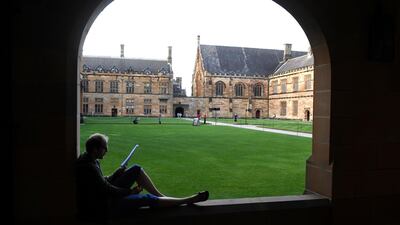
A student reads while sitting on a ledge at the Quadrangle of the University of Sydney, Australia May 2, 2017. International students are expected to begin returning to Australia next month despite Chinese warnings of pandemic-related racism, the Australian prime minister said on Friday, June 12, 2020. (Paul Miller/AAP Image via AP) -
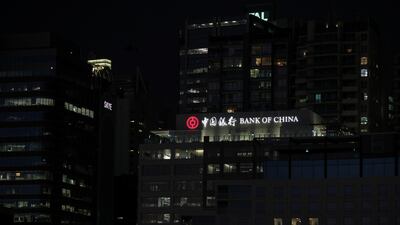
Office buildings and the Bank of China logo are seen amidst the easing of the coronavirus disease restrictions in the Central Business District of Sydney, Australia. Reuters -
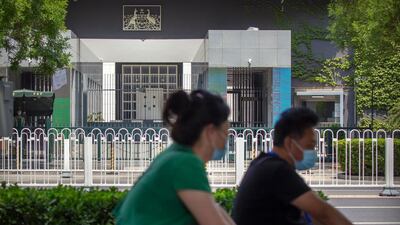
People wearing face masks to protect against the new coronavirus ride past the Australian Embassy in Beijing last week. China is advising its citizens not to visit Australia, citing racial discrimination and violence against Asians, in what appears to be Beijing's latest attempt to punish the country for advocating an investigation into the coronavirus pandemic. AP Photo -
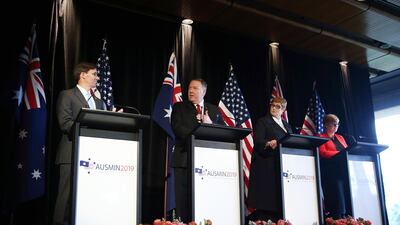
US Secretary of State Mike Pompeo, second left, alongside American and Australian officials during a news conference in Sydney. The two countries agreed to seek a probe into the outbeak of Covid-19. Bloomberg -

University of Queensland student and activist Drew Pavlou, centre, takes part in a protest in support of Hong Kong, outside the Chinese consulate in Brisbane, Australia, last month. EPA -
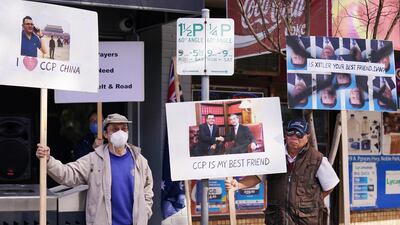
Pro democracy Hong Kong protesters gather outside the electorate office of Victorian Premier Daniel Andrews in Melbourne, Australia, last month. EPA -
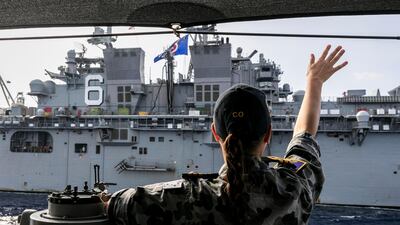
The Commanding Officer of HMAS Parramatta, Commander Anita Nemarich, waves at USS America in the South China Sea last month. Australia is a member of the so-called Quadrilateral Security Dialogue. Reuters


But as Dennis Richardson, a former top defence official and Australian ambassador to Washington, has pointed out, this approach "puts at risk more than $100 billion of exports that will impact on living standards of Australians". He thinks the Morrison administration is paying too much attention to what La Trobe's Professor Walker calls "a China-obsessed national security establishment" rather than to "advisers who actually know something about China".
No one disputes that the world needs to work out how to avoid another pandemic, and that includes drawing whatever lessons possible from this one. The Chinese reaction to Mr Morrison's stance on this and related matters may also seem excessive to some. But that reaction partly stems from Mr Morrison's desperation to appear as close as possible to Mr Trump, taking every opportunity to back him up and follow his lead, including in his tirades against China; and this at a time when people who once served the US leader and tried to do their best for him, such as the former defence secretary James Mattis, have given up on his increasingly erratic Presidency.

Mr Morrison seems to be clinging to the notion that Australia should be America’s “deputy sheriff” in the region, a somewhat subservient designation that was nonetheless embraced by the former Australian prime minister John Howard when George W Bush was in the White House. Such a one-sided relationship goes way further back than then, of course. Witness Australia’s ill-advised participation in the Vietnam War when, by contrast, Britain’s then premier Harold Wilson politely but firmly refused then US president Lyndon Johnson’s request for British combat troops.
That was half a century ago, though, and even by Mr Howard’s time it was thoroughly outdated. Geopolitically and economically Australia no longer towered above countries to its north, many of which were distinctly ambivalent about an island-state whose leadership too often gave the impression of thinking that the white man still held sway. Others in the region were not impressed, making plain that Australia had to have a rethink if it wanted to be accepted as a friend and partner in the Asia-Pacific.
As Malaysia’s then prime minister, Dr Mahathir Mohamad, said in 2002: “Australia has to choose whether it's an Asian country or a western country. If you take the position of being a deputy sheriff to America, you cannot very well be accepted by the countries of this region.”
Dr Mahathir had huge respect throughout the developing world and had been a highly forthright voice in the region for more than two decades. He punched above Malaysia’s weight, but ultimately he did not helm a major state. Australia could afford not to answer his question at that time. But now it is China that is asking it, and Canberra can duck it no more.
So far, Mr Morrison has given the wrong answer. Australia may never be a truly Asian, as opposed to a western, country. But it can and should try to be both. Mr Morrison would be advised to consider that before he continues to sing from the same songsheet as the US President, whose behaviour has done much to put the lie to any lingering myths of western superiority.
Sholto Byrnes is a commentator and consultant in Kuala Lumpur and a corresponding fellow of the Erasmus Forum

