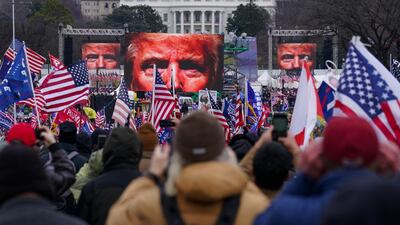
Trump supporters participate in a rally in Washington before the ugly scenes of the Capitol riots. AP Photo

America's corporate citizens want a role in governing public life


  • English
  • Arabic

Can big business help clean up America’s public square? It’s a question that matters enormously in the current context, as the US gets a new president while still wrestling with the insurrectionist impulses and polarisation promoted by the outgoing one.

A fortnight after the rampage at the US Capitol in Washington, at least two dozen American companies declared that they will penalise some Republican politicians for their alleged role in the riot as well as their frenzied legislative attempts to overturn the results of a free and fair presidential election.

Well-known international brands – including Amazon, Walmart, Disney, Nike, Airbnb, Morgan Stanley, Dell and American Express – will withhold funding to certain politicians. Dozens of other companies, including Bank of America, Target, Google, Facebook, JPMorgan, Visa, Boston Scientific and Citigroup have announced a more neutral approach, by suspending all political giving – to Republicans and Democrats alike – pending a policy "review".

The popular take on the unprecedented backlash from business towards overly unruly politicians is that Donald Trump (as well as his Republican Party) has been impeached twice in one week – by the House of Representatives on January 13 and, following that, by corporate America.

If only it were that simple. At least three questions arise from corporate America’s stated revulsion to the violent, failed attempt to derail the country’s centuries-old tradition of the peaceful transfer of power. How long will the anger last? Can a good corporate citizen really influence the change it wants to see? That is to say, is the corporate chequebook really that invaluable in the business of politics? And finally, do chief executives of large companies have the moral stature to bend an increasingly inchoate style of politics to their will?

The last question is the most easily addressed. There is good news for business in a new 28-country survey by PR agency Edelman, which has been measuring public trust in people and institutions across the world for 20 years and normally releases the Edelman Trust Barometer at the World Economic Forum in Davos. This year’s survey of 33,000 people found perilously low trust in all institutions including government, NGOs and the media, but a strikingly high level of faith in business. With 61 per cent trust level globally, business is well placed “to be the connective tissue (of a country), while the politics are sorted out,” says Richard Edelman, the company’s chief executive.

The survey explains its findings by pointing to the internationally held belief that business is the only institution that is “both ethical and competent”, but at least in America there may be another, slightly less wholesome factor. Americans emerge from this year's Edelman survey as people who repose faith only in the individuals and institutions they personally know, which means they trust the companies from whom they buy and where they work; their own boss but not a government official. This shrinking of the circle of trust to locally present entities could be seen as a form of tribalism. But it offers an undoubted opportunity for business to lead. And more to the point, to have a reasonable chance of building support for the cause.

Will it? Suspending political donations to the Republicans right now is significant but so too is the timing. The current pause coincides with the first quarter after a presidential election, a period that is normally light on donor activity anyway.

As William Oberndorf, an influential Republican donor, recently noted, it had been a mistake for the party not to oust Mr Trump during his first impeachment trial last year and “they now have a chance to address this egregious mistake and make sure Donald Trump will never be able to run for public office again”. He added, in a reference to Mr Trump’s upcoming impeachment trial in the Senate, that “Republican donors should be paying attention to how our elected officials vote on this matter”.

There is something to be said for making monetary gifts conditional on desirable political behaviour. It remains to be seen if companies will forswear the chance to clandestinely give to groups that aren’t required to disclose their donors and simply funnel the takings to unsavoury political actors.

Even so, American elections are notoriously expensive and business can expect to exert some influence, even if not always decisive. It is in corporate America’s self-interest anyway. The Aspen Institute’s Judy Samuelson, whose eponymous new book lays out the six new rules of business, says: “a business can’t succeed in a failed society”.

In fact, the implications are even more dire. Were political instability to roil America for much longer, US government bonds, long considered the safest assets on the planet, could become riskier. That would increase the US government’s long-term borrowing costs, hurting the country’s finances and its banking system.

We are not yet at that point but big business is clearly feeling and articulating the fear. “We had sedition and insurrection in DC,” says Jamie Dimon, the chief executive of JPMorgan Chase. “I feel betrayed,” adds Ken Langone, the billionaire co-founder of Home Depot and an ardent supporter of Mr Trump. “There’s going to be consequences, no question about it,” declares Ed Bastian, chief executive of Delta Air Lines. So, are they and other chief executives poised to take up the challenge of serving as “the fourth branch of government”, as some say they now must?

Perhaps America’s approach to the leverage of business on politics – and on society more generally – is best understood through the words of a US president in a different time, but faced with some of the issues that bedevil America today.

When Calvin Coolidge took office in 1923, after the scandal-scarred term of his predecessor Warren Harding, he said: “the chief business of the American people is business. They are profoundly concerned with producing, buying, selling, investing and prospering in the world.” And then the caveat that says it all: Wealth must be “the means and not the end”.

Rashmee Roshan Lall is a columnist for The National

Results

6.30pm: Mazrat Al Ruwayah Group Two (PA) US$55,000 (Dirt) 1,600m; Winner: Rasi, Harry Bentley (jockey), Sulaiman Al Ghunaimi (trainer).

7.05pm: Meydan Trophy (TB) $100,000 (Turf) 1,900m; Winner: Ya Hayati, William Buick, Charlie Appleby.

7.40pm: Handicap (TB) $135,000 (D) 1,200m; Winner: Bochart, Richard Mullen, Satish Seemar.

8.15pm: Balanchine Group Two (TB) $250,000 (T) 1,800m; Winner: Magic Lily, William Buick, Charlie Appleby.

8.50pm: Handicap (TB) $135,000 (T) 1,000m; Winner: Waady, Jim Crowley, Doug Watson.

9.25pm: Firebreak Stakes Group Three (TB) $200,000 (D) 1,600m; Winner: Capezzano, Mickael Barzalona, Salem bin Ghadayer.

10pm: Handicap (TB) $175,000 (T) 2,410m; Winner: Eynhallow, Mickael Barzalona, Charlie Appleby.

500 People from Gaza enter France

115 Special programme for artists

25   Evacuation of injured and sick

UAE currency: the story behind the money in your pockets
COPA DEL REY

Semi-final, first leg

Barcelona 1 (Malcom 57')
Real Madrid (Vazquez 6')

Second leg, February 27

The%20Iron%20Claw
%3Cp%3E%3Cstrong%3EDirector%3A%3C%2Fstrong%3E%20Sean%20Durkin%C2%A0%3C%2Fp%3E%0A%3Cp%3E%3Cstrong%3EStarring%3A%3C%2Fstrong%3E%20Zac%20Efron%2C%20Jeremy%20Allen%20White%2C%20Harris%20Dickinson%2C%20Maura%20Tierney%2C%20Holt%20McCallany%2C%20Lily%20James%3C%2Fp%3E%0A%3Cp%3E%3Cstrong%3ERating%3A%3C%2Fstrong%3E%204%2F5%3C%2Fp%3E%0A
Results

1.30pm Handicap (PA) Dh50,000 (Dirt) 1,400m

Winner Al Suhooj, Saif Al Balushi (jockey), Khalifa Al Neyadi (trainer)

2pm Handicap (TB) 68,000 (D) 1,950m

Winner Miracle Maker, Xavier Ziani, Salem bin Ghadayer

2.30pm Maiden (TB) Dh60,000 (D) 1,600m

Winner Mazagran, Tadhg O’Shea, Satish Seemar

3pm Handicap (TB) Dh84,000 (D) 1,800m

Winner Tailor’s Row, Royston Ffrench, Salem bin Ghadayer

3.30pm Handicap (TB) Dh76,000 (D) 1,400m

Winner Alla Mahlak, Adrie de Vries, Rashed Bouresly

4pm Maiden (TB) Dh60,000 (D) 1,200m

Winner Hurry Up, Royston Ffrench, Salem bin Ghadayer

4.30pm Handicap (TB) Dh68,000 (D) 1,200m

HAJJAN
%3Cp%3EDirector%3A%20Abu%20Bakr%20Shawky%C2%A0%3C%2Fp%3E%0A%3Cp%3E%3Cbr%3EStarring%3A%20Omar%20Alatawi%2C%20Tulin%20Essam%2C%20Ibrahim%20Al-Hasawi%C2%A0%3C%2Fp%3E%0A%3Cp%3E%3Cbr%3ERating%3A%204%2F5%3C%2Fp%3E%0A
WE%20NO%20LONGER%20PREFER%20MOUNTAINS
%3Cp%3E%3Cstrong%3EDirector%3A%3C%2Fstrong%3E%20Inas%20Halabi%3C%2Fp%3E%0A%3Cp%3E%3Cstrong%3EStarring%3A%20%3C%2Fstrong%3ENijmeh%20Hamdan%2C%20Kamal%20Kayouf%2C%20Sheikh%20Najib%20Alou%3C%2Fp%3E%0A%3Cp%3E%3Cstrong%3ERating%3A%3C%2Fstrong%3E%204%2F5%3C%2Fp%3E%0A

A Long Way Home by Peter Carey
Faber & Faber

COMPANY%20PROFILE
%3Cp%3E%3Cstrong%3ECompany%20name%3C%2Fstrong%3E%3A%20ASI%20(formerly%20DigestAI)%3C%2Fp%3E%0A%3Cp%3E%3Cstrong%3EStarted%3A%3C%2Fstrong%3E%202017%3C%2Fp%3E%0A%3Cp%3E%3Cstrong%3EFounders%3A%3C%2Fstrong%3E%20Quddus%20Pativada%3C%2Fp%3E%0A%3Cp%3E%3Cstrong%3EBased%3A%3C%2Fstrong%3E%20Dubai%2C%20UAE%3C%2Fp%3E%0A%3Cp%3E%3Cstrong%3EIndustry%3A%3C%2Fstrong%3E%20Artificial%20intelligence%2C%20education%20technology%3C%2Fp%3E%0A%3Cp%3E%3Cstrong%3EFunding%3A%3C%2Fstrong%3E%20%243%20million-plus%3C%2Fp%3E%0A%3Cp%3E%3Cstrong%3EInvestors%3A%3C%2Fstrong%3E%20GSV%20Ventures%2C%20Character%2C%20Mark%20Cuban%3C%2Fp%3E%0A

COMPANY PROFILE

Name: Rain Management

Year started: 2017

Based: Bahrain

Employees: 100-120

Amount raised: $2.5m from BitMex Ventures and Blockwater. Another $6m raised from MEVP, Coinbase, Vision Ventures, CMT, Jimco and DIFC Fintech Fund

Ruwais timeline

1971 Abu Dhabi National Oil Company established

1980 Ruwais Housing Complex built, located 10 kilometres away from industrial plants

1982 120,000 bpd capacity Ruwais refinery complex officially inaugurated by the founder of the UAE Sheikh Zayed

1984 Second phase of Ruwais Housing Complex built. Today the 7,000-unit complex houses some 24,000 people.  

1985 The refinery is expanded with the commissioning of a 27,000 b/d hydro cracker complex

2009 Plans announced to build $1.2 billion fertilizer plant in Ruwais, producing urea

2010 Adnoc awards $10bn contracts for expansion of Ruwais refinery, to double capacity from 415,000 bpd

2014 Ruwais 261-outlet shopping mall opens

2014 Production starts at newly expanded Ruwais refinery, providing jet fuel and diesel and allowing the UAE to be self-sufficient for petrol supplies

2014 Etihad Rail begins transportation of sulphur from Shah and Habshan to Ruwais for export

2017 Aldar Academies to operate Adnoc’s schools including in Ruwais from September. Eight schools operate in total within the housing complex.

2018 Adnoc announces plans to invest $3.1 billion on upgrading its Ruwais refinery 

2018 NMC Healthcare selected to manage operations of Ruwais Hospital

2018 Adnoc announces new downstream strategy at event in Abu Dhabi on May 13

Source: The National

PRISCILLA
%3Cp%3EDirector%3A%20Sofia%20Coppola%3C%2Fp%3E%0A%3Cp%3EStarring%3A%20Cailee%20Spaeny%2C%20Jacob%20Elordi%3C%2Fp%3E%0A%3Cp%3ERating%3A%203%2F5%3C%2Fp%3E%0A
MATCH INFO

Europa League semi-final, second leg
Atletico Madrid (1) v Arsenal (1)

Where: Wanda Metropolitano
When: Thursday, kick-off 10.45pm
Live: On BeIN Sports HD

The story in numbers

18

This is how many recognised sects Lebanon is home to, along with about four million citizens

450,000

More than this many Palestinian refugees are registered with UNRWA in Lebanon, with about 45 per cent of them living in the country’s 12 refugee camps

1.5 million

There are just under 1 million Syrian refugees registered with the UN, although the government puts the figure upwards of 1.5m

73

The percentage of stateless people in Lebanon, who are not of Palestinian origin, born to a Lebanese mother, according to a 2012-2013 study by human rights organisation Frontiers Ruwad Association

18,000

The number of marriages recorded between Lebanese women and foreigners between the years 1995 and 2008, according to a 2009 study backed by the UN Development Programme

77,400

The number of people believed to be affected by the current nationality law, according to the 2009 UN study

4,926

This is how many Lebanese-Palestinian households there were in Lebanon in 2016, according to a census by the Lebanese-Palestinian dialogue committee

The biog

Name: Fareed Lafta

Age: 40

From: Baghdad, Iraq

Mission: Promote world peace

Favourite poet: Al Mutanabbi

Role models: His parents
