Live updates: Follow the latest on Israel-Gaza
Israel’s alleged double-counting of aid lorries entering Gaza could affect Britain’s decision to continue arms exports to the country, The National can reveal.
Following the air strikes that killed three British aid workers on April 1, it is understood that Israel has promised to increase the number of aid convoys entering Gaza, which is on the brink of famine.
However, UK government is re-examining its arms export licences that provide key parts for Israeli fighter jets with a view to banning them if food supplies remain inadequate.
Sir William Patey, a former British ambassador to several Middle East countries, has also told The National that foreign office legal advice is likely to suggest the possibility that Israeli attacks “fall foul of international law”.
Disputed numbers
Britain’s angry reaction to the drone strike on the World Central Kitchen convoy, which killed seven in total, most of them westerners, led to a pledge by Israel to increase aid convoy access to 500 lorries a day.
But on Tuesday, the Israelis said 419 lorries crossed into Gaza whereas the UN put it at 238.
After further investigation it was found that the Israelis had arrived at the figure after they allegedly included lorries that had been barred from entering the Palestinian territory.
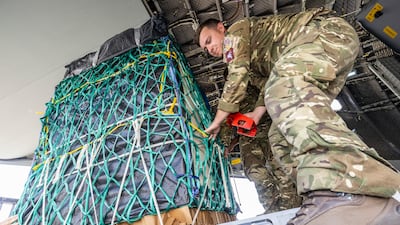
They also allegedly counted one vehicle as three when supplies from three were mounted on to a single vehicle to make a 20 tonne load and also to make up shortfalls of drivers who have visas.
Further questions have also been raised on Israel’s commitment to reopen the Erez crossing in northern Gaza, Ashdod port and the Kerem Shalom crossing around the clock.
Withdraw arms licences?
The British government is coming under increasing pressure to re-examine its arms exports licences and three sources have told The National that Foreign Secretary David Cameron is weighing up whether to withdraw them.
There is a very strict formula for licences in which the government has to be convinced that there is “no clear risk” that they are going to be used in a serious breach of international humanitarian law.
It is understood that the latest British legal advice is based on an assessment made well before the World Central Kitchen attack making it significantly out of date.
Whitehall is now rapidly re-examining the process and whether it is fulfilling its duties on the export licence criteria.
There is said to be a “pressure and appetite” to moves things quickly and re-examine the licences in “a robust fashion” although imposing a ban in the short term has been ruled out.
Britain’s reputation
Senior officials from the ruling Conservative Party have suggested that the WCK attack was a “turning point” in how the government reviewed arms exports.
“I get the impression that Lord Cameron has read the tea leaves on how this is going to affect Britain's reputation in the world,” one said.
“The public’s view of Israel is certainly changing, regarding their actions as inhumane and that it’s certainly not it's an electoral asset to be supporting unconditionally what Israel is doing. It’s now quite possible that there's a change in export licences.”
The source also suggested that Lord Cameron, a former prime minister, had the political clout to stand up to the “UK branch of the Likud party” in the Tories. “He's big enough to take it”.
Sir William, who was UK ambassador to Afghanistan, Iraq, Saudi Arabia and Sudan, said that given UK components for aircraft might have been used to attack civilian areas
“there's a case to answer, but the government has so far resisted it”.
Foreign Office lawyers’ legal opinion would likely have argued that supplying arms that “may be used in breaches of international law is possible”.
“I don't think international law would accept the Israeli rules of engagement, which seem to be that 100 civilians dead is a permissible price to pay killing one Hamas fighter,” he added.
The former diplomat, who passed dozens of arms licences during his time in the Foreign Office, suggested that the updated legal advice might lead to a departmental official refusing to agree an export licence.
“You could get a civil servant saying ‘I'm not going to sign this because of the legal advice that says that I could be implicated’.”
Sir William also said that an attack on Rafah where more than a million Palestinians are sheltering, would potentially be a “tipping point” for Britain.
If Britain did withdraw arms support it would carry the symbolic value of a major Israeli ally saying “enough is enough on the humanitarian side”, he added.
It would also increase pressure on the US although Washington was “worried that the Iranians might take some signal of diminished American military support for Israel as a sign that they could attack with impunity”.
Suspend arms
The Campaign Against the Arms Trade stated that Britain should immediately halt all arms exports.
“Under our own export guidelines, if there's a clear risk that equipment transferred could be used in the commission of war crimes operations then it has to be suspended,” said Emily Apple, spokeswoman for the pressure group.
The UK supplied 15 per cent of the F-35 fighter parts and the heads-up-display units for F-16s, with both aircraft active over Gaza.
If Britain withdrew the licences it would “send a very, very clear message that the UK will not be complicit in violations of international humanitarian law” she added.
“It will also put pressure on other countries, particularly the US over their own exports and also on Israel in terms of their conduct in this war.”

Benefits of first-time home buyers' scheme
- Priority access to new homes from participating developers
- Discounts on sales price of off-plan units
- Flexible payment plans from developers
- Mortgages with better interest rates, faster approval times and reduced fees
- DLD registration fee can be paid through banks or credit cards at zero interest rates
Company Profile
Name: Thndr
Started: 2019
Co-founders: Ahmad Hammouda and Seif Amr
Sector: FinTech
Headquarters: Egypt
UAE base: Hub71, Abu Dhabi
Current number of staff: More than 150
Funds raised: $22 million
Ziina users can donate to relief efforts in Beirut
Ziina users will be able to use the app to help relief efforts in Beirut, which has been left reeling after an August blast caused an estimated $15 billion in damage and left thousands homeless. Ziina has partnered with the United Nations High Commissioner for Refugees to raise money for the Lebanese capital, co-founder Faisal Toukan says. “As of October 1, the UNHCR has the first certified badge on Ziina and is automatically part of user's top friends' list during this campaign. Users can now donate any amount to the Beirut relief with two clicks. The money raised will go towards rebuilding houses for the families that were impacted by the explosion.”
'Peninsula'
Stars: Gang Dong-won, Lee Jung-hyun, Lee Ra
Director: Yeon Sang-ho
Rating: 2/5
UAE currency: the story behind the money in your pockets
The specs
Engine: 3.0-litre six-cylinder turbo
Power: 398hp from 5,250rpm
Torque: 580Nm at 1,900-4,800rpm
Transmission: Eight-speed auto
Fuel economy, combined: 6.5L/100km
On sale: December
Price: From Dh330,000 (estimate)
The specs
Engine: four-litre V6 and 3.5-litre V6 twin-turbo
Transmission: six-speed and 10-speed
Power: 271 and 409 horsepower
Torque: 385 and 650Nm
Price: from Dh229,900 to Dh355,000
EXPATS
%3Cp%3E%3Cstrong%3EDirector%3A%3C%2Fstrong%3E%20Lulu%20Wang%26nbsp%3B%3C%2Fp%3E%0A%3Cp%3E%3Cstrong%3EStars%3A%3C%2Fstrong%3E%20Nicole%20Kidman%2C%20Sarayu%20Blue%2C%20Ji-young%20Yoo%2C%20Brian%20Tee%2C%20Jack%20Huston%3C%2Fp%3E%0A%3Cp%3E%3Cstrong%3ERating%3A%3C%2Fstrong%3E%204%2F5%3C%2Fp%3E%0A
Our family matters legal consultant
Name: Hassan Mohsen Elhais
Position: legal consultant with Al Rowaad Advocates and Legal Consultants.
Read more from Johann Chacko
How will Gen Alpha invest?
Mark Chahwan, co-founder and chief executive of robo-advisory firm Sarwa, forecasts that Generation Alpha (born between 2010 and 2024) will start investing in their teenage years and therefore benefit from compound interest.
“Technology and education should be the main drivers to make this happen, whether it’s investing in a few clicks or their schools/parents stepping up their personal finance education skills,” he adds.
Mr Chahwan says younger generations have a higher capacity to take on risk, but for some their appetite can be more cautious because they are investing for the first time. “Schools still do not teach personal finance and stock market investing, so a lot of the learning journey can feel daunting and intimidating,” he says.
He advises millennials to not always start with an aggressive portfolio even if they can afford to take risks. “We always advise to work your way up to your risk capacity, that way you experience volatility and get used to it. Given the higher risk capacity for the younger generations, stocks are a favourite,” says Mr Chahwan.
Highlighting the role technology has played in encouraging millennials and Gen Z to invest, he says: “They were often excluded, but with lower account minimums ... a customer with $1,000 [Dh3,672] in their account has their money working for them just as hard as the portfolio of a high get-worth individual.”
Wicked: For Good
Director: Jon M Chu
Starring: Ariana Grande, Cynthia Erivo, Jonathan Bailey, Jeff Goldblum, Michelle Yeoh, Ethan Slater
Rating: 4/5
Desert Warrior
Starring: Anthony Mackie, Aiysha Hart, Ben Kingsley
Director: Rupert Wyatt
Rating: 3/5
Mercer, the investment consulting arm of US services company Marsh & McLennan, expects its wealth division to at least double its assets under management (AUM) in the Middle East as wealth in the region continues to grow despite economic headwinds, a company official said.
Mercer Wealth, which globally has $160 billion in AUM, plans to boost its AUM in the region to $2-$3bn in the next 2-3 years from the present $1bn, said Yasir AbuShaban, a Dubai-based principal with Mercer Wealth.
“Within the next two to three years, we are looking at reaching $2 to $3 billion as a conservative estimate and we do see an opportunity to do so,” said Mr AbuShaban.
Mercer does not directly make investments, but allocates clients’ money they have discretion to, to professional asset managers. They also provide advice to clients.
“We have buying power. We can negotiate on their (client’s) behalf with asset managers to provide them lower fees than they otherwise would have to get on their own,” he added.
Mercer Wealth’s clients include sovereign wealth funds, family offices, and insurance companies among others.
From its office in Dubai, Mercer also looks after Africa, India and Turkey, where they also see opportunity for growth.
Wealth creation in Middle East and Africa (MEA) grew 8.5 per cent to $8.1 trillion last year from $7.5tn in 2015, higher than last year’s global average of 6 per cent and the second-highest growth in a region after Asia-Pacific which grew 9.9 per cent, according to consultancy Boston Consulting Group (BCG). In the region, where wealth grew just 1.9 per cent in 2015 compared with 2014, a pickup in oil prices has helped in wealth generation.
BCG is forecasting MEA wealth will rise to $12tn by 2021, growing at an annual average of 8 per cent.
Drivers of wealth generation in the region will be split evenly between new wealth creation and growth of performance of existing assets, according to BCG.
Another general trend in the region is clients’ looking for a comprehensive approach to investing, according to Mr AbuShaban.
“Institutional investors or some of the families are seeing a slowdown in the available capital they have to invest and in that sense they are looking at optimizing the way they manage their portfolios and making sure they are not investing haphazardly and different parts of their investment are working together,” said Mr AbuShaban.
Some clients also have a higher appetite for risk, given the low interest-rate environment that does not provide enough yield for some institutional investors. These clients are keen to invest in illiquid assets, such as private equity and infrastructure.
“What we have seen is a desire for higher returns in what has been a low-return environment specifically in various fixed income or bonds,” he said.
“In this environment, we have seen a de facto increase in the risk that clients are taking in things like illiquid investments, private equity investments, infrastructure and private debt, those kind of investments were higher illiquidity results in incrementally higher returns.”
The Abu Dhabi Investment Authority, one of the largest sovereign wealth funds, said in its 2016 report that has gradually increased its exposure in direct private equity and private credit transactions, mainly in Asian markets and especially in China and India. The authority’s private equity department focused on structured equities owing to “their defensive characteristics.”
England's Ashes squad
Joe Root (captain), Moeen Ali, Jimmy Anderson, Jofra Archer, Jonny Bairstow, Stuart Broad, Rory Burns, Jos Buttler, Sam Curran, Joe Denly, Jason Roy, Ben Stokes, Olly Stone, Chris Woakes.