
Incidents of women being assaulted in Khartoum are on the rise. A number of attacks, including ones where women are whipped, slapped in the face and beaten in public by young men, have been recorded as a violent social media campaign seeking to “punish the immodestly dressed,” takes to the streets.
Just over two years after Islamist autocrat Omar Al Bashir was removed from power, the illegal attacks echo his notorious but now repealed rules that discriminated against women and restricted their personal freedoms.
Several women in Khartoum gave identical accounts of young men patrolling the streets, lashing their victims before speeding off in their cars.
The National spoke to men who readily admitted to taking part in beatings and who have been trying to rally support for the campaign, known as "Assawt", after the Arabic word for whip.
The attacks kicked off after a hashtag promoting the crackdown on women's freedom went viral on social media at the end of March. Facebook posts showed hundreds of messages of support from Sudanese men.
The drive-by floggings coincide with the second anniversary of a public uprising that toppled Al Bashir, who seized power in a 1989 coup and ruled the country for nearly 30 years.
"This heinous campaign was launched by a group of misogynistic, insecure and radical men who can't tolerate seeing women taking their places in society after the December revolution," Enass Muzamel, a Sudanese human rights activist, told The National.
Ms Muzamel, 31, recently had a close call with a group of men wielding whips while she was cycling around a walled-off compound.
“I was on my bicycle with a group of women a few days ago and it happened to us,” she said. “A group of around four young men disembarked from their car and started shouting through the gate: ‘Next time we will lash all of you. Put on headscarves!’”
Public order laws introduced in 1991 imposed many restrictions on personal freedoms, particularly for women.
Under the laws, Sudanese women faced arrest and punishment of up to 40 lashes for "indecent and immoral acts", purposely kept vague.
Sudan's new transitional government – a joint military-civilian council with a civilian-led Cabinet – revoked the laws soon after being installed in 2019. Repealing them was a key demand of the protesters who took the streets calling for reforms.
Prime Minister Abdalla Hamdok has paid tribute to women who had "endured the atrocities that resulted from the implementation of this law".
Sudanese women’s groups and female activists played a key role in the 2019 uprising and in the powerful professional unions that rallied the crowds.
The threat of an 'endless loop of misogyny'

For Salma Abdel Kareem, a 27-year-old food delivery rider, the social media campaign sounded ominous from the start.
With the pandemic already taking a toll on her mental health, for Ms Abdel Kareem and other women, the threat of punishment as part of the campaign has been like a ticking time-bomb.
"I was waiting at the bus stop. Then a car slowed down and a guy hit the ground with a whip to intimidate me. He said next time they will flog me if they find me wearing trousers and a short-sleeved T-shirt,” she said.
For someone like Ms Abdel Kareem, whose job requires her to get out and about on her bicycle in a deeply conservative society, the challenges are enormous even without the threat of violence over her choice of clothes.
“I always carry a sharp object to defend myself if men sexually harass or try to assault me like these whip campaign idiots,” she said, adding that she had threatened her would-be floggers.
“I was scared deep inside.”
The campaign of intimidation and violence has also made life difficult for university student Ramaz Al Fadel, 19, who was slapped in the face by a man for wearing trousers.
“I was on my way home last month from university and a man got closer to me and told me off for wearing a T-shirt and jeans,” she recalled.
“I told him it was none of his business, then he slapped me hard on my face.
“It was more shocking to me that men passing by stood idle and even justified his act.”
Ms Al Fadel, who said her family was proudly left-wing, hasn’t given in to the abuse. “I took the incident in my stride, but what made me really angry and sad was the way other men stood by that violent, barbaric man. One of them said: ‘It’s all right! He’s like your big brother.’”
Women in Sudan, she said, “live in an endless loop of misogyny”. “Abuse by men follows abuse by men.”

Some men feel they are entitled to act violently. Mohamed Ahmed Al Tayib, 34, said women deserved to be punished for dressing immodestly.
“They violate my rights too. They are trying to arouse me with their dresses. This is a basic instinct in men,” he claimed.
“They are everywhere – I turn my eye from the left side to find another one in revealing clothes on the right.”
Mr Al Tayib said he believed he was entitled to punish women he considered to be dressed inappropriately because he was “a real man”.
He added that he had no problem with his wife or sister being lashed by another man for the clothes they were wearing.
“If I don’t beat them myself, then men are encouraged to beat them.”
What the Sudanese government says
-
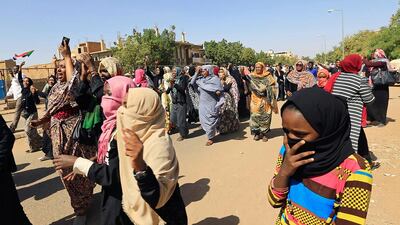
Sudanese women chant slogans near the home of a demonstrator who died of a gunshot wound sustained during anti-government protests in Khartoum, Sudan. Reuters -

Sudanese women march in Khartoum to mark International Day for Eliminating Violence against Women, in the first such rally held in the northeast African country in decades, on November 25, 2019. - Chanting "Freedom, peace, justice," the catchcry of the protest movement that led to autocrat Omar al-Bashir's ouster in April, the demonstrators took to the streets in the Burri district, a site of regular anti-Bashir protests earlier this year. AFP -
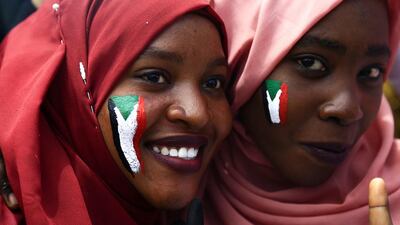
Sudanese women with national flags painted on their faces take part in a rally in the area of the military headquarters in the capital Khartoum. AFP -
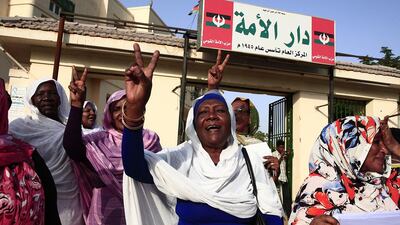
Sudanese women take part in a rally against the oppression of women, in Oumdurman the capital Khartoumís twin city. AFP -

A Sudanese woman takes part in a rally against the oppression of women, in Oumdurman the capital Khartoumís twin city. AFP -
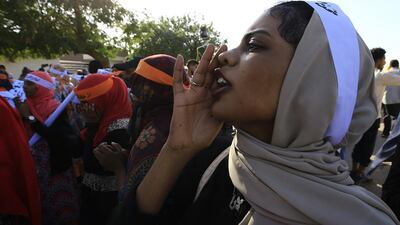
Sudanese women march in Khartoum to mark International Day for Eliminating Violence against Women, in the first such rally held in the northeast African country in decades, on November 25, 2019. Chanting "Freedom, peace, justice," the catchcry of the protest movement that led to autocrat Omar al-Bashir's ouster in April, the demonstrators took to the streets in the Burri district, a site of regular anti-Bashir protests earlier this year. AFP -
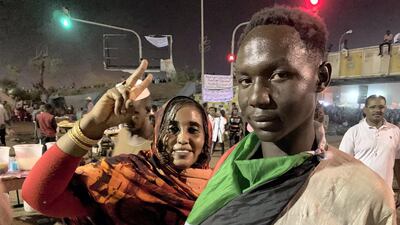
This May 1, 2019 photo shows Sudanese protester Mohammed Bakr campaigning for women's rights at the site of a sit-in outside the headquarters of the Sudanese armed forces. Photo by Hamza Hendawi for The National. -
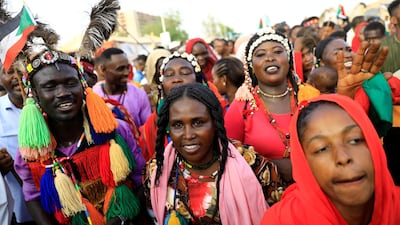
Sudanese women have played a major role in the protests that led to the fall of Omar Al Bashir. Reuters


The outcry over the campaign was swift and broad in Sudan, drawing widespread condemnation from women.
But men were less vocal in the ensuing heated debates that played out on social media.
The public floggings come at an extraordinarily delicate moment for Sudan. The country is marking the second anniversary of the revolution, which broke out after decades of oppression under a regime that ruled by decree.
"This campaign is a full-frontal attack on our democracy," the First Assistant of the Public Prosecutor in Sudan, Mamoun Farouq, told The National.
“This will be treated as an act of terror. If women are hit on the streets for their clothes, this is terrorism and flagrant violation of their human rights,” he said.
“We encourage any girl or woman who has been threatened or hit by such criminals to stand up and be counted. They should report such crimes to the police and they will find support."
Mr Farouq said however that most of the incidents go unreported, “because women fear stigma in society”.
'Flog me if you dare'
The public order laws made international headlines in 2009 when United Nations worker Lubna Hussein was arrested along with other women for wearing trousers in a restaurant in Khartoum.
Ms Hussein challenged her arrest in court, rebuffed a presidential pardon, but was later released after the Union of Journalists paid a fine.
Now living in Canada after moving between many countries since leaving Sudan three months after the traumatic incident, Ms Hussein has been able to put the event into perspective.
"My arrest for wearing trousers back in 2009 was not the strongest shock in my life," she told The National in a phone interview. "We have thick skin, as we say in Sudan.
“When I was 18 they arrested me after taking part in a campus protest against Bashir and put me in solitary confinement for one week.”
Today, Ms Hussein is torn between desperation and hope when she thinks about what the future holds for Sudan.
“Today women live in a new Sudan after removing Bashir, they should tell these abusive men in the face: ‘flog me if you dare,’” she said.
Long-standing ties between the state and religion have darkened her outlook, however.
“We can’t really make any progress in society if we don’t separate governance and religion,” she said.
“The government is responsible for opening hospitals, schools, and creating job opportunities. It has nothing to do with sending people to hell or paradise.”
The mass protests that convulsed Khartoum two years ago may have ousted Al Bashir, but the transitional government is still trying to stamp out the rampant misogyny that was allowed to flourish during his tenure. Sudan is not a signatory to the Convention on the Elimination of all Forms of Discrimination Against Women (CEDAW).
But the transitional authorities have introduced key reforms including repealing the abusive public order law, outlawing female genital mutilation and removing the death penalty and lashing as punishments for many offences.
Rights activists and Sudanese women have fought hard for greater freedoms for themselves and their country during decades of oppression under Al Bashir.
But their fight isn’t only against repressive rules.
Women are trying to uproot deeply-held beliefs, tied up with traditions, that permeate many areas of Sudanese society.
“Masculinity is deeply anchored in Sudanese society,” said Ms Muzamel. “You have the evil mix of masculinity and tradition, which is very hard to defeat.”
Women in Sudan, she said, continue to live under the protection of male guardians even after the controversial public order laws were repealed.
Ms Muzamel blamed families for giving men a sexist and misogynist “mandate” to dictate how women should behave in public.
“For them, a civil country is synonymous with obscenity and debauchery,” she said. "They see women wearing jeans, make-up or piercing their noses with the traditional Zummam ring as a sign of indecency."
The public order laws, she said, were designed to live on as a way of thinking in the minds of men and women.
Additional reporting Shawki Abdel Azeem in Khartoum

