
Top Palestinian officials on Tuesday welcomed a report by Human Rights Watch that accused Israel of committing the crime of "apartheid" by seeking to maintain Jewish "domination" over Palestinians and its own Arab population.
The explosive allegations were fiercely denounced by Israel.
Palestinian President Mahmoud Abbas called for international action on what he said were “war crimes”.
"It is urgent for the international community to intervene, including by making sure that their states, organisations and companies are not contributing in any way to the execution of war crimes and crimes against humanity in Palestine," he said.
Palestinian Prime Minister Mohammad Shtayyeh also welcomed the report.
It “articulately defines Israeli policies and atrocities against the Palestinian people using the proper legal definition for crimes and criminals,” he said on Tuesday.
HRW said its finding that Israel is "committing the crimes against humanity of apartheid and persecution" against Palestinians was based on robust sourcing including government planning materials and statements by public officials.
The 213-page report finds that the Israeli government is the "single authority" with primary control "over the area between the Jordan River and the Mediterranean Sea".
Currently under investigation by the International Criminal Court for alleged war crimes, Israel blasted HRW's accusations as "preposterous and false", accusing the New York-based group of having "a long-standing anti-Israeli agenda".
"The purpose of this spurious report is in no way related to human rights, but to an ongoing attempt by HRW to undermine the State of Israel's right to exist as the nation state of the Jewish people," Strategic Affairs Minister Michael Biton said.
Israel's Foreign Ministry told AFP the HRW report amounted to a "propaganda pamphlet" from an organisation that has been "actively seeking for years to promote boycotts against Israel".
The ministry said HRW's Israel programme was being "led by a known [BDS] supporter, with no connection to facts or reality on the ground," referring to the pro-Palestinian Boycott, Divestment and Sanctions movement.
-
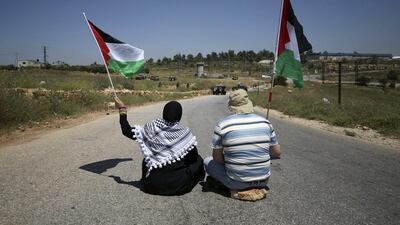
Palestinian protesters wave flags as Israeli troops take position during a protest against Jewish settlements in the West Bank village of Nabi Saleh, near Ramallah. Reuters -
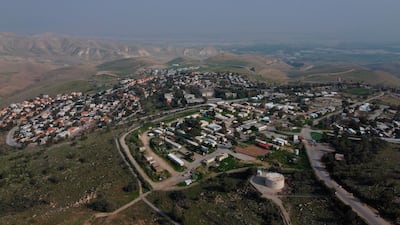
Now that Prime Minister Benjamin Netanyahu has secured a new term in office, there’s little to prevent him from annexing large parts of the West Bank as early as this summer. AP -

An Israeli soldier stands guard during a tour made by Israeli parliament members in the Jordan Valley near the Jewish settlement of Maale Efrayim. Reuters -
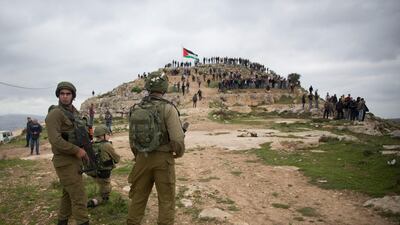
Israeli soldiers take position as Palestinian demonstrators gather during a protest against expansion of Israeli settlements in the West Bank. AP -
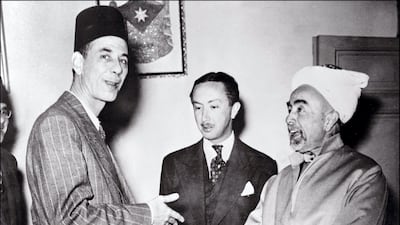
King Abdullah (r) of Transjordan on May 13, 1948 in Amman with Abed Al Rahman Azzam, the secretary general of the Arab League and Abd Al Elah Ibn Ali, the Prince Regent of Iraq, the day before the beginning of the first Arab-Israeli War. AFP -
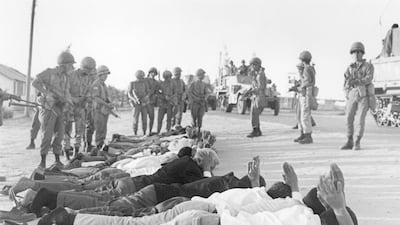
Palestinians surrender to Israeli soldiers in June 1967 in the occupied territory of the West Bank after Israel launched a pre-emptive attack on Egypt and Syria and seized the Gaza Strip, Sinai Peninsula and the Golan Heights in Syria as well as the West Bank and Arab East Jerusalem. AFP -
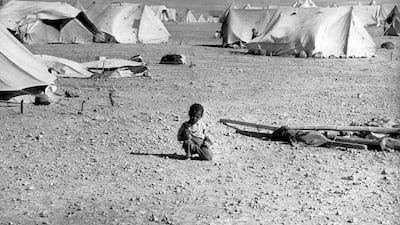
A Palestinian child plays in a refugee camp in Jordan on June 23, 1967. AFP -
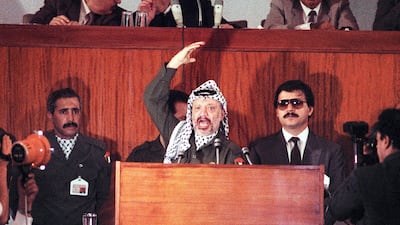
PLO chairman Yasser Arafat delivers a speech to the Palestine National Council meeting to make the historic proclamation of a Palestinian state in the Israeli-occupied territories and to recognize Israel in the Palace of Nations conference hall on November 12, 1988, in Algiers. AFP -

US President Bill Clinton stands between PLO leader Yasser Arafat and Israeli Prime Minister Yitzahk Rabin as they shake hands for the first time on September 13, 1993 at the White House. AFP -
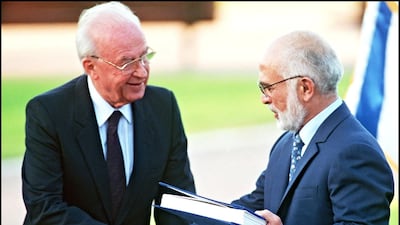
Hussein Ibn Talal, King of Jordan and Israeli Premier Yitzhak Rabin shake hands after they exchanged the documents of the Peace Treaty at Beit Gabriel conference centre on November 10, 1994 on the southern shore of the Sea of Galilee. AFP -
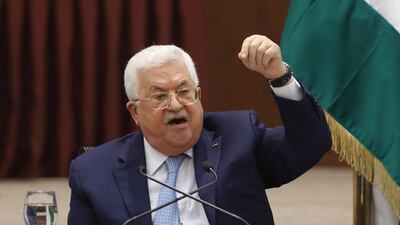
Palestinian President Mahmoud Abbas speaks during the Palestinian leadership meeting and threatened to end security coordination with Israel and the United States, saying Israeli annexation would ruin chances for peace. AFP -
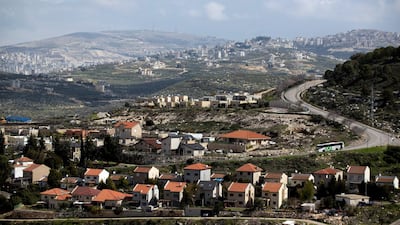
Houses in the Israeli settlement of settlement of Kedumim are seen in the foreground as part of the Palestinian city of Nablus is seen in the background (far left) in the Israeli-occupied West Bank. Reuters -
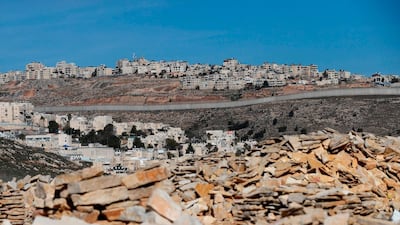
Israel's controversial concrete barrier (C) separating the Jewish settlement of Neve Yaakov (foreground) in the northern part of east Jerusalem and the Palestinian area of al-Ram (background) in the occupied West Bank. AFP -

An Israeli activist holds a banner during a protest against the US peace plan for the Middle East, in front of the US ambassador's residence in Jerusalem, on May 15, 2020, as Palestinians commemorate the 72nd anniversary of the 1948 Nakba or "catastrophe". AFP -
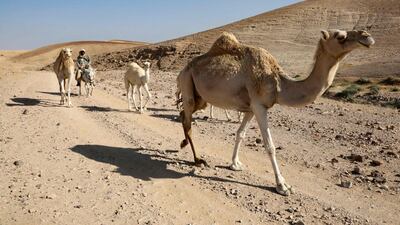
A Palestinian shepherd tends to his camels on arid land considered to be in "Area C" (under Israeli security and administrative control), southeast of Yatta town in the southern West Bank district of Hebron. AFP -
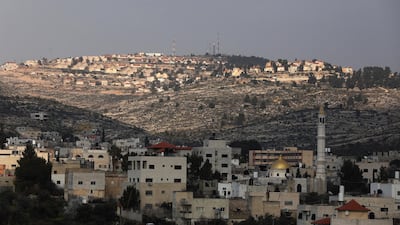
A general view of the Israeli settlement of Elon Moreh, as seen from the Palestinian village of Azmout near the West Bank City of Nablus. EPA -
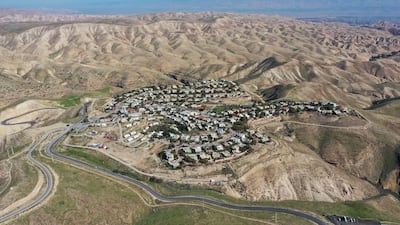
The West Bank Jewish settlement of Maale Michmash. AP


The report's author, HRW Israel and Palestine Director Omar Shakir, was expelled from Israel in 2019 over accusations he backs BDS.
Mr Shakir denies that his work and pro-Palestinian statements he made before being appointed to the HRW post in 2016 constitute active support for BDS.
He said HRW also sent the ICC its 2018 report about possible crimes against humanity by Mr Abbas's Palestinian Authority and the Islamist militant Hamas.
But, he told AFP there have been warnings for years that "apartheid is around the corner".
"I think it's quite clear that that threshold has been crossed," Mr Shakir said from Jordan.
Within Israeli controlled territory, there is "an overarching Israeli government policy to maintain the domination by Jewish Israelis over Palestinians," HRW said.
The group said its findings apply to Israeli treatment of Palestinians in the occupied West Bank, the blockaded Gaza Strip, occupied East Jerusalem as well as to Arab Israelis – a term referring to Palestinians who stayed on their land following Israel's creation in 1948.
HRW said that while apartheid was initially coined with respect to the institutional persecution of blacks in South Africa, it was now a universally recognised legal term.
An apartheid system is defined by "an effort to maintain domination by one racial group over another, a context of systematic oppression by the dominant group over the marginalised group [and] inhuman acts," the group said.
Israel has occupied the West Bank since 1967, the same year it annexed east Jerusalem.
Since then, Jewish settlers in both areas have absorbed increased amounts of land.
Palestinians in East Jerusalem and across much of the West Bank are regularly denied building permits, while Jewish home construction has steadily grown.
While HRW is the first major international organisation to level the controversial apartheid charge against Israel, it is following a move made last year by Israeli civil society group B'Tselem.
The settler watchdog charged that the "Israeli regime implements laws, practices and state violence designed to cement the supremacy of one group – Jews – over another – Palestinians."

