Latest from the Israel-Gaza war - in pictures
-
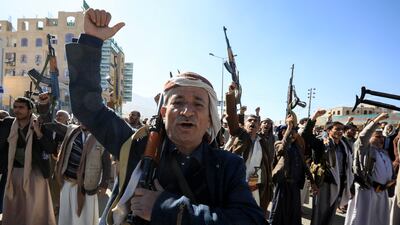
Houthi fighters shout gather in Sanaa. The rebels have launched attacks in the Red Sea in response to the Gaza war. EPA -

From left, Israeli Foreign Ministry adviser Tal Becker, lawyer Malcolm Shaw and Gilad Noam, deputy attorney general for international affairs, at the International Court of Justice in The Hague. AFP -

A Palestinian man injured in an Israeli strike receives treatment in Khan Younis, southern Gaza. AP -
Palestinian medics mourn after members of the Palestinian Red Crescent were killed in an Israeli strike in Deir Al Balah. Reuters -

Israeli soldiers take up positions during a ground operation in Khan Younis. AP -

Mourners gather at Al Najar hospital in Rafah, after several relatives of a member of the Hamas general military council were killed in a strike. AFP -
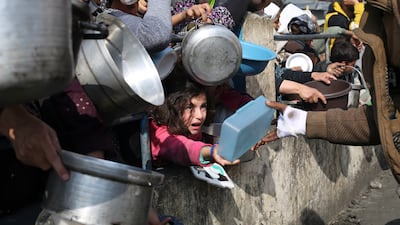
Palestinians wait to receive food aid in Rafah. AP -

A mass grave in Rafah. More than 23,000 people have been killed in Gaza since October 7. AFP -

Palestinians search the rubble of destroyed buildings after an Israeli attack on Rafah. AFP -

Injured Palestinians receive treatment at Nasser hospital in Khan Younis. AFP -
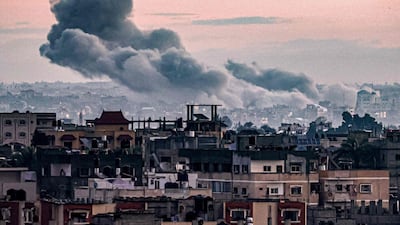
Smoke rises over Khan Younis in the southern Gaza Strip, as seen from Rafah, during sustained Israeli air strikes. AFP -
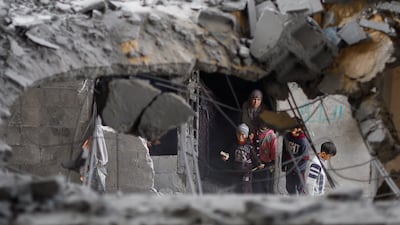
The destruction has spread throughout the Gaza Strip, from the north to Rafah in the south. Reuters -

Israeli soldiers stand on an armoured personnel carrier near the Israel-Gaza border, in southern Israel. Reuters -
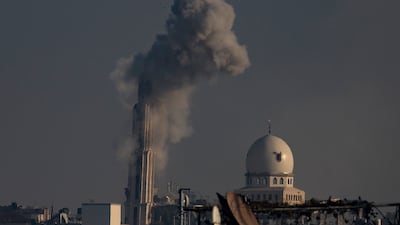
Smoke rises following Israeli air strikes in Khan Younis, the southern Gaza Strip. EPA -
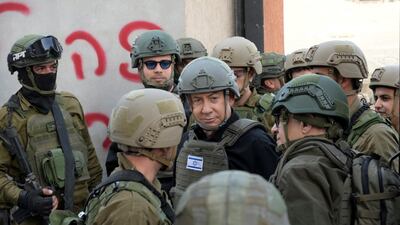
Israeli Prime Minister Benjamin Netanyahu receives a security briefing with commanders and soldiers in the northern Gaza Strip. AP -

Palestinians mourn their relatives killed in an Israeli strike on the Al Maghazi refugee camp. AFP -

A Palestinian man detained by the Israeli military awaits treatment for his injuries in Rafah. AFP


The five new places of worship
Church of South Indian Parish
St Andrew's Church Mussaffah branch
St Andrew's Church Al Ain branch
St John's Baptist Church, Ruwais
Church of the Virgin Mary and St Paul the Apostle, Ruwais
Specs
Engine: Dual-motor all-wheel-drive electric
Range: Up to 610km
Power: 905hp
Torque: 985Nm
Price: From Dh439,000
Available: Now
THE BIO
Ambition: To create awareness among young about people with disabilities and make the world a more inclusive place
Job Title: Human resources administrator, Expo 2020 Dubai
First jobs: Co-ordinator with Magrudy Enterprises; HR coordinator at Jumeirah Group
Entrepreneur: Started his own graphic design business
Favourite singer: Avril Lavigne
Favourite travel destination: Germany and Saudi Arabia
Family: Six sisters
You might also like
Brief scores:
Manchester United 4
Young 13', Mata 28', Lukaku 42', Rashford 82'
Fulham 1
Kamara 67' (pen),
Red card: Anguissa (68')
Man of the match: Juan Mata (Man Utd)
Ten tax points to be aware of in 2026
1. Domestic VAT refund amendments: request your refund within five years
If a business does not apply for the refund on time, they lose their credit.
2. E-invoicing in the UAE
Businesses should continue preparing for the implementation of e-invoicing in the UAE, with 2026 a preparation and transition period ahead of phased mandatory adoption.
3. More tax audits
Tax authorities are increasingly using data already available across multiple filings to identify audit risks.
4. More beneficial VAT and excise tax penalty regime
Tax disputes are expected to become more frequent and more structured, with clearer administrative objection and appeal processes. The UAE has adopted a new penalty regime for VAT and excise disputes, which now mirrors the penalty regime for corporate tax.
5. Greater emphasis on statutory audit
There is a greater need for the accuracy of financial statements. The International Financial Reporting Standards standards need to be strictly adhered to and, as a result, the quality of the audits will need to increase.
6. Further transfer pricing enforcement
Transfer pricing enforcement, which refers to the practice of establishing prices for internal transactions between related entities, is expected to broaden in scope. The UAE will shortly open the possibility to negotiate advance pricing agreements, or essentially rulings for transfer pricing purposes.
7. Limited time periods for audits
Recent amendments also introduce a default five-year limitation period for tax audits and assessments, subject to specific statutory exceptions. While the standard audit and assessment period is five years, this may be extended to up to 15 years in cases involving fraud or tax evasion.
8. Pillar 2 implementation
Many multinational groups will begin to feel the practical effect of the Domestic Minimum Top-Up Tax (DMTT), the UAE's implementation of the OECD’s global minimum tax under Pillar 2. While the rules apply for financial years starting on or after January 1, 2025, it is 2026 that marks the transition to an operational phase.
9. Reduced compliance obligations for imported goods and services
Businesses that apply the reverse-charge mechanism for VAT purposes in the UAE may benefit from reduced compliance obligations.
10. Substance and CbC reporting focus
Tax authorities are expected to continue strengthening the enforcement of economic substance and Country-by-Country (CbC) reporting frameworks. In the UAE, these regimes are increasingly being used as risk-assessment tools, providing tax authorities with a comprehensive view of multinational groups’ global footprints and enabling them to assess whether profits are aligned with real economic activity.
Contributed by Thomas Vanhee and Hend Rashwan, Aurifer
Four reasons global stock markets are falling right now
There are many factors worrying investors right now and triggering a rush out of stock markets. Here are four of the biggest:
1. Rising US interest rates
The US Federal Reserve has increased interest rates three times this year in a bid to prevent its buoyant economy from overheating. They now stand at between 2 and 2.25 per cent and markets are pencilling in three more rises next year.
Kim Catechis, manager of the Legg Mason Martin Currie Global Emerging Markets Fund, says US inflation is rising and the Fed will continue to raise rates in 2019. “With inflationary pressures growing, an increasing number of corporates are guiding profitability expectations downwards for 2018 and 2019, citing the negative impact of rising costs.”
At the same time as rates are rising, central bankers in the US and Europe have been ending quantitative easing, bringing the era of cheap money to an end.
2. Stronger dollar
High US rates have driven up the value of the dollar and bond yields, and this is putting pressure on emerging market countries that took advantage of low interest rates to run up trillions in dollar-denominated debt. They have also suffered capital outflows as international investors have switched to the US, driving markets lower. Omar Negyal, portfolio manager of the JP Morgan Global Emerging Markets Income Trust, says this looks like a buying opportunity. “Despite short-term volatility we remain positive about long-term prospects and profitability for emerging markets.”
3. Global trade war
Ritu Vohora, investment director at fund manager M&G, says markets fear that US President Donald Trump’s spat with China will escalate into a full-blown global trade war, with both sides suffering. “The US economy is robust enough to absorb higher input costs now, but this may not be the case as tariffs escalate. However, with a host of factors hitting investor sentiment, this is becoming a stock picker’s market.”
4. Eurozone uncertainty
Europe faces two challenges right now in the shape of Brexit and the new populist government in eurozone member Italy.
Chris Beauchamp, chief market analyst at IG, which has offices in Dubai, says the stand-off between between Rome and Brussels threatens to become much more serious. "As with Brexit, neither side appears willing to step back from the edge, threatening more trouble down the line.”
The European economy may also be slowing, Mr Beauchamp warns. “A four-year low in eurozone manufacturing confidence highlights the fact that producers see a bumpy road ahead, with US-EU trade talks remaining a major question-mark for exporters.”

