

Sudanese Prime Minister Abdullah Hamdok announced the formation of a new government on Monday.
Dr Mariam Al Mahdi is the new foreign minister in a Cabinet comprising 25 members.
A medical doctor by education, she is no stranger to the political landscape – making her a good fit for Sudan’s latest ministerial formation.
The country is facing a number of crises on both the economic and security fronts, including rising prices and security challenges along the Sudanese-Ethiopian border and the Ethiopian Grand Renaissance Dam and its repercussions on Sudan's water security.
Daughter of the late politician and former Sudanese prime minister Al Sadiq Al Mahdi, Dr Al Mahdi served as vice president of the Sudanese National Umma Party and a spokeswoman for the Council of Partners for the Transitional Period.
The National Umma party was founded by Dr Al Mahdi's father, after he was overthrown by the Islamist government led by Omar Al Bashir in 1989.
Both father and daughter were key opposition leaders against dictator Mr Al Bashir, who was removed from power by his generals in April 2019 after months of street protests against his 29-year rule.
Dr Al Mahdi is the second woman to hold the position of foreign affairs minister in the history of Sudan.
Asma Muhammad Abdullah was appointed as the foreign minister in late 2019, as part of Sudan's 18-member transitory council.
In his speech on Monday, Mr Hamdok said the new Sudanese government aimed to seek balanced foreign relations. He said the new Cabinet was chosen based on the competency and abilities of its members.
Opposition parties were weakened greatly under Al Bashir's three-decade regime, and are jostling for power with the military during Sudan's transition, making the Umma Party's continued unity crucial to maintaining the balance of power.
Dr Al Mahdi accumulated almost three decades of political experience, working to free her country from the role of the Muslim Brotherhood, through her many positions in the National Umma Party.
At the same time, she studied to obtain her first degree in general medicine and surgery from the University of Jordan in 1991, followed by degree in tropical paediatric medicine from Liverpool Schools of Tropical Medicine in 1995.
She only practised medicine as a general practitioner in Sudan’s children hospitals for six years in the mid-1990s.
Dr Al Mahdi furthered her studies, and received a higher diploma in development and gender issues from Ahfad University for Girls in Omdurman in 2006, and a Bachelor of Law from Neelain University in Sudan in 2013.
-
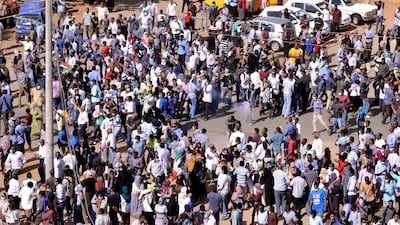
Sudanese demonstrators eject a teargas canister lobbed to disperse them as they march along the street during anti-government protests in Khartoum, Sudan December 25, 2018. Reuters -
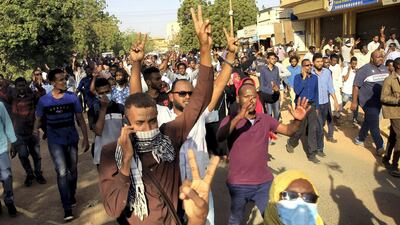
Sudanese demonstrators chant slogans as they march along the street during anti-government protests in Khartoum, Sudan December 25, 2018. Reuters -

Sudanese demonstrators run from teargas lobbed to disperse them as they march along the street during anti-government protests in Khartoum, Sudan December 25, 2018. Reuters -
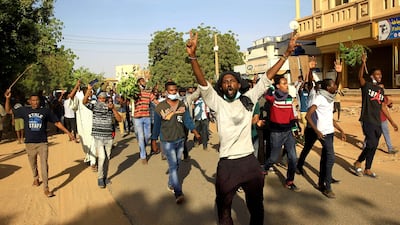
Sudanese demonstrators chant slogans as they march along the street during anti-government protests in Khartoum, Sudan December 25, 2018. Reuters -

Sudanese protesters run away from tear gas smokes during a demonstration in Khartoum, on December 31, 2018. AFP -
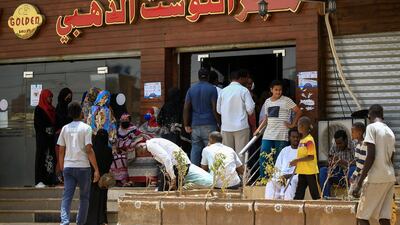
Residents of the Sudanese capital Khartoum queue in front of a bakery. AFP -

People stand in a queue on July 31, 2019 outside a bakery in the central Sudanese city of Al-Obeid, two days after five pupils were shot dead for protesting against a shortage of bread. AFP -

People stand in a queue on July 31, 2019 outside a bakery in the central Sudanese city of Al-Obeid, two days after five pupils were shot dead for protesting against a shortage of bread. AFP


With the start of protests in Sudan to overthrow Omar Al Basher in late 2018, Dr Al Mahdi supported an end to Bashir’s three-decade rule.
Due to her active role in public life, Dr Al Mahdi was detained several times by security forces, last of which was in January 2019 as anti-government protests spread to Khartoum university.
According to Amnesty international’s website, Dr Al Mahdi was also was arrested and detained on August 11, 2014 without charge and an in unknown location as she arrived at Khartoum Airport.
Dr Al Mahdi's father died from the coronavirus last November at the age of 84. He was Sudan's last democratically elected prime minister prior to the military coup that brought former president Omar Al Bashir to power.

