

In the dozen conflicts and warzones where Lise Grande has worked, she says women's right have been marginalised, neglected or entirely forgotten.
Before becoming President and CEO of the US Institute for Peace in December last year, Ms Grande served as UN Humanitarian Coordinator in the world’s worst place for women: Yemen.
"Since the war started, 80 per cent of the population have been hurt but those hurt the most are women … Women are a million times worse off because of the war. They have lost access to food, access to the political sphere, access to education and access to healthcare," she told The National before International Women's Day on March 8.
“At the same time, women are also the ones expected to cope with every disaster, to feed the family, get medicines when children are sick, find fuel, look after relatives, run the household, even as their own lives are disintegrating."
Women are not offered the resources to carry out the disproportionately large responsibility expected of them by society, she added.
“The burden of supporting and caring for their families falls on them. Women are the least empowered but expected to do the most despite this.”
Women’s oppression does not occur within one sect, group or affiliate but across the board, Ms Grande says.
“The systems of patriarchy, power and oppression are deeply embedded and extremely difficult to transform. That also means that the process of change is not something that will happen quickly or overnight. It’s a long road and struggle."
For 13 years in the row, Yemen ranked last in the World Economic Forum’s Global Gender Gap Index, making it the worst place for a woman to live.
-
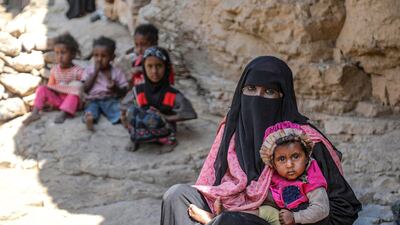
A woman holds a child as she sits near other children outside a cave where a Yemeni family has sought refuge due to poverty and lack of housing, west of the suburbs of Yemen's third city of Taez. AFP -

Women wait to receive supplemental nutrition shakes at malnutrition treatment ward of al-Sabeen hospital in Sanaa, Yemen. Reuters -

Yemeni women pick the rounded flesh leaves of Ghulaf to use as a main meal at the mountain village of Bani al-Qallam, some 100 km south west of Sanaa, Yemen. EPA -
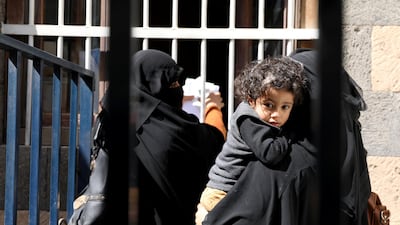
Women and a boy wait for foodstuff assistance vouchers at an aid distribution center in Sanaa, Yemen. Reuters -
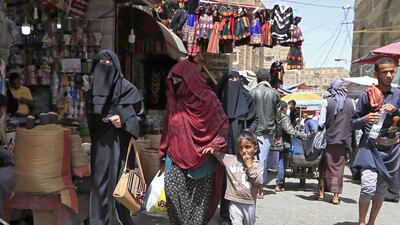
Yemeni women walk past shops in the old city market of the capital Sanaa. AFP -
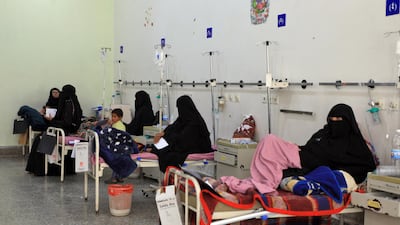
Women sit with their children receiving treatment at al-Sabeen Maternity and Child Hospital in the Yemeni capital Sanaa. AFP -
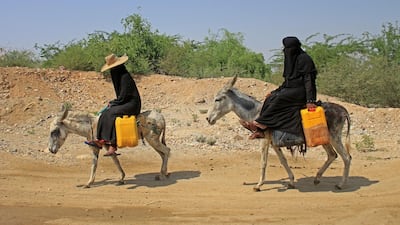
Yemeni women commute on donkeys carrying jerrycans of water at a camp for internally displaced people by conflict in the northern Hajjah province. AFP


It moved up four places in the Index’s 2020 edition but remains the least progressive country for women in the Middle East.
Only a third of women in Yemen are literate, making up less than 2 per cent of the political process and a mere 6 per cent of the labour force, the lowest in the world, according to the 2020 Global Gender Gap Index.
Ms Grande says she saw some of this first hand.
"I was the only woman in 98 per cent of all official meetings in Yemen," she said.
In 2019, rights group Amnesty International released a report featuring interviews with women from Sanaa, Taez and Marib.
“By God, I am broken from the inside. It’s not normal, I don’t feel like a human being. I can’t breathe properly like other human beings," one of the women told Amnesty.
"We suffer from the forced niqab, child marriage, divorce shame, domestic violence and honour killings. I don’t know … as if we are aliens. They [male family members] have to oppress us and we have to stay oppressed – like a puppet controlled by strings."
Ms Grande says the situation for women in Yemen was incomparably dire – even against other conflicts she has worked in like Sudan, the Congo and Armenia.
“I have seen nothing like it,” Ms Grande says.
Against all odds, local and UN-supported women’s rights groups exist across Yemen, hoping to make strides for women in education, policy, and human rights.
Organisations like women-led NGO Food 4 Humanity and the Abs Development Organisation for Woman and Child (ADO) have collaborated with other like-minded groups on equality in Yemen.
“It is our collective responsibility to support these groups, politically and financially, and to stand in solidarity with them," Ms Grande said.
Some 230,000 Yemenis have been killed since the war began with the Houthi takeover of Sanaa in 2015, and the Saudi-led Arab Coalition's intervention to restore Yemen's legitimate government into power, according to UN estimates.
For years, the UN and the US have been attempting to bring all warring parties of the conflict to a negotiating table for peace talks.
While progress has been made on several occasions, resulting in the mutual release of prisoners and precarious ceasefires, lasting and concrete steps have yet to be taken in the political process.
“People make the argument that the peace process is hard enough and that it would be harder to achieve and take longer if the process has to include women. 'We’ll get to the women later,' people would say. That’s what has to stop and that has to stop now,” Ms Grande said.
“It’s high time that the mediators who help to build peace are women. Women mediators won’t say that women’s equality can wait – that men have created the problem and need to solve it. As victims of patriarchy women mediators understand, in ways that most male mediators do not, that patriarchal systems do not produce lasting peace or equality.”
On this year’s International Women’s Day, Ms Grande says one of the most important things the world can all do is to honour, support and stand in solidarity with women in every country who are struggling for peace and changing the patriarchal status quo.
"Our job is to help build networks of women across the world that may one day be the foundation for tangible progress in the realm of women’s rights in Yemen."

