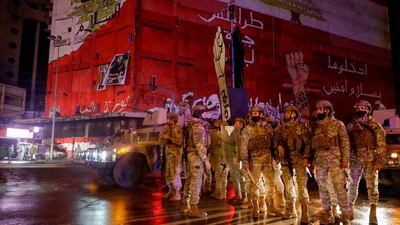
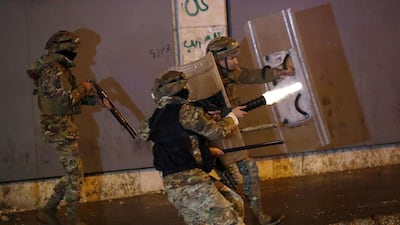
Issam saw his $1 million life savings slipping away when Lebanon’s financial crisis hit in late 2019 and banks refused to hand over cash.
Desperate to claw it back, the 70-year-old retiree became one of the growing number of Lebanese who turned to a murky system of intermediaries who help depositors to access their savings but take a hefty cut.
"I got some money back, but I am afraid most of it is gone," the retired architect told The National.
The economic collapse was triggered by decades of corruption, mismanagement and a shortage of foreign currency.
Banks imposed informal capital controls with tight limits on withdrawals, especially of foreign currency.
Savings locked in the bank
Some banks limited dollar withdrawals to $100 a week, causing panic among savers.
Banks also restricted money transfers abroad, without seeking approval from parliament or the central bank.
Issam, a father of two, said he worried he could no longer send money to his children living overseas who rely on his financial support.
"One day, the banks told us all you have left is $400 per month," he said, in reference to the weekly limits.
Depositors like Issam fear they may never be able get their hands on their savings – even if the money still shows on their account balance.
As the crisis drags on, a market has emerged in which depositors can get their dollar savings in cash, but at a cost. Some lose as much as two thirds of their money in the process.
Well-connected middlemen, including currency exchange owners, businesspeople, lawyers and even delivery drivers, play a central role in the system.
Depositors write cheques for dollar amounts that the middlemen sell on to a third party – taking a small cut of between 0.25 and 1 per cent in the process. The third party pays the depositor just 30 per cent of the cheque value in hard cash.
While such services are technically legal, experts told The National that they are hard to regulate.
The scheme allowed some depositors to retrieve at least part of their dollar savings but they have deepened popular distrust of the country's leaders who have so far failed to end the crisis or even offer a road map to better times.
Lebanese media reported last year that some of the country’s wealthiest people used their connections to evade capital controls and transferred at least $2 billion in deposits abroad after the restrictions were implemented in October 2019.
Financial expert and former banking executive Dan Azzi said that only people with “super-connections” were able to get their fortunes out of the Lebanese banking system without incurring losses.
Desperate solutions as money runs out
Ordinary depositors have had to rely on ad hoc solutions – like the cash-for-cheque schemes.
Bankers say that the people buying the cheques are primarily businesses or individuals with debts – mostly to the banks – in Lebanon.
Through the scheme, they can settle their loans for relatively little cash.
A shop owner, for example, could repay a $100,000 loan having bought a cheque for that amount after parting with just $30,000.
Desperate for cash, Issam handed over cheques worth $400,000 to the owner of an exchange shop early last year. The shop owner then sold them on to business owners to repay their debts.
Issam received $300,000 in cash at the end of the exchange.
The remaining $600,000 of his savings are frozen in his bank account.
The retiree said the $100,000 he lost in the deal “was nothing” compared with what he would lose if he made the exchange today.
Deepening financial hardships
Officially pegged at 1,515 to the dollar, the Lebanese pound has depreciated to more than 8,500 lira to the dollar over the past year.
As demand for foreign currency increases and the lira continues to depreciate, the amount depositors are losing in cheque-for-cash schemes has increased from 10 per cent in the early days of the crisis to nearly 70 per cent today.
Mohannad, a Lebanese-French father of four, wrote a cheque for $100,000 in October and expects to get only $40,000 in exchange.
He moved his savings from Paris to Beirut a decade ago because of the high interest rates of more than 10 per cent being offered on dollar deposits. He even persuaded his French in-laws to follow suit.
"Even if I lose two thirds of my savings at the new rate, it's better than losing all my money," he said. "I will not wait for the situation to get better. It will never get better."
The exchange does not come risk-free.
Mohannad is still waiting for his cash. He said his contact planned to buy yachts with his money and resell them in Turkey; he will get his cut only once the boats are delivered.
The financial authorities warned people against using such risky schemes but have not moved to regulate against it.
"We cannot stop people from writing these cheques because it not illegal," a central bank official told The National.
Middlemen managing the schemes
Lebanese from all walks of life have got in on the trade. Fawaz, 28, a lawyer, is one of them.
“Every week I am inundated with calls asking me what is the daily rate,” he said. “It’s like the stock market.”
But he said the market was getting tough for intermediaries as clients find direct buyers and cut them out.
Since December, banks began to impose new restrictions to make it hard to buy and sell these cheques.
Cheques now face a freeze of up to six months before they can be used and then can be used only for certain transactions.
“People are still looking to get their dollar savings out by selling cheques, but for buyers and intermediaries it's becoming more complicated,” a banker said.
He said it had also become harder for depositors to find people to buy their cheques because “many business owners with loans to settle have repaid their debt by now”.
While the bonanza in this parallel market may be diminished, no one expects it to die out.
"It will not stop," Fawaz said. "There is a need for cash, and where there is a need, a market will emerge."

Mercer, the investment consulting arm of US services company Marsh & McLennan, expects its wealth division to at least double its assets under management (AUM) in the Middle East as wealth in the region continues to grow despite economic headwinds, a company official said.
Mercer Wealth, which globally has $160 billion in AUM, plans to boost its AUM in the region to $2-$3bn in the next 2-3 years from the present $1bn, said Yasir AbuShaban, a Dubai-based principal with Mercer Wealth.
“Within the next two to three years, we are looking at reaching $2 to $3 billion as a conservative estimate and we do see an opportunity to do so,” said Mr AbuShaban.
Mercer does not directly make investments, but allocates clients’ money they have discretion to, to professional asset managers. They also provide advice to clients.
“We have buying power. We can negotiate on their (client’s) behalf with asset managers to provide them lower fees than they otherwise would have to get on their own,” he added.
Mercer Wealth’s clients include sovereign wealth funds, family offices, and insurance companies among others.
From its office in Dubai, Mercer also looks after Africa, India and Turkey, where they also see opportunity for growth.
Wealth creation in Middle East and Africa (MEA) grew 8.5 per cent to $8.1 trillion last year from $7.5tn in 2015, higher than last year’s global average of 6 per cent and the second-highest growth in a region after Asia-Pacific which grew 9.9 per cent, according to consultancy Boston Consulting Group (BCG). In the region, where wealth grew just 1.9 per cent in 2015 compared with 2014, a pickup in oil prices has helped in wealth generation.
BCG is forecasting MEA wealth will rise to $12tn by 2021, growing at an annual average of 8 per cent.
Drivers of wealth generation in the region will be split evenly between new wealth creation and growth of performance of existing assets, according to BCG.
Another general trend in the region is clients’ looking for a comprehensive approach to investing, according to Mr AbuShaban.
“Institutional investors or some of the families are seeing a slowdown in the available capital they have to invest and in that sense they are looking at optimizing the way they manage their portfolios and making sure they are not investing haphazardly and different parts of their investment are working together,” said Mr AbuShaban.
Some clients also have a higher appetite for risk, given the low interest-rate environment that does not provide enough yield for some institutional investors. These clients are keen to invest in illiquid assets, such as private equity and infrastructure.
“What we have seen is a desire for higher returns in what has been a low-return environment specifically in various fixed income or bonds,” he said.
“In this environment, we have seen a de facto increase in the risk that clients are taking in things like illiquid investments, private equity investments, infrastructure and private debt, those kind of investments were higher illiquidity results in incrementally higher returns.”
The Abu Dhabi Investment Authority, one of the largest sovereign wealth funds, said in its 2016 report that has gradually increased its exposure in direct private equity and private credit transactions, mainly in Asian markets and especially in China and India. The authority’s private equity department focused on structured equities owing to “their defensive characteristics.”
Champions League Last 16
Red Bull Salzburg (AUT) v Bayern Munich (GER)
Sporting Lisbon (POR) v Manchester City (ENG)
Benfica (POR) v Ajax (NED)
Chelsea (ENG) v Lille (FRA)
Atletico Madrid (ESP) v Manchester United (ENG)
Villarreal (ESP) v Juventus (ITA)
Inter Milan (ITA) v Liverpool (ENG)
Paris Saint-Germain v Real Madrid (ESP)
%3Cp%3E%3Cstrong%3ETHE%20SPECS%3C%2Fstrong%3E%0D%3Cbr%3EEngine%3A%203.5-litre%20V6%0D%3Cbr%3ETransmission%3A%209-speed%20automatc%0D%3Cbr%3EPower%3A%20279hp%0D%3Cbr%3ETorque%3A%20350Nm%0D%3Cbr%3EPrice%3A%20From%20Dh250%2C000%0D%3Cbr%3EOn%20sale%3A%20Now%3C%2Fp%3E%0A
Should late investors consider cryptocurrencies?
Wealth managers recommend late investors to have a balanced portfolio that typically includes traditional assets such as cash, government and corporate bonds, equities, commodities and commercial property.
They do not usually recommend investing in Bitcoin or other cryptocurrencies due to the risk and volatility associated with them.
“It has produced eye-watering returns for some, whereas others have lost substantially as this has all depended purely on timing and when the buy-in was. If someone still has about 20 to 25 years until retirement, there isn’t any need to take such risks,” Rupert Connor of Abacus Financial Consultant says.
He adds that if a person is interested in owning a business or growing a property portfolio to increase their retirement income, this can be encouraged provided they keep in mind the overall risk profile of these assets.
Dirham Stretcher tips for having a baby in the UAE
Selma Abdelhamid, the group's moderator, offers her guide to guide the cost of having a young family:
• Buy second hand stuff
They grow so fast. Don't get a second hand car seat though, unless you 100 per cent know it's not expired and hasn't been in an accident.
• Get a health card and vaccinate your child for free at government health centres
Ms Ma says she discovered this after spending thousands on vaccinations at private clinics.
• Join mum and baby coffee mornings provided by clinics, babysitting companies or nurseries.
Before joining baby classes ask for a free trial session. This way you will know if it's for you or not. You'll be surprised how great some classes are and how bad others are.
• Once baby is ready for solids, cook at home
Take the food with you in reusable pouches or jars. You'll save a fortune and you'll know exactly what you're feeding your child.
START-UPS%20IN%20BATCH%204%20OF%20SANABIL%20500'S%20ACCELERATOR%20PROGRAMME
%3Cp%3E%3Cstrong%3ESaudi%20Arabia%3C%2Fstrong%3E%3C%2Fp%3E%0A%3Cp%3E%3Cstrong%3EJoy%3A%3C%2Fstrong%3E%20Delivers%20car%20services%20with%20affordable%20prices%3C%2Fp%3E%0A%3Cp%3E%3Cstrong%3EKaraz%3A%3C%2Fstrong%3E%20Helps%20diabetics%20with%20gamification%2C%20IoT%20and%20real-time%20data%3C%2Fp%3E%0A%3Cp%3E%3Cstrong%3EMedicarri%3A%3C%2Fstrong%3E%20Medical%20marketplace%20that%20connects%20clinics%20with%20suppliers%3C%2Fp%3E%0A%3Cp%3E%3Cstrong%3EMod5r%3C%2Fstrong%3E%3A%20Makes%20automated%20and%20recurring%20investments%20to%20grow%20wealth%3C%2Fp%3E%0A%3Cp%3E%3Cstrong%3EStuck%3A%3C%2Fstrong%3E%20Live%2C%20on-demand%20language%20support%20to%20boost%20writing%3C%2Fp%3E%0A%3Cp%3E%3Cstrong%3EWalzay%3A%3C%2Fstrong%3E%20Helps%20in%20recruitment%20while%20reducing%20hiring%20time%3C%2Fp%3E%0A%3Cp%3E%3Cstrong%3EUAE%3C%2Fstrong%3E%3C%2Fp%3E%0A%3Cp%3E%3Cstrong%3EEighty6%3A%20%3C%2Fstrong%3EMarketplace%20for%20restaurant%20and%20supplier%20procurements%3C%2Fp%3E%0A%3Cp%3E%3Cstrong%3EFarmUnboxed%3A%20%3C%2Fstrong%3EHelps%20digitise%20international%20food%20supply%20chain%3C%2Fp%3E%0A%3Cp%3E%3Cstrong%3ENutriCal%3A%3C%2Fstrong%3E%20Helps%20F%26amp%3BB%20businesses%20and%20governments%20with%20nutritional%20analysis%3C%2Fp%3E%0A%3Cp%3E%3Cstrong%3EWellxai%3A%3C%2Fstrong%3E%20Provides%20insurance%20that%20enables%20and%20rewards%20user%20habits%3C%2Fp%3E%0A%3Cp%3E%3Cstrong%3EEgypt%3C%2Fstrong%3E%3C%2Fp%3E%0A%3Cp%3E%3Cstrong%3EAmwal%3A%3C%2Fstrong%3E%20A%20Shariah-compliant%20crowd-lending%20platform%3C%2Fp%3E%0A%3Cp%3E%3Cstrong%3EDeben%3A%3C%2Fstrong%3E%20Helps%20CFOs%20manage%20cash%20efficiently%3C%2Fp%3E%0A%3Cp%3E%3Cstrong%3EEgab%3A%3C%2Fstrong%3E%20Connects%20media%20outlets%20to%20journalists%20in%20hard-to-reach%20areas%20for%20exclusives%3C%2Fp%3E%0A%3Cp%3E%3Cstrong%3ENeqabty%3A%3C%2Fstrong%3E%20Digitises%20financial%20and%20medical%20services%20of%20labour%20unions%3C%2Fp%3E%0A%3Cp%3E%3Cstrong%3EOman%3C%2Fstrong%3E%3C%2Fp%3E%0A%3Cp%3E%3Cstrong%3EMonak%3A%3C%2Fstrong%3E%20Provides%20financial%20inclusion%20and%20life%20services%20to%20migrants%3C%2Fp%3E%0A
Forced%20Deportations
%3Cp%3EWhile%20the%20Lebanese%20government%20has%20deported%20a%20number%20of%20refugees%20back%20to%20Syria%20since%202011%2C%20the%20latest%20round%20is%20the%20first%20en-mass%20campaign%20of%20its%20kind%2C%20say%20the%20Access%20Center%20for%20Human%20Rights%2C%20a%20non-governmental%20organization%20which%20monitors%20the%20conditions%20of%20Syrian%20refugees%20in%20Lebanon.%3C%2Fp%3E%0A%3Cp%3E%E2%80%9CIn%20the%20past%2C%20the%20Lebanese%20General%20Security%20was%20responsible%20for%20the%20forced%20deportation%20operations%20of%20refugees%2C%20after%20forcing%20them%20to%20sign%20papers%20stating%20that%20they%20wished%20to%20return%20to%20Syria%20of%20their%20own%20free%20will.%20Now%2C%20the%20Lebanese%20army%2C%20specifically%20military%20intelligence%2C%20is%20responsible%20for%20the%20security%20operation%2C%E2%80%9D%20said%20Mohammad%20Hasan%2C%20head%20of%20ACHR.%3Cbr%3EIn%20just%20the%20first%20four%20months%20of%202023%20the%20number%20of%20forced%20deportations%20is%20nearly%20double%20that%20of%20the%20entirety%20of%202022.%26nbsp%3B%3C%2Fp%3E%0A%3Cp%3ESince%20the%20beginning%20of%202023%2C%20ACHR%20has%20reported%20407%20forced%20deportations%20%E2%80%93%20200%20of%20which%20occurred%20in%20April%20alone.%26nbsp%3B%3C%2Fp%3E%0A%3Cp%3EIn%20comparison%2C%20just%20154%20people%20were%20forcfully%20deported%20in%202022.%3C%2Fp%3E%0A
Violence%20
%3Cp%3EInstances%20of%20violence%20against%20Syrian%20refugees%20are%20not%20uncommon.%3C%2Fp%3E%0A%3Cp%3EJust%20last%20month%2C%20security%20camera%20footage%20of%20men%20violently%20attacking%20and%20stabbing%20an%20employee%20at%20a%20mini-market%20went%20viral.%20The%20store%E2%80%99s%20employees%20had%20engaged%20in%20a%20verbal%20altercation%20with%20the%20men%20who%20had%20come%20to%20enforce%20an%20order%20to%20shutter%20shops%2C%20following%20the%20announcement%20of%20a%20municipal%20curfew%20for%20Syrian%20refugees.%3Cbr%3E%E2%80%9CThey%20thought%20they%20were%20Syrian%2C%E2%80%9D%20said%20the%20mayor%20of%20the%20Nahr%20el%20Bared%20municipality%2C%20Charbel%20Bou%20Raad%2C%20of%20the%20attackers.%3Cbr%3EIt%20later%20emerged%20the%20beaten%20employees%20were%20Lebanese.%20But%20the%20video%20was%20an%20exemplary%20instance%20of%20violence%20at%20a%20time%20when%20anti-Syrian%20rhetoric%20is%20particularly%20heated%20as%20Lebanese%20politicians%20call%20for%20the%20return%20of%20Syrian%20refugees%20to%20Syria.%3Cbr%3E%3Cbr%3E%3C%2Fp%3E%0A
Our legal consultant
Name: Hassan Mohsen Elhais
Position: legal consultant with Al Rowaad Advocates and Legal Consultants.
Company profile
Date started: 2015
Founder: John Tsioris and Ioanna Angelidaki
Based: Dubai
Sector: Online grocery delivery
Staff: 200
Funding: Undisclosed, but investors include the Jabbar Internet Group and Venture Friends