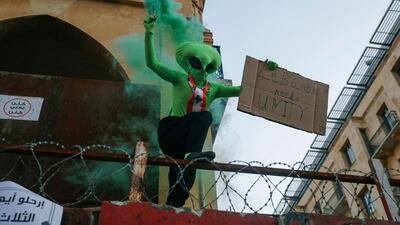

The Lebanese pound tumbled on Saturday trading at more than 12,000 lira to the dollar, a depreciation of more than 20 per cent in less than two weeks despite a bid by the president to take action against "illegal" money exchangers and online platforms to arrest its slide.
The Lebanese currency remains officially pegged at 1507.5 to the dollar but its market value plummeted to 12,600 on Saturday, a drop of more than 80 per cent in one year.
“The question is not why the lira fell to 12,000 to the dollar, but why it hasn’t fallen even more,” said Andy Khalil, a Lebanese financial expert.
“There is no upper bound on the lira depreciating so long as there are no financial reforms.”
Lebanon has been hit by a severe economic crisis for the past year and a half, triggered in part by a shortage of foreign currency and by decades of corruption and economic mismanagement.
-
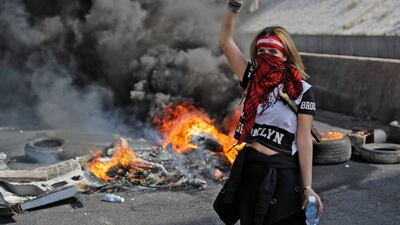
A bandana-clad anti-government demonstrator gestures as she stands by the smoke of burning tires at a makeshift roadblock in Zouk Mosbeh, north of Lebanon's capital Beirut. AFP -
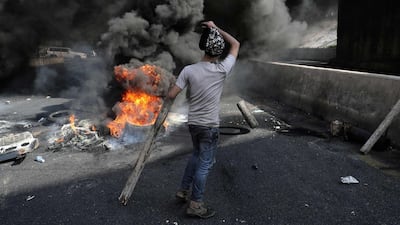
Protesters took to the streets after the Lebanese pound plummeted to a record 10,000 to the US dollar. AFP -
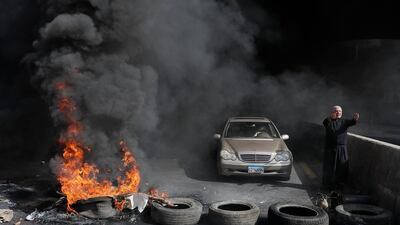
A Maronite priest pleads with anti-government protesters to let him pass with his vehicle as he stands next to burning tyres at a makeshift roadblock in Zouk Mosbeh, north of Lebanon's capital Beirut. AFP -
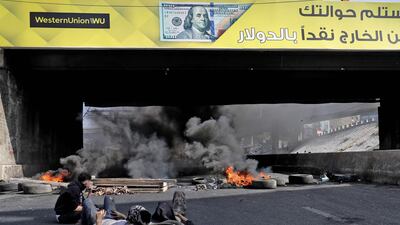
Anti-government protesters sit next to burning tyres at a makeshift roadblock in Zouk Mosbeh, north of Lebanon's capital Beirut. AFP -
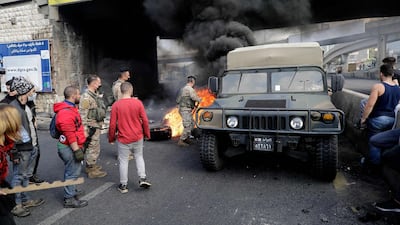
Soldiers clear burning tyres set up by anti-government protesters at a makeshift roadblock in Zouk Mosbeh, north of Lebanon's capital Beirut. AFP -
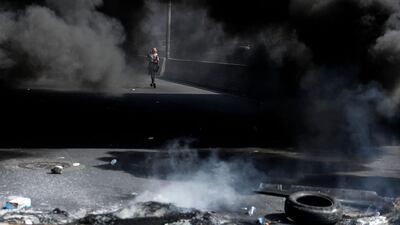
Young men lit tyres on the streets in various cities to show their anger.. AFP -

Anti-government demonstrators erect a brick wall to block the highway at the southern entrance of Lebanon's northern port city of Tripoli. AFP -
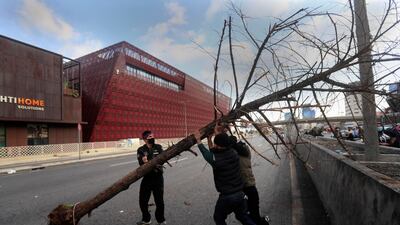
Protesters move a tree to block a main highway, during a protest in the town of Jal el-Dib, north of Beirut. AP Photo -
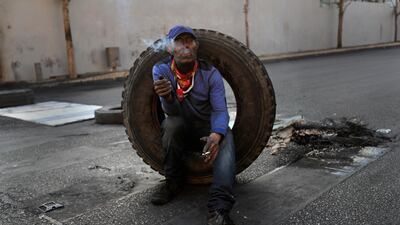
A protester smokes a cigarette as he aims to block a road during a protest in Beirut. AP Photo -
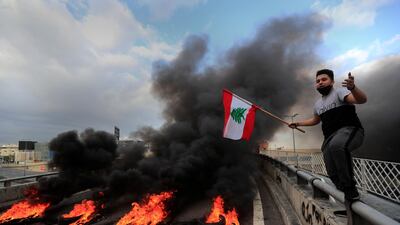
Protests also occurred in southern Saida, in Qornayel and the Bhamdoun villages in the Mount Lebanon governorate. AP -
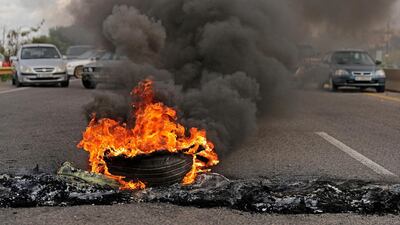
Tyres burn at a make-shift roadblock made by anti-government demonstrators in the city of Byblos, north of Lebanon's capital. AFP -
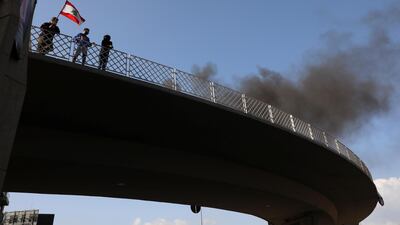
Demonstrators stand on a bridge as smoke rises from tyres set on fire in Jal el-Dib. Reuters -
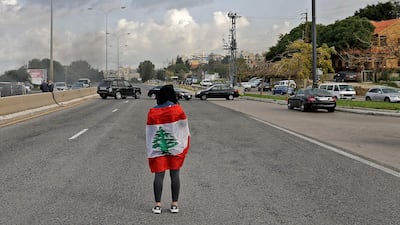
An anti-government demonstrator draped in the Lebanese national flag stands at a make-shift roadblock in Byblos. AFP


Disputes between politicians and between the government and the central bank have prevented the implementation of reforms needed to access billions in debt relief and loans from foreign governments and international institutions such as the International Monetary Fund.
Among the reforms sought is a forensic audit of the central bank and an overhaul of the electricity sector, which takes up more than $1 billion of the annual budget despite failing to provide 24-hour electricity for the past 30 years.
President Michel Aoun called a high-level meeting on Monday to address the currency's depreciation after the pound fell from about 8,500 to the dollar to 10,000 in early March.
He ordered security forces to crack down on "illegal" online platforms that estimate the pound's real rate and close down exchange shops that operate according to the rate on the parallel market, which has become the rate in use in Lebanon after the currency started depreciating.
Many money exchangers have closed temporarily, operating only on a delivery basis for clients they know and trust for fear of arrest.
"They are treating money exchangers like drug dealers," Mr Khalil said, pointing out that authorities had attempted to take action against them last year with little result.
The crackdown is probably having the opposite effect to that intended, he said. Instead of regulating the market, the move is making it more difficult for ordinary Lebanese and residents to buy dollars.
“This is the worst thing they could do right now,” he said. “The more you constrain this market the more it is susceptible to manipulation. They are shooting themselves in the foot.”
While authorities struggle to halt the pound's depreciation, inflation is taking a toll on people's purchasing power.
Hisham, 70, the owner of a photography studio, said the currency's fall had forced him to raise his prices as equipment, imported in dollars, was more expensive to buy.
"I used to sell eight photos for 10,000 lira just one year ago. Now I am selling them for 25,000 lira," he told The National.
After speaking to a caller asking about his rates, he said: "He doesn't want to pay this much, but what can I do?"
According to UN data, more than half of the Lebanese population is now living in poverty.
The government continues to subsidise essential goods such as wheat, fuel and flour, but the prices of other imports, on which Lebanon relies, have increased. At the same time salaries, paid in Lebanese pounds, have severely depreciated. The minimum wage of 675,000 pounds, once worth about $450, is now roughly equivalent to $56.
Protests broke out when the pound reached the threshold of 10,000 to the dollar earlier this month. Hundreds again took to the streets of downtown Beirut on Saturday after the pound's latest losses. On Friday, protesters marched to Parliament to demand political reforms and better living conditions.

