


The atmosphere at the Beirut-Rafic Hariri International Airport feels heavy and the mood is sombre.
Resigned faces can be spotted among the families exchanging tearful goodbyes, mirroring what they know deep down inside: their loved ones are not coming back.
Lebanon has long been a country of emigration, but this time those leaving say it feels final.
The country is crumbling under the weight of one of the world's worst economic crises since the mid-19th century, and its consequences are brutal.
Yet despite the many reasons pushing people to find a way out, leaving is still not an easy decision.
"I never wanted to leave," May Chalhoub, 25, told The National.
Ms Chalhoub moved to Canada to start afresh with her family in May 2021, but they had been considering emigration since the end of 2019.
While the family weighed up the familiarity of their home country against the uncertainty of a new beginning, their decision was made by the Beirut blast.
“It was a point of no return,” Ms Chalhoub said. “Living in Lebanon clearly became a dangerous hazard.”
More than 200 people were killed and 7,000 injured on August 4, when a huge quantity of ammonium nitrate exploded at the Beirut port, destroying large parts of the city.
-
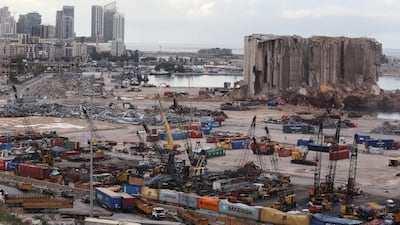
The site of the August 4 explosion at Beirut port in December. Reuters -
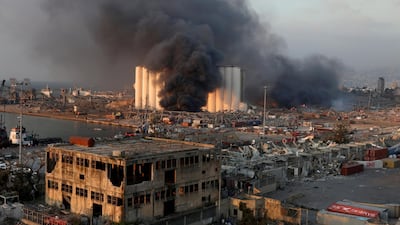
Smoke rises from the site of an explosion in Beirut's port area, Lebanon on August 4, 2020. Reuters -
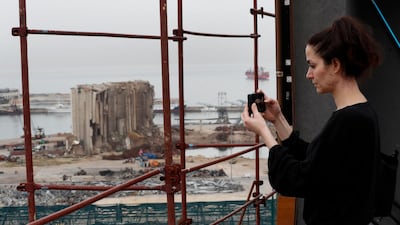
Joana Dagher, 33, who lost her memory for two full months from the trauma she suffered in the massive August explosion at the Beirut port takes pictures of the explosion scene from her damaged apartment rooftop. AP -
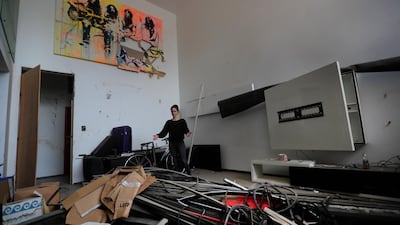
The mental health impact of the Beirut explosion that killed more than 200 and wounded more than 6,000 continues to lay its heavy weight on those who managed to survive the day. AP -
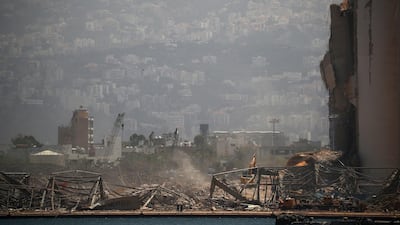
A general view shows damage at the site of the blast in Beirut's port area, Lebanon. Reuters -

A drone picture shows the destruction after the explosion in the seaport of Beirut, Lebanon. AP


The country had already been reeling under a failing economy that had pushed more than half of the population into poverty and a significant number to seek a life outside its borders.
Razan Halawi, 25, an occupational psychologist, moved to London in December 2020, more than a year after the onset of the financial crisis.
Having lost her job to the Covid-19 pandemic, Ms Halawi was forced to defer her graduate studies because of financial problems.
She said she also lost access to her savings, the result of arbitrary capital controls implemented by local banks.
"Typical scenario really … I had to do something detrimental to my personal and professional decisions, and at the expense of my own happiness," she told The National.
While she misses her loved ones back home, Ms Halawi does not want to go back to the place that brought her misery.
“I used to be hopeful and eager, wanting to be part of a change to make Lebanon a better place, up until August 4.
“The hardest part is knowing that I have been stripped away from my own happiness, career growth, aspirations, and my basic rights.
I have to start again from scratch."
Also in London, Mohammad Fawaz, 27, is a real estate developer who left Lebanon in February 2020 to seek opportunities abroad after failing to find a suitable job in his country.
Despite feeling relieved in the beginning, reality eventually kicked in and his yearning for home settled.
"It's sort of like the feeling of being out all day working, running errands, going to the gym and being exhausted, just wanting to be in bed," Mr Fawaz told The National.
"Lebanon is like that bed you can’t wait to get into.”
While acknowledging that Lebanon is "not an option for young people", he still longs to be near his loved ones.
"I'm stuck between feeling homesick and sick of home," Mr Fawaz said.
“When I miss Lebanon, I miss its memories and its beauty. When I'm finally back, I get sick of its negatives.”
This love-hate relationship with the home country is shared by many of the young diaspora, including Aabed Banna, 24, a masters student.
After a protracted process, he moved to Budapest to pursue his "dream major" on a scholarship.
While Mr Banna also reports feeling nostalgic for his former life in Lebanon, he says the country's politics jolt him back to reality.
He took part in Lebanon's protests against the ruling class in October 2019, but the movement soon lost momentum.
“It started to look like we'd reached a dead end and the outcome of the uprising seemed quite ambiguous.
"That's when I decided to look for some other opportunities abroad," he told The National.
His sentiments echo those of many other young Lebanese living abroad.
Mr Banna says that even though getting accustomed to a new country can be challenging, it is "a lot easier than having to deal with the severity of the crisis" back home.

