
For the past few weeks, excavators have worked through layers of decades-old decomposing rubbish on the Lebanese coast to clear 40,000 square metres of space for another half a million tonnes of trash.
Early in January, Lebanon narrowly avoided a rubbish disposal crisis by extending yet another temporary solution. Experts said the cash-strapped country will face problems once again after the extension that is under construction reaches its capacity in only 18 months.
“The problem is that temporary solutions always end up being permanent,” said Dany Khoury, chief executive of Khoury Contracting Company, which operates the two landfills in Bourj Hammoud and Jdeideh, two coastal suburbs north-east of Beirut.
The extension is situated near Jdeideh’s landfill, which was opened in February 2018 and was saturated by April 2020. It stands only a few minutes’ drive from the closed landfill of Bourj Hammoud, which operated between October 2016 and February 2019.
Both were hastily built after a garbage crisis in 2015 caused by the closure of another temporary landfill. They are situated on the remains of a 40-metre-high dump that was operational from 1978 to 1997.
KCC used waste from the old dump to reclaim land on the Mediterranean coast. At the time, environmental activists accused the company of throwing garbage straight into the sea, but Mr Khoury rejects such accusations.
When Jdeideh’s landfill reached its maximum capacity last year, the government asked KCC to keep piling the rubbish higher – from the initially planned 13,5 metres to 16 metres.
The volume of incoming waste increased after the massive explosion on August 4 at Beirut’s port that killed more than 200 people and destroyed the landfill’s composting and sorting plants.
“It’s accelerating the problem,” said Toufic Kazmouz, who manages the landfill.
Last September, the government announced that it would unlock funds for KCC to build an extension to the landfill, but no contract was signed.
Mr Khoury grew increasingly frustrated. “Due to this economic situation and craziness, no ministers or officials in government want to take any decision,” he said, referring to the country’s economic meltdown and political crisis.
-
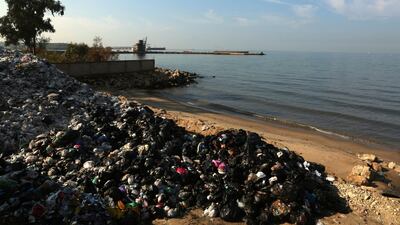
Rubbish is piled up at a temporary garbage dump on a beach in Zalka north of Beirut on December 22, 2015. AFP -
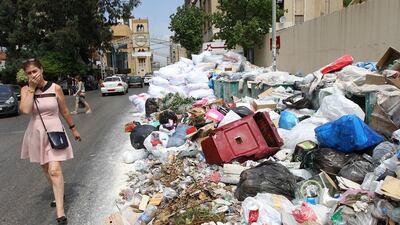
A woman holds her breath as she walks near a temporary garbage dump in the neighbourhood of Jdeideh, northeast of the Lebanese capital Beirut. Lebanon has been going through a garbage crisis caused by the closure of its main landfill more than a year ago. AFP -

Piles of plastic waste are pictured on the seaside in the coastal town of Khalde, south of the Lebanese capital Beirut. AFP -
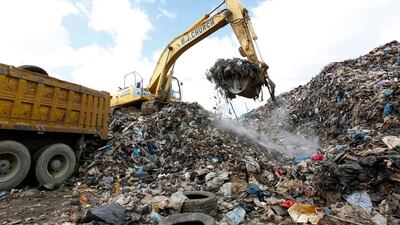
Workers use a front-loader to move piles of garbage from a Beirut suburb to the country's largest landfill of Naameh, just south of the Lebanese capital. AFP -
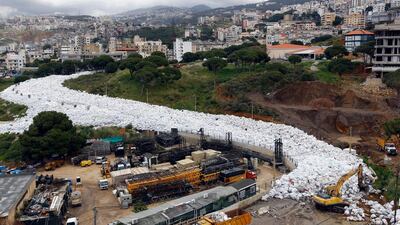
Trucks are seen next to piles of garbage in Jdeideh, a Beirut suburb, ahead of moving it to the country's largest landfill of Naameh, just south of the Lebanese capital. AFP -

A man pushes his bicycle as he walks past a pile of garbage in the town of Jdeideh North East of the Lebanese capital Beirut. AFP -
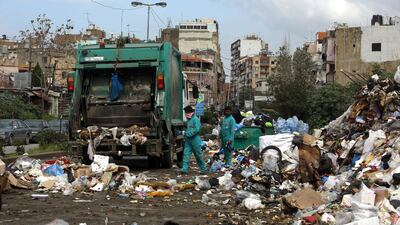
Asian employees from Sukleen, a local trash management company, collect garbage from a temporary garbage dump in an eastern suburb of the Lebanese capital, Beirut. AFP -
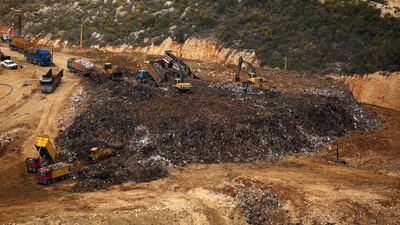
Trucks dumping their load at the Naameh landfill, just south of the Lebanese capital, Beirut. AFP


KCC stopped accepting waste between January 4 and 10. Garbage piled up in the streets of Beirut suburbs.
"I said: 'You [the government] have to decide'. Technically, I could not stack the garbage any higher," Mr Khoury told The National.
Rainy season in Lebanon
Mr Khoury said he also feared for the safety of his staff. “It’s the rainy season now. The soil becomes looser and looser. When it rains, my team is endangered more than in summer. Imagine the headlines if it collapsed and killed my workers,” he said.
The strike pushed the government to contact Mr Khoury and promise an $18 million contract, which is being finalised, he said.
The Finance Ministry confirmed it had approved the payment of the contract. An engineer at the CDR, the French acronym of the Conseil du developpement et de la reconstruction, the public body that oversees infrastructure projects, said its board of directors had not yet taken an official decision.
Late in January, KCC started working on the extension, and expects it to be operational in less than two weeks.
The smell of the waste being moved around is pungent but not overpowering. Mr Khoury said it is inert, meaning it does not contain organic materials or gases.
Layers of the old refuse will be used to cover new waste and stifle odours. Ultimately, all of the old waste is expected to be integrated into the extension.
In the meantime, the landfill still receives about 850 tonnes of waste per day, which is dumped in a 10,000-square-metre car park nearby.
Payment problems
Mr Khoury said he was unhappy with the new contract because the $18 million will be paid in cheque dollars, not in cash. The government switched to this mode of payment with most of its contractors after banks started running low on American dollars in the summer of 2019, causing a financial meltdown.
Cheque dollars, or “Lebanese dollars”, can only be cashed in a Lebanese bank in exchange for Lebanese pounds. Currently, the value of the cheques is roughly half of what dollars in cash are worth on the black market. Costs are going up for Mr Khoury, who has to buy imported equipment for the landfill’s extension with cash dollars.
“It’s a headache for me,” he said. “If I just walk away, I’ll be attacked for leaving garbage in the streets. I’ll go to court, the judge will say I’m blackmailing them.”
-
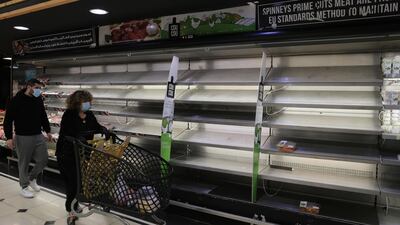
Citizens shopping at Spinneys supermarket in Beirut, Lebanon, 11 January 2021. EPA -

People queue outside a shop in Dbayeh north of Beirut as they stock up on provisions two days before a total lockdown due to the spread of the Covid-19 pandemic on January 12, 2021. AFP -
A mask-clad man carries two gas cylinders in the southern Lebanese city of Sidon on January 13, 2021 as the Lebanese rush to stock up on provisions one day before a total lockdown due to the spread of the COVID-19 pandemic. AFP -
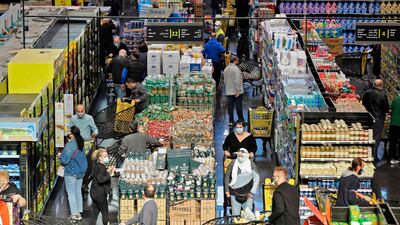
People shop at a supermarket in Beirut as they stock up on provisions two days before a total lockdown due to the spread of the Covid-19 pandemic on January 12, 2021. AFP -
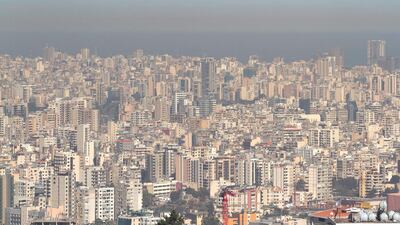
Beirut's skyline shrouded in smog. File photo / Getty Images -

The scene of the August 4 explosion that hit the seaport of Beirut, Lebanon. AP Photo -
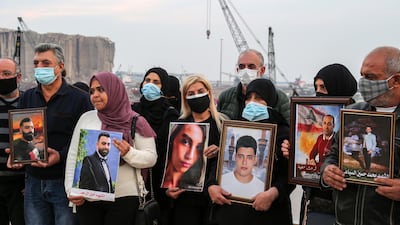
Relatives of victims of the 4 August Beirut port explosion pose with portraits of the deceased relatives, during a protest in Beirut, Lebanon, January 4, 2021. EPA -
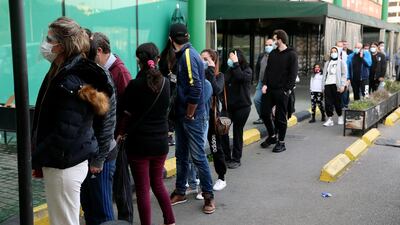
A queue to enter a supermarket, in Beirut, Lebanon, on January 11, 2021. Panic buyers swarmed to grocery shops after reports the government planned to close them as part of the tightened lockdown. AP


But sympathy for contractors such as Mr Khoury is minimal in a country where politicians and important infrastructure projects are perceived as highly corrupt.
“A handful of people make money, but the public’s interest is not taken into account,” said environmental activist Paul Abi Rached
Mr Khoury denies having links to politicians and said KCC was awarded the contract for the Bourj Hammoud and Jdeideh landfills in 2016 in a public tender. “All the TVs were there. It wasn’t behind hidden doors,” he said.
Mr Abi Rached criticised the new extension as well as Lebanon’s history with coastal landfills as unsustainable and dangerous for the environment.
“These landfills should be stopped. The government should work on composting and sorting instead,” he said.
This would reduce the volume of garbage sent to existing landfills and extend their lifetime.
The Environment minister did not respond to The National's request for comment. Despite multiple requests, the CDR had no shared the 2016 Environmental Impact Assessment of Bourj Hammoud and Jdeideh with The National by the time this article was published.
The extension to the Jdeideh landfill will have a capacity of 500,000 tonnes of waste, stacked 15.5m high. It is expected to reach maximum capacity by mid-2022.
“By this time, I hope they’ll have a better solution than doing landfills on the seafront,” Mr Khoury said.

