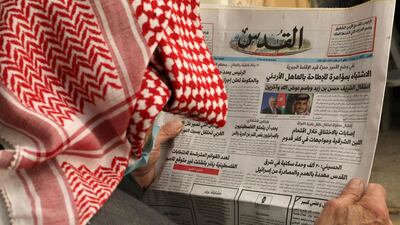

Jordan's former crown prince Hamzah bin Hussein was engaged in activities with foreign agents aimed at destabilising the kingdom, Deputy Prime Minister Ayman Al Safadi said on Sunday
Mr Al Safadi explained why former senior officials had been arrested late the previous evening.
On Saturday night, the official Petra news agency said former chief of the royal court Bassem Awadallah, royal family member Sharif Hassan Ben Zaid and other, unidentified figures had been detained for “security-related” reasons.
Prince Hamzah had said in a video recording that he was under house arrest along with his family, and had been told to stay at home and not contact anyone.
On Sunday's Mr Al Safadi, who is also the Foreign Minister, said Prince Hamzah was in communication with Mr Awadallah and other figures inside and outside the country to destabilise Jordan.
The figures had been monitored for a long period by security forces, and King Abdullah had been briefed on the situation.
People around the prince had links with an undisclosed "foreign party", Mr Al Safadi said.
-
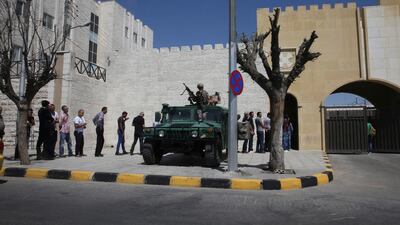
Jordan's State Security Court in the capital, Amman. AP Photo -
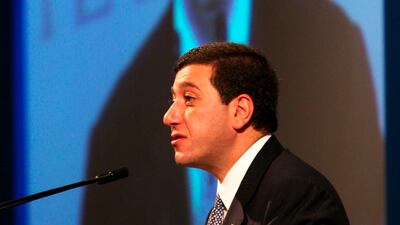
Bassem Awadallah, a former right-hand man of King Abdullah II. Mr Awadallah, who played a major role developing the country's economic policy, was arrested on 'security grounds'. EPA -

Officials, the military and state media denied reports that former crown prince Hamzah bin Hussein had been detained or his movement restricted. AFP -

King Abdullah II and Queen Rania of Jordan. Jordanian Royal Palace -
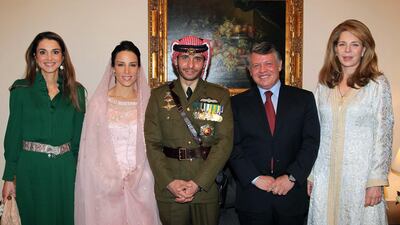
Jordan's King Abdullah; Queen Noor, widow of late King Hussein; and Queen Rania posing for a picture with Prince Hamzah, half-brother of Jordan's King Abdullah and his new wife Princess Basma Otoum in 2012. AFP, HO -
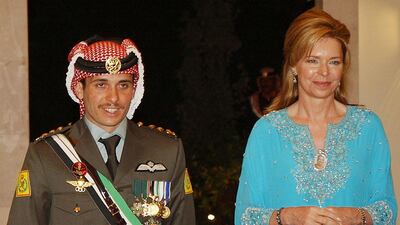
Jordan's Prince Hamzah with his mother Queen Noor. AP File -
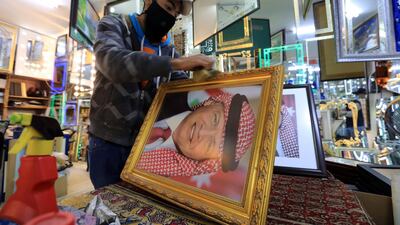
A frame maker in Amman displays a picture of king Abdullah II. EPA -

A frame maker in Amman displays a picture of king Abdullah II. EPA -

A frame maker in Amman displays pictures of king Abdullah II. EPA -
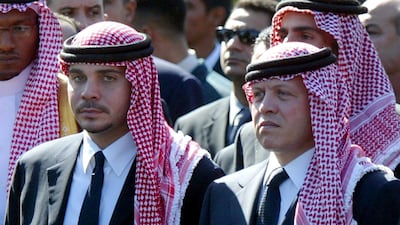
Prince Ali with his half brother King Abdullah of Jordan as they walk together in the funeral procession of Palestinian President Yasser Arafat in Cairo on November 12, 2004. EPA, file -

Prince Hamzah, right, and Prince Hashem Bin Al Hussein, left, half brothers of King Abdullah II of Jordan. AP, File -
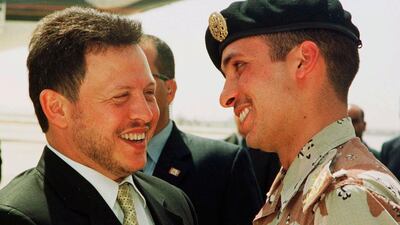
Jordan’s King Abdullah II laughs with his half brother Prince Hamzah, right, shortly before the monarch embarked on a tour of the United States. AP, file


The authorities intercepted communications between Prince Hamzah and foreign parties over the timing of steps to undermine Jordan's security, he said.
Efforts were made to contain the situation within the family, but they were ultimately unsuccessful.
After the suspects moved to a stage beyond planning to talking about the timing of when to act that authorities stepped in, Mr Al Safadi said. In all, 16 people were arrested.
The minister said a foreign intelligence agency had contacted Prince Hamzah's wife to ensure an aircraft was available to take them out of the country.
Although Mr Al Safadi did not specifically rule out reports that Prince Hamzah had tried to instigate a coup, he said "there is no talk of arresting any members of the armed forces" in connection with the plot.
This would appear to rule out a coup.
Security services have asked for those involved in the plot to be referred to the state security court, Mr Al Safadi said.
He also said that the operation was now concluded.
Officials initially denied that Prince Hamzah had been detained but that he had been told to “stop movements and activities that are employed to target the security of Jordan and its stability”.
Mr Awadallah was once a key player in drawing up the country's economic policy and served as chief of the Royal Hashemite Court until stepping down in 2008.
Countries rally around Jordan
The US, which has provided Jordan with substantial economic aid over the decades, was quick to issue a statement expressing concern and stressing the importance of stability in the kingdom.
US State Department spokesman Ned Price said Washington was in touch with officials in Amman and was monitoring the situation.
“King Abdullah is a key partner of the United States and he has our full support,” Mr Price said on Sunday night.
The US is Jordan's single largest provider of assistance since Amman signed a peace treaty with Israel in 1994.
Washington provided more than $1.5 billion in 2020, including including $425 million in military assistance.
Regional countries also released statements of support for King Abdullah and the Jordanian government after the arrests.
Jordan’s ability to weather crises is inspiring the regional and international community to back the stability of the country, UAE presidential adviser Dr Anwar Gargash tweeted on Sunday.
The Emirate’s Ministry of Presidential Affairs said the nation “affirmed its full solidarity with the Hashemite Kingdom of Jordan”, state-run Wam news agency reported.
Saudi Arabia was quick to issue a statement of support for the Jordanian government on Saturday night.
Saudi Crown Prince Mohammed bin Salman called King Abdullah to offer his support.
Riyadh said it would "stand by the Hashemite kingdom of Jordan and give its full support with all its capabilities for all decisions and measures taken by King Abdullah II and His Highness Prince Hussein bin Abdullah, Crown Prince, to maintain security and stability".
The Arab League, GCC, Bahrain, Oman, Iraq, Lebanon, Egypt, Qatar, Yemen, Palestine, Morocco and others also backed King Abdullah.

