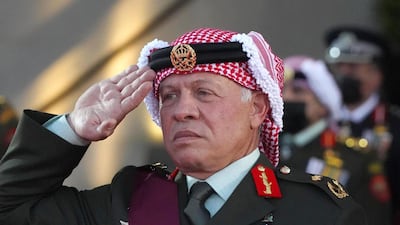
Jordan's King Abdullah II succeeded his father, the late King Hussein, in 1999. AFP

Jordan's King Abdullah II forms committee to modernise political system


Khaled Yacoub Oweis
  • English
  • Arabic

Jordan's King Abdullah II on Thursday said he is seeking qualitative changes to the kingdom’s political system amid socio-economic turmoil.

The country has been ruled by the Hashemite monarchy for the past 100 years.

The king formed a mostly loyalist committee to come up with proposals for political reform centred on the 130-member parliament, which has little power in Jordan.

Last week, a tribal political figure called on his followers to challenge the monarch’s authority, prompting the largely pro-government parliament to remove him.

“We are intent on making a qualitative jump in the political and parliamentarian life,” the king said in a letter to the committee’s chairman, former prime minister Samir Al Rifai.

According to the royal court, the committee will be made up of 92 members, led by Mr Rifai.

Jordan is in a recession and unemployment is officially at a record 24 per cent. The government said last year it had increased the social assistance budget as more people sought support.

Several independent committees were formed to submit proposals for political reform since the king succeeded his father, the late King Hussein, in 1999. These were established mostly in times of political and economic uncertainty.

Power is concentrated with the king. Parliament, which is dominated by tribes, is a forum for government-sanctioned criticism. Jordan's tribes are also a main component of the security forces and largely employed by the state, as opposed to the private sector.

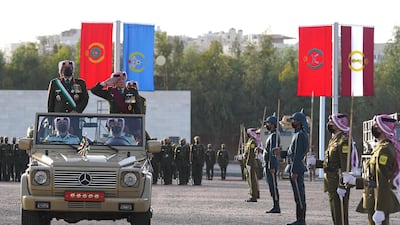
Jordan's King Abdullah II attends a military parade to mark the kingodm's centenary. Courtesy Royal Hashemite Court

The king said the committee’s mission was to “modernise the political system” and come up with proposals for a new election law for the legislature.

Parliamentary seats are largely allocated to outlaying electoral districts that have relatively small populations.

The king instructed the committee to “give recommendations on modernising legislation that governs local government and enlarge the base of participation in decision-making”.

He did not give details but said he wanted to see a parliament based on blocs “with programmes” and progress “in the way the executive branch exercise its powers”.

On Monday, the monarch ordered an end to the current session of the sitting parliament.

The ruling came a day after parliament removed Osama Al Ajarmeh, a tribal deputy from the urban and agricultural region of Naour, south of Amman.

In a street address to his followers last week, Mr Al Ajarmeh made disparaging remarks about the king and called on his supporters to disobey the monarch.

At the end of April, the king released 16 tribe members from other regions who the authorities implied were involved in sedition.

The 16 were linked to Prince Hamzah bin Hussein, a half-brother of the king, who had sought to court the tribes.

__________

King Abdullah attends JAF ceremony

  • King Abdullah II, the Supreme Commander of the Jordan Armed Forces-Arab Army, accompanied by Crown Prince Hussein, attends a’ ceremony to mark the state’s centennial. All photos courtesy Royal Hashemite Court
    King Abdullah II, the Supreme Commander of the Jordan Armed Forces-Arab Army, accompanied by Crown Prince Hussein, attends a’ ceremony to mark the state’s centennial. All photos courtesy Royal Hashemite Court
  • King Abdullah was received at Al Rayah Parade Ground, located at the Royal Hashemite Court, by Crown Prince Hussein and chairman of the joint chiefs of staff, Maj Gen Yousef Hneiti.
    King Abdullah was received at Al Rayah Parade Ground, located at the Royal Hashemite Court, by Crown Prince Hussein and chairman of the joint chiefs of staff, Maj Gen Yousef Hneiti.
  • The ceremony coincides with Accession to the Throne Day, Army Day and the Great Arab Revolt anniversary.
    The ceremony coincides with Accession to the Throne Day, Army Day and the Great Arab Revolt anniversary.
  • Representatives from armies and security agencies of friendly countries with ties to Jordan through military co-operation and joint training, including Saudi Arabia, Egypt, Bahrain, Oman, the UAE, Qatar, Palestine, the UK, France, and Pakistan, participated.
    Representatives from armies and security agencies of friendly countries with ties to Jordan through military co-operation and joint training, including Saudi Arabia, Egypt, Bahrain, Oman, the UAE, Qatar, Palestine, the UK, France, and Pakistan, participated.
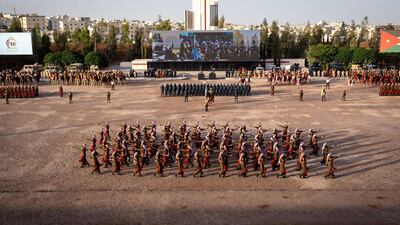
  • A drill squad performs at the JAF and security agencies’ ceremony marking Jordan's centennial.
    A drill squad performs at the JAF and security agencies’ ceremony marking Jordan's centennial.
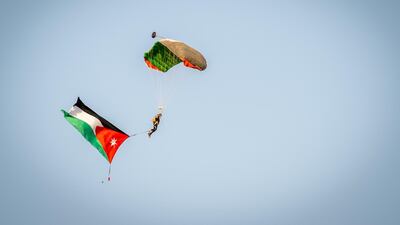
  • A parachutist flies the Jordanian flag at the centennial ceremony.
    A parachutist flies the Jordanian flag at the centennial ceremony.
  • Put your best foot forward ... a military band on parade at the celebrations.
    Put your best foot forward ... a military band on parade at the celebrations.
  • A mounted unit at the ceremony at Jordan's Royal Hashemite Court.
    A mounted unit at the ceremony at Jordan's Royal Hashemite Court.
  • King Abdullah II at the JAF and security agencies’ ceremony.
    King Abdullah II at the JAF and security agencies’ ceremony.
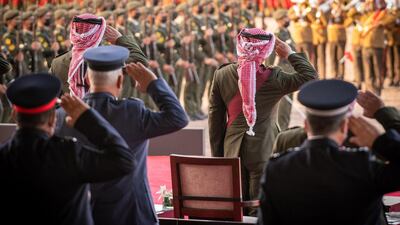
  • King Abdullah II takes the salute at the celebratory march past.
    King Abdullah II takes the salute at the celebratory march past.
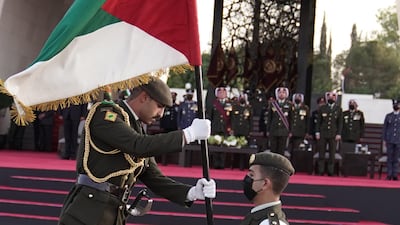
  • The 2nd Al Hussein Mechanised Battalion receives the Great Arab Revolt flag from the 9th Prince Mohammed Mechanised Battalion.
    The 2nd Al Hussein Mechanised Battalion receives the Great Arab Revolt flag from the 9th Prince Mohammed Mechanised Battalion.
  • Airborne Jordanian flags accompany King Abdullah as he crosses the parade ground.
    Airborne Jordanian flags accompany King Abdullah as he crosses the parade ground.
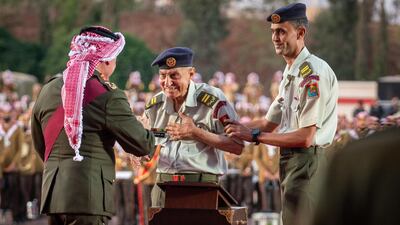
  • King Abdullah bestows the Order of the State Centennial on the Jordan Armed Forces, the Public Security Directorate, the General Intelligence Department, and several army and security personnel, in addition to Royal medals on JAF and security officers.
    King Abdullah bestows the Order of the State Centennial on the Jordan Armed Forces, the Public Security Directorate, the General Intelligence Department, and several army and security personnel, in addition to Royal medals on JAF and security officers.
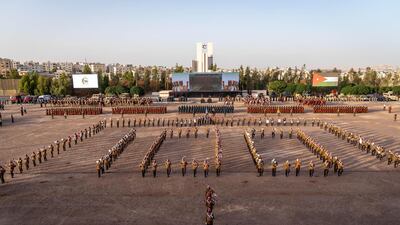
  • Salute and march past at the parade to mark Jordan's centennial.
    Salute and march past at the parade to mark Jordan's centennial.

__________

A large proportion of Jordan’s tribes declared their allegiance to the Hashemites when King Abdullah I, the great grandfather of the current king, founded what would become the Hashemite Kingdom of Jordan with British support in the early 1920s.

The tribes are concentrated mainly in the centre and south of Jordan. But a large proportion of the country’s population of 10 million people is of Palestinian origin.

The kingdom's Palestinian populations are mostly concentrated in urban areas in northern and central Jordan. Most of their ancestors fled the conflict that erupted after the creation of Israel in 1948 and during the 1967 war.


Match info:

Portugal 1
Ronaldo (4')

Morocco 0

Chatham House Rule

A mark of Chatham House’s influence 100 years on since its founding,  was Moscow’s formal declaration last month that it was an “undesirable
organisation”. 


The depth of knowledge and academics that it drew on
following the Ukraine invasion had broadcast Mr Putin’s chicanery.  


The institute is more used to accommodating world leaders,
with Nelson Mandela, Margaret Thatcher among those helping it provide
authoritative commentary on world events. 


Chatham House was formally founded as the Royal Institute of
International Affairs following the peace conferences of World War One. Its
founder, Lionel Curtis, wanted a more scientific examination of international affairs
with a transparent exchange of information and ideas.  


That arena of debate and analysis was enhanced by the “Chatham
House Rule” states that the contents of any meeting can be discussed outside Chatham
House but no mention can be made identifying individuals who commented.  


This has enabled some candid exchanges on difficult subjects
allowing a greater degree of free speech from high-ranking figures.  


These meetings are highly valued, so much so that
ambassadors reported them in secret diplomatic cables that – when they were
revealed in the Wikileaks reporting – were thus found to have broken the rule. However,
most speeches are held on the record.  


Its research and debate has offered fresh ideas to
policymakers enabling them to more coherently address troubling issues from climate
change to health and food security.   

 
TOP%2010%20MOST%20POLLUTED%20CITIES
%3Cp%3E1.%20Bhiwadi%2C%20India%0D%3Cbr%3E2.%20Ghaziabad%2C%20India%0D%3Cbr%3E3.%20Hotan%2C%20China%0D%3Cbr%3E4.%20Delhi%2C%20India%0D%3Cbr%3E5.%20Jaunpur%2C%20India%0D%3Cbr%3E6.%20Faisalabad%2C%20Pakistan%0D%3Cbr%3E7.%20Noida%2C%20India%0D%3Cbr%3E8.%20Bahawalpur%2C%20Pakistan%0D%3Cbr%3E9.%20Peshawar%2C%20Pakistan%0D%3Cbr%3E10.%20Bagpat%2C%20India%3C%2Fp%3E%0A%3Cp%3E%3Cem%3ESource%3A%20IQAir%3C%2Fem%3E%3C%2Fp%3E%0A
How much do leading UAE’s UK curriculum schools charge for Year 6?
  1. Nord Anglia International School (Dubai) – Dh85,032
  2. Kings School Al Barsha (Dubai) – Dh71,905
  3. Brighton College Abu Dhabi - Dh68,560
  4. Jumeirah English Speaking School (Dubai) – Dh59,728
  5. Gems Wellington International School – Dubai Branch – Dh58,488
  6. The British School Al Khubairat (Abu Dhabi) - Dh54,170
  7. Dubai English Speaking School – Dh51,269

*Annual tuition fees covering the 2024/2025 academic year

Formula%204%20Italian%20Championship%202023%20calendar
%3Cp%3EApril%2021-23%3A%20Imola%3Cbr%3EMay%205-7%3A%20Misano%3Cbr%3EMay%2026-28%3A%20SPA-Francorchamps%3Cbr%3EJune%2023-25%3A%20Monza%3Cbr%3EJuly%2021-23%3A%20Paul%20Ricard%3Cbr%3ESept%2029-Oct%201%3A%20Mugello%3Cbr%3EOct%2013-15%3A%20Vallelunga%3C%2Fp%3E%0A
Ten tax points to be aware of in 2026

1. Domestic VAT refund amendments: request your refund within five years

If a business does not apply for the refund on time, they lose their credit.

2. E-invoicing in the UAE

Businesses should continue preparing for the implementation of e-invoicing in the UAE, with 2026 a preparation and transition period ahead of phased mandatory adoption. 

3. More tax audits

Tax authorities are increasingly using data already available across multiple filings to identify audit risks. 

4. More beneficial VAT and excise tax penalty regime

Tax disputes are expected to become more frequent and more structured, with clearer administrative objection and appeal processes. The UAE has adopted a new penalty regime for VAT and excise disputes, which now mirrors the penalty regime for corporate tax.

5. Greater emphasis on statutory audit

There is a greater need for the accuracy of financial statements. The International Financial Reporting Standards standards need to be strictly adhered to and, as a result, the quality of the audits will need to increase.

6. Further transfer pricing enforcement

Transfer pricing enforcement, which refers to the practice of establishing prices for internal transactions between related entities, is expected to broaden in scope. The UAE will shortly open the possibility to negotiate advance pricing agreements, or essentially rulings for transfer pricing purposes. 

7. Limited time periods for audits

Recent amendments also introduce a default five-year limitation period for tax audits and assessments, subject to specific statutory exceptions. While the standard audit and assessment period is five years, this may be extended to up to 15 years in cases involving fraud or tax evasion. 

8. Pillar 2 implementation 

Many multinational groups will begin to feel the practical effect of the Domestic Minimum Top-Up Tax (DMTT), the UAE's implementation of the OECD’s global minimum tax under Pillar 2. While the rules apply for financial years starting on or after January 1, 2025, it is 2026 that marks the transition to an operational phase.

9. Reduced compliance obligations for imported goods and services

Businesses that apply the reverse-charge mechanism for VAT purposes in the UAE may benefit from reduced compliance obligations. 

10. Substance and CbC reporting focus

Tax authorities are expected to continue strengthening the enforcement of economic substance and Country-by-Country (CbC) reporting frameworks. In the UAE, these regimes are increasingly being used as risk-assessment tools, providing tax authorities with a comprehensive view of multinational groups’ global footprints and enabling them to assess whether profits are aligned with real economic activity. 

Contributed by Thomas Vanhee and Hend Rashwan, Aurifer

Living in...

This article is part of a guide on where to live in the UAE. Our reporters will profile some of the country’s most desirable districts, provide an estimate of rental prices and introduce you to some of the residents who call each area home.

COMPANY PROFILE
Name: Mamo 

 Year it started: 2019 Founders: Imad Gharazeddine, Asim Janjua

 Based: Dubai, UAE

 Number of employees: 28

 Sector: Financial services

 Investment: $9.5m

 Funding stage: Pre-Series A Investors: Global Ventures, GFC, 4DX Ventures, AlRajhi Partners, Olive Tree Capital, and prominent Silicon Valley investors. 


Name: Peter Dicce

Title: Assistant dean of students and director of athletics

Favourite sport: soccer

Favourite team: Bayern Munich

Favourite player: Franz Beckenbauer

Favourite activity in Abu Dhabi: scuba diving in the Northern Emirates 


Terror attacks in Paris, November 13, 2015

- At 9.16pm, three suicide attackers killed one person outside the Atade de France during a foootball match between France and Germany- At 9.25pm, three attackers opened fire on restaurants and cafes over 20 minutes, killing 39 people- Shortly after 9.40pm, three other attackers launched a three-hour raid on the Bataclan, in which 1,500 people had gathered to watch a rock concert. In total, 90 people were killed- Salah Abdeslam, the only survivor of the terrorists, did not directly participate in the attacks, thought to be due to a technical glitch in his suicide vest- He fled to Belgium and was involved in attacks on Brussels in March 2016. He is serving a life sentence in France


The burning issue

The internal combustion engine is facing a watershed moment – major manufacturer Volvo is to stop producing petroleum-powered vehicles by 2021 and countries in Europe, including the UK, have vowed to ban their sale before 2040. The National takes a look at the story of one of the most successful technologies of the last 100 years and how it has impacted life in the UAE. 

Read part four: an affection for classic cars lives on

Read part three: the age of the electric vehicle begins

Read part two: how climate change drove the race for an alternative 

Results

4.30pm Jebel Jais – Maiden (PA) Dh60,000 (Turf) 1,000m; Winner: MM Al Balqaa, Bernardo Pinheiro (jockey), Qaiss Aboud (trainer)

5pm: Jabel Faya – Maiden (PA) Dh60,000 (T) 1,000m; Winner: AF Rasam, Tadhg O’Shea, Ernst Oertel

5.30pm: Al Wathba Stallions Cup – Handicap (PA) Dh70,000 (T) 2,200m; Winner: AF Mukhrej, Tadhg O’Shea, Ernst Oertel

6pm: The President’s Cup Prep – Conditions (PA) Dh100,000 (T) 2,200m; Winner: Mujeeb, Richard Mullen, Salem Al Ketbi

6.30pm: Abu Dhabi Equestrian Club – Prestige (PA) Dh125,000 (T) 1,600m; Winner: Jawal Al Reef, Antonio Fresu, Abubakar Daud

7pm: Al Ruwais – Group 3 (PA) Dh300,000 (T) 1,200m; Winner: Ashton Tourettes, Pat Dobbs, Ibrahim Aseel

7.30pm: Jebel Hafeet – Maiden (TB) Dh80,000 (T) 1,400m; Winner: Nibraas, Richard Mullen, Nicholas Bachalard