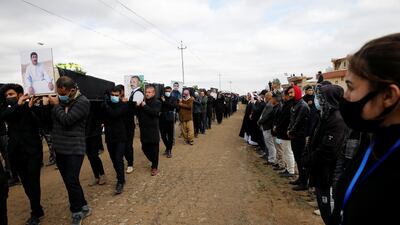
ISIS used chemical weapons against Iraqis between 2014 and 2016, a report by the UN investigation body for ISIS crimes said this week, urging authorities to seek justice.
The insurgents, which took over large areas of Iraq and Syria in 2014, declared a so-called caliphate and imposed a reign of terror over northern Iraq that included public beheadings and the sexual enslavement of Yazidi women.
“A new investigation opened with respect to the development and use of chemical and biological weapons by ISIS in Iraq has developed rapidly,” said a report by the UN investigative body, known as Unitad.
The agency was created to bring ISIS suspects to justice.
Weaponised vesicants, nerve agents and toxic industrial compounds are suspected to have been used
“Through the collection of a diverse range of evidence, the team has confirmed the repeated deployment of chemical weapons by ISIS against civilian populations in Iraq between 2014 and 2016, as well as the testing of biological agents on prisoners,” said the report.
Under pressure from human rights lawyer Amal Clooney and Yazidi survivors, the UN Security Council in 2017 created Unitad to help Iraq collect and preserve evidence for future prosecution.
“Weaponised vesicants, nerve agents and toxic industrial compounds are suspected to have been used,” said the report.
The report's findings that portrayed ISIS's use of "indigenous chemical weapons capability" may present an "unprecedented moment for accountability in modern conflict with respect to non-state actors."
Unitad has finalized an initial case-brief addressing the legal characterization of the crimes committed against the Yazidis community. It will propose that ISIS crimes against the minority group amounts to war crimes and genocide.
The briefing will "identify those most responsible, and detailing modes of liability pursuant to which the identified perpetrators could be tried for war crimes, crimes against humanity or genocide," said the report.
A US-led military coalition along with Iraqi military declared victory over ISIS in December 2017.
Since then, Iraqi authorities have prosecuted tens of thousands of detained former fighters, but Human Rights Watch and Yazidi activists say the trials are often flawed.
The report also found 875 ISIS victims, which were identified in 11 mass graves, in addition to the identification of four execution sites following the attack on Badoush prison in Nineveh.
ISIS fighters killed the inmates at the prison when they overran the site in 2014 after the terror group captured Mosul in June of that same year.
The militants used the prison to hold their own captives including thousands of members of the Yazidi religious minority, but blew it up some time before Iraqi forces drew near.
Iraqi authorities have voiced concerns of an ISIS comeback in recent weeks following sporadic attacks across the country.
At least 18 members of Iraqi and Kurdish security forces were killed recently across the country this week, according to military and security officials, prompting calls from Iraq's president, Barham Saleh, for vigilance against the threat of a resurgence.

Six large-scale objects on show
- Concrete wall and windows from the now demolished Robin Hood Gardens housing estate in Poplar
- The 17th Century Agra Colonnade, from the bathhouse of the fort of Agra in India
- A stagecloth for The Ballet Russes that is 10m high – the largest Picasso in the world
- Frank Lloyd Wright’s 1930s Kaufmann Office
- A full-scale Frankfurt Kitchen designed by Margarete Schütte-Lihotzky, which transformed kitchen design in the 20th century
- Torrijos Palace dome
Email sent to Uber team from chief executive Dara Khosrowshahi
From: Dara
To: Team@
Date: March 25, 2019 at 11:45pm PT
Subj: Accelerating in the Middle East
Five years ago, Uber launched in the Middle East. It was the start of an incredible journey, with millions of riders and drivers finding new ways to move and work in a dynamic region that’s become so important to Uber. Now Pakistan is one of our fastest-growing markets in the world, women are driving with Uber across Saudi Arabia, and we chose Cairo to launch our first Uber Bus product late last year.
Today we are taking the next step in this journey—well, it’s more like a leap, and a big one: in a few minutes, we’ll announce that we’ve agreed to acquire Careem. Importantly, we intend to operate Careem independently, under the leadership of co-founder and current CEO Mudassir Sheikha. I’ve gotten to know both co-founders, Mudassir and Magnus Olsson, and what they have built is truly extraordinary. They are first-class entrepreneurs who share our platform vision and, like us, have launched a wide range of products—from digital payments to food delivery—to serve consumers.
I expect many of you will ask how we arrived at this structure, meaning allowing Careem to maintain an independent brand and operate separately. After careful consideration, we decided that this framework has the advantage of letting us build new products and try new ideas across not one, but two, strong brands, with strong operators within each. Over time, by integrating parts of our networks, we can operate more efficiently, achieve even lower wait times, expand new products like high-capacity vehicles and payments, and quicken the already remarkable pace of innovation in the region.
This acquisition is subject to regulatory approval in various countries, which we don’t expect before Q1 2020. Until then, nothing changes. And since both companies will continue to largely operate separately after the acquisition, very little will change in either teams’ day-to-day operations post-close. Today’s news is a testament to the incredible business our team has worked so hard to build.
It’s a great day for the Middle East, for the region’s thriving tech sector, for Careem, and for Uber.
Uber on,
Dara
The biog
Name: Shamsa Hassan Safar
Nationality: Emirati
Education: Degree in emergency medical services at Higher Colleges of Technology
Favourite book: Between two hearts- Arabic novels
Favourite music: Mohammed Abdu and modern Arabic songs
Favourite way to spend time off: Family visits and spending time with friends
COMPANY%20PROFILE%20
%3Cp%3E%3Cstrong%3EName%3A%3C%2Fstrong%3E%20Dooda%20Solutions%0D%3Cbr%3E%3Cstrong%3EBased%3A%3C%2Fstrong%3E%20Lebanon%0D%3Cbr%3E%3Cstrong%3EFounder%3A%20%3C%2Fstrong%3ENada%20Ghanem%0D%3Cbr%3E%3Cstrong%3ESector%3A%3C%2Fstrong%3E%20AgriTech%0D%3Cbr%3E%3Cstrong%3ETotal%20funding%3A%20%3C%2Fstrong%3E%24300%2C000%20in%20equity-free%20funding%0D%3Cbr%3E%3Cstrong%3ENumber%20of%20employees%3A%3C%2Fstrong%3E%2011%3C%2Fp%3E%0A
Mohammed bin Zayed Majlis
POWERWASH%20SIMULATOR
%3Cp%3E%3Cstrong%3EDeveloper%3A%3C%2Fstrong%3E%20FuturLab%3Cbr%3E%3Cstrong%3EPublisher%3A%20%3C%2Fstrong%3ESquare%20Enix%20Collective%3Cbr%3E%3Cstrong%3EConsole%3A%20%3C%2Fstrong%3ENintendo%20Switch%2C%3Cstrong%3E%20%3C%2Fstrong%3EPlayStation%204%20%26amp%3B%205%2C%20Xbox%20Series%20X%2FS%20and%20PC%3Cbr%3E%3Cstrong%3ERating%3A%3C%2Fstrong%3E%204%2F5%3C%2Fp%3E%0A
Wicked: For Good
Director: Jon M Chu
Starring: Ariana Grande, Cynthia Erivo, Jonathan Bailey, Jeff Goldblum, Michelle Yeoh, Ethan Slater
Rating: 4/5
