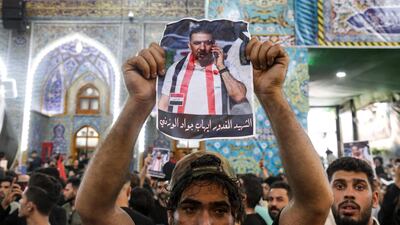
There's little hope of Iraqi authorities bringing the killers of Ihab Al Wazni and other activists to justice, human rights groups and activists said.
The civil society activist was shot dead last week in Karbala. His death sparked daylong protests in the southern holy city that saw demonstrators block roads and bridges with burning tyres.
"The groups behind these killings are extremely powerful to the point that the Iraqi state and law enforcement system is unable to hold them to account," Belkis Wille, a senior researcher at Human Rights Watch, told The National.
“It means we have incredibly powerful armed groups that can perpetrate crimes with impunity on the streets of Iraq in broad daylight and the state cannot do much to curb these attacks."
Calls to the Iraqi Prime Minister's office and the Interior Ministry failed to obtain a comment on the investigation. Iraqi authorities had opened an immediate investigation after the incident, but have yet to announce the perpetrators.
Real accountability and justice will not prevail and the attacks against members of Iraq’s civil society and journalists will continue as long as armed groups are able to “instill fear and silence criticism”, Ms Wille said.
Militias linked to political parties, some backed by Iran, have tightened their grip over state institutions since the US invasion that toppled former dictator Saddam Hussein in 2003.
Prime Minister Mustafa Al Kadhimi, who took office in May, has pledged justice for activists killed or abused by armed groups, and has faced off against some Iran-backed parties.
Al Wazni's assassination triggered outrage at the government's lack of action in providing civilian protection, basic public services and jobs. Al Wazni was a vocal opponent of corruption, the stranglehold of Tehran-linked armed groups and Iran's influence in Iraq.
Nationwide anti-government protests, which began in late 2019, resulted in the killing, arrests and forced disappearances of hundreds of people whose families are still waiting for news of their fate.
"There is no progress on the ground concerning the investigation or accountability processes,'' Ali Al Bayati, a member of the semi-official Iraqi Human Rights Commission, told The National.
“Unfortunately, impunity is the usual end of such crimes which encourages the perpetrators to not stop and intimidate and the assaults will continue,” Mr Al Bayati said.
Dhia Al Hindi, one of the youngest leaders of the protest movement in Karbala, told The National that Al Wazni was the third member of the movement killed by Iranian-back militias that operate in the south.
“We believe that the Iraqi government knows exactly who killed Al Wazni and the two other men just as we know,” Mr Al Hindi said, who is running the upcoming elections. “The killers are working under the cover of the government, they are sides that are loyal to Iran.”
"We have conducted so many protests to pressure the government to punish the killers but nothing has been made," Mr Al Hindi said. "The truth will not prevail under a weak prime minister like Mustafa Al Kadhimi."
The area where Al Wazni was shot is a very secure one, surrounded by CCTV cameras, he said.
“This means whoever conducted the assassination works in the government, and the authorities are aware of this,” Mr Al Hindi said.
Civil society has lost hope that the government will reveal the identities of the perpetrators, said Hassan Wahab, from the Baghdad-based Al Amal human rights group.
“I don’t think the Iraqi government will be serious this time in revealing the killers of Ihab Al Wazni because it has already made many promises that have not been fulfilled,” Mr Wahab said. “Due to the despair of achieving justice the rhetoric of protesters has changed, it has escalated and they’ve threatened to boycott the upcoming elections.”

Tamkeen's offering
- Option 1: 70% in year 1, 50% in year 2, 30% in year 3
- Option 2: 50% across three years
- Option 3: 30% across five years
UAE currency: the story behind the money in your pockets
LIVERPOOL SQUAD
Alisson Becker, Virgil van Dijk, Georginio Wijnaldum, James Milner, Naby Keita, Roberto Firmino, Sadio Mane, Mohamed Salah, Joe Gomez, Adrian, Jordan Henderson, Alex Oxlade-Chamberlain, Adam Lallana, Andy Lonergan, Xherdan Shaqiri, Andy Robertson, Divock Origi, Curtis Jones, Trent Alexander-Arnold, Neco Williams
What are the GCSE grade equivalents?
- Grade 9 = above an A*
- Grade 8 = between grades A* and A
- Grade 7 = grade A
- Grade 6 = just above a grade B
- Grade 5 = between grades B and C
- Grade 4 = grade C
- Grade 3 = between grades D and E
- Grade 2 = between grades E and F
- Grade 1 = between grades F and G
The specs: Lamborghini Aventador SVJ
Price, base: Dh1,731,672
Engine: 6.5-litre V12
Gearbox: Seven-speed automatic
Power: 770hp @ 8,500rpm
Torque: 720Nm @ 6,750rpm
Fuel economy: 19.6L / 100km
'Nightmare Alley'
Director:Guillermo del Toro
Stars:Bradley Cooper, Cate Blanchett, Rooney Mara
Rating: 3/5
Real estate tokenisation project
Dubai launched the pilot phase of its real estate tokenisation project last month.
The initiative focuses on converting real estate assets into digital tokens recorded on blockchain technology and helps in streamlining the process of buying, selling and investing, the Dubai Land Department said.
Dubai’s real estate tokenisation market is projected to reach Dh60 billion ($16.33 billion) by 2033, representing 7 per cent of the emirate’s total property transactions, according to the DLD.
Will the pound fall to parity with the dollar?
The idea of pound parity now seems less far-fetched as the risk grows that Britain may split away from the European Union without a deal.
Rupert Harrison, a fund manager at BlackRock, sees the risk of it falling to trade level with the dollar on a no-deal Brexit. The view echoes Morgan Stanley’s recent forecast that the currency can plunge toward $1 (Dh3.67) on such an outcome. That isn’t the majority view yet – a Bloomberg survey this month estimated the pound will slide to $1.10 should the UK exit the bloc without an agreement.
New Prime Minister Boris Johnson has repeatedly said that Britain will leave the EU on the October 31 deadline with or without an agreement, fuelling concern the nation is headed for a disorderly departure and fanning pessimism toward the pound. Sterling has fallen more than 7 per cent in the past three months, the worst performance among major developed-market currencies.
“The pound is at a much lower level now but I still think a no-deal exit would lead to significant volatility and we could be testing parity on a really bad outcome,” said Mr Harrison, who manages more than $10 billion in assets at BlackRock. “We will see this game of chicken continue through August and that’s likely negative for sterling,” he said about the deadlocked Brexit talks.
The pound fell 0.8 per cent to $1.2033 on Friday, its weakest closing level since the 1980s, after a report on the second quarter showed the UK economy shrank for the first time in six years. The data means it is likely the Bank of England will cut interest rates, according to Mizuho Bank.
The BOE said in November that the currency could fall even below $1 in an analysis on possible worst-case Brexit scenarios. Options-based calculations showed around a 6.4 per cent chance of pound-dollar parity in the next one year, markedly higher than 0.2 per cent in early March when prospects of a no-deal outcome were seemingly off the table.
Bloomberg
NATIONAL%20SELECTIONS
%3Cp%3E6.00pm%3A%20Heros%20de%20Lagarde%3Cbr%3E6.35pm%3A%20City%20Walk%3Cbr%3E7.10pm%3A%20Mimi%20Kakushi%3Cbr%3E7.45pm%3A%20New%20Kingdom%3Cbr%3E8.20pm%3A%20Siskany%3Cbr%3E8.55pm%3A%20Nations%20Pride%3Cbr%3E9.30pm%3A%20Ever%20Given%3C%2Fp%3E%0A
