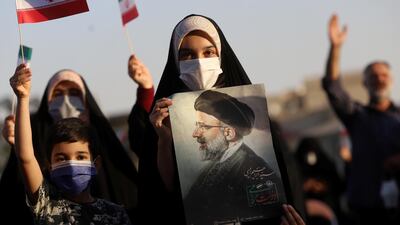

Iran’s incoming president, hardline cleric Ebrahim Raisi, could turn the country inwards and usher in more repressive policies when he takes office in August, experts have said.
Mr Raisi's election was met with a muted response from Iranians, many of whom boycotted the polls on Friday.
Dina Esfandiary, senior adviser on the Mena region at International Crisis Group, said there was real political exhaustion among the Iranian population.
"There's a lack of hope, they don't see much change no matter who gets elected so they don't see the point of getting involved," she said.
Almost 50 per cent of eligible voters stayed at home, an all-time low, amid allegations the election had been rigged.
Mr Raisi won with 17.8 million votes, about the same number he received in 2017, when he lost to Hassan Rouhani.
Apathy towards the political process has long been a symptom of the malaise in Iranian politics.
But for many Iranians, this election – and its apparently predetermined outcome – was the final straw.
“This wasn’t an election; it was a selection,” said Holly Dagres, a senior fellow at the Atlantic Council think tank.
“The fact that candidates conceded before the official results were announced tells you everything you need to know.”
The decision by the Guardian Council, a 12-member body appointed by Supreme Leader Ayatollah Ali Khamenei, to pick mostly conservative candidates made the eventual result all but inevitable, as did Mr Raisi’s close relationship with the supreme leader.
Ms Dagres said Mr Raisi’s win ultimately had little to do with the will or needs of the Iranian people, however, and was more a move to secure Mr Khamenei’s personal legacy.
With a hardliner as president, the three branches of the Iranian government will be ideologically aligned. She said this suited Mr Khamenei’s vision of a “young and pious” government.
Mr Raisi will take over as leader during a pivotal time for the country.
The former judiciary chief will inherit a crumbling economy, a high level of poverty and President Rouhani’s nuclear negotiations, should they not be resolved by August.

Although hardliners such as Mr Raisi often focus on Iran’s role on the international stage – Mr Raisi himself has long been critical of the West and taken a more combative stance in diplomacy – he is largely expected to leave the country’s foreign policy unchanged.
Such matters, although introduced by the president and the Foreign Ministry, are set by the supreme leader.
Discussing Iran's approach to the 2015 nuclear deal with the US and other nations, US National Security Advisor Jake Sullivan seemed unfazed by Mr Raisi's election.
“The ultimate decision for whether or not to come back lies with Iran’s supreme leader,” said Mr Sullivan. “And he was the same person before this election as he is after the election.”
Ms Esfandiary said the coming of a hardliner like Mr Raisi could make negotiations with the West tougher in tone, but "if a deal is reached then it is likelier to last because it will face less opposition internally from a political elite that’s more unified."
-
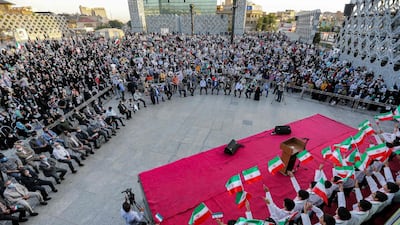
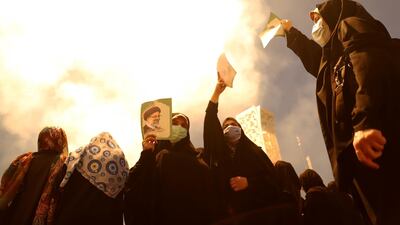
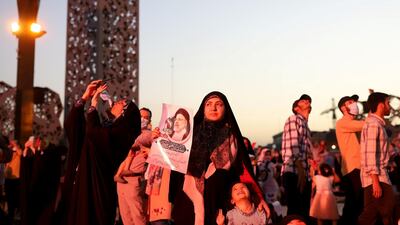
Supporters of Iran's newly elected president Ebrahim Raisi gather at a rally celebrating his victory, in Imam Hossein square, in the capital Tehran. AFP -
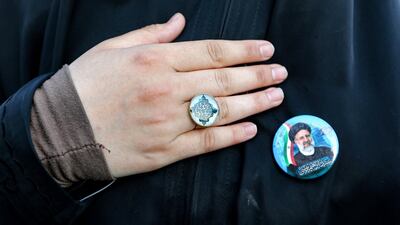
A woman wears a pin bearing the image of Iran's newly elected president Ebrahim Raisi during a rally in Imam Hossein square. AFP -
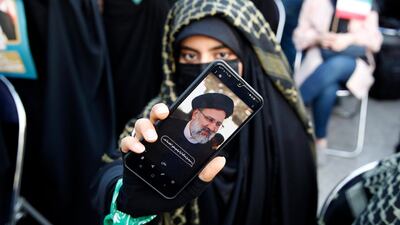
A woman shows an image of Iranian president-elect Ebrahim Raisi on her phone. He received 17.9 million votes in a landslide victory. EPA -
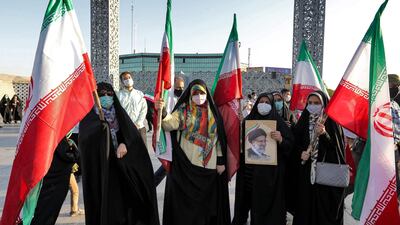
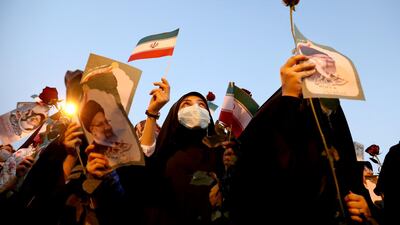
Women supporters of Ebrahim Raisi hold posters depicting him and national flags as they celebrate his presidential victory. More than 28 million Iranians out of 59 million eligible voters cast their ballots. AFP -
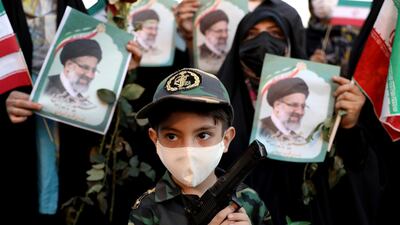
An Iranian child holds a toy gun at a celebration to mark the victory of Ebrahim Raisi in the presidential elections. The vote appeared to see the lowest turnout in the Islamic Republic’s history. AP Photo -
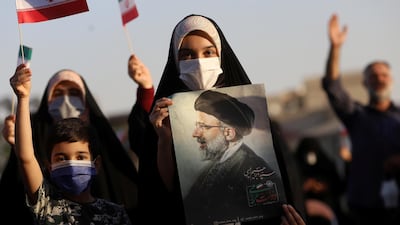
Ebrahim Raisi supporters display his portrait during a celebratory rally for his presidential election victory in Tehran. He will succeed President Hassan Rouhani, who is coming to the end of his second term in office. Reuters -
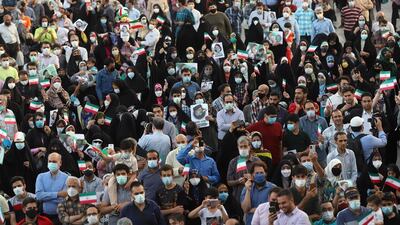
Supporters of Ebrahim Raisi gather to celebrate his presidential election victory in Tehran. He had the support of supreme leader Ayatollah Ali Khamenei and the backing of the powerful Guardian Council. Reuters -
A conservative cleric and head of Iran’s judiciary, Ebrahim Raisi is expected to usher in hardline policies that will close Iran off from much of the world. Reuters -
Ebrahim Raisi will be the first Iranian president to have had sanctions imposed against him by the US government before entering office. Reuters -
Although critical of the West, Ebrahim Raisi is keen to to revive the 2015 nuclear accord that lifted global sanctions on Tehran. AP Photo -

Other pressing issues Iran's president-elect Ebrahim Raisi faces include an economic downturn that has led to spiralling inflation and job losses and tackling the region's worst outbreak of Covid-19. Reuters -

Supporters of Ebrahim Raisi celebrate his presidential election victory in Tehran. Reuters


Continued negotiations and a softening stance towards its regional rivals is a policy handed down from the very top of the country, so Mr Raisi will have little ability to change that mandate. He could, however, have a far stronger impact within Iran’s borders.
Although they have long lived under repressive policies, the lives of many Iranians have begun to change for the better during Mr Rouhani’s eight-year tenure. Such incremental changes are partly due to rise of social media.
But experts sounded warnings this is likely to change, and Ms Dagres said she feared the future for Iranians did not bode well.
“Under his tenure as Judiciary Chief, executions have continued and, in some ways, have worsened. For example, in 2020, a man was executed for merely drinking alcohol,” she said.
“Similarly, before the election, there were reports of Iranian journalists being harassed merely for reporting on Raisi’s dark background. These are signs of what is to come.”

