Iran’s parliamentary speaker Ali Larijani and Iranian judiciary chief Ebrahim Raisi. Reuters, AFP

Iran's June elections threaten to split conservatives


Leila Gharagozlou
  • English
  • Arabic

Iran’s presidential election next month could could cause a split among the country’s conservatives.

The June 18 election is already widely expected to be a showdown between conservative Ali Larijani, a former Parliament speaker, who is now billing himself as a reformer, and ultraconservative judiciary chief Ebrahim Raisi.

While the list of approved candidates has yet to be released, the elections committee said close to 600 candidates, including 40 women, have registered to stand to succeed moderate President Hassan Rouhani. He cannot run again because of term limits.

Many candidates are linked to Iran’s Islamic Revolutionary Guard Corps.

All will be vetted by the Guardian Council, a conservative-dominated, unelected body in charge of overseeing elections, and only a handful will be allowed to run.

This is causing fissures within the ranks of political hardliners, who must unite and decide which candidate to back.

Fractures within Iran’s conservatives date back to the “Green Movement”, which emerged in 2009 when the re-election of populist president Mahmoud Ahmadinejad was disputed.

Mr Ahmadinejad’s re-election ushered in Iran’s “ultraconservatives” who defined themselves as “revolutionaries”, in reference to a saying by supreme leader Ayatollah Ali Khamenei: “I am not a diplomat. I am a revolutionary.”

The ultraconservatives oppose traditional conservatives, accusing them of being "the guardians of the status quo", according to the ultraconservative daily newspaper Javan.

Conservatives and ultraconservatives opposed Mr Rouhani in 2013, the year he won the presidency. So-called “principalists” mobilised against his policy of openness with the West, accusing him of selling off Iran’s interests.

  • Iranian President Hassan Rouhani, right, and the head of Atomic Energy Organization of Iran Ali Akbar Salehi inspect the nuclear technology on the occasion of Iran National Nuclear Technology Day in Tehran in 2019. EPA
    Iranian President Hassan Rouhani, right, and the head of Atomic Energy Organization of Iran Ali Akbar Salehi inspect the nuclear technology on the occasion of Iran National Nuclear Technology Day in Tehran in 2019. EPA
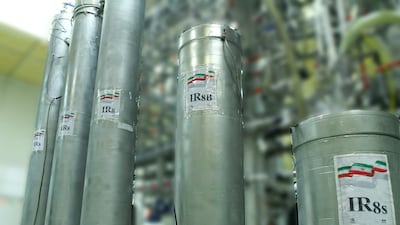
  • IR-8 centrifuges at Natanz nuclear power plant, some 300 kilometres south of capital Tehran. AFP
    IR-8 centrifuges at Natanz nuclear power plant, some 300 kilometres south of capital Tehran. AFP
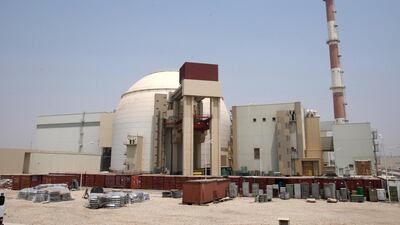
  • The Iranian nuclear power plant in Bushehr in 2010. EPA
    The Iranian nuclear power plant in Bushehr in 2010. EPA
  • Salehi speaks with media while visiting Natanz enrichment facility, in central Iran in 2019. Atomic Energy Organization of Iran via AP
    Salehi speaks with media while visiting Natanz enrichment facility, in central Iran in 2019. Atomic Energy Organization of Iran via AP
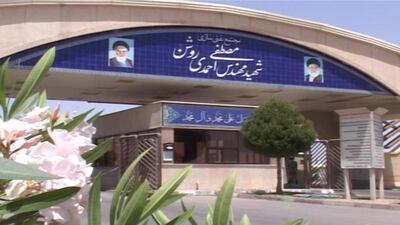
  • The gate of Natanz nuclear power plant in Natanz , Isfahan province, in 2019. EPA
    The gate of Natanz nuclear power plant in Natanz , Isfahan province, in 2019. EPA
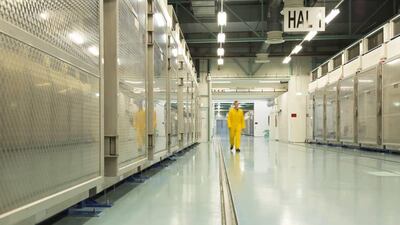
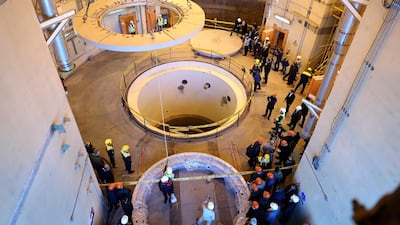
  • Inside of the Iran's Fordow nuclear facility, in Fordow, Qom province in 2019. EPA
    Inside of the Iran's Fordow nuclear facility, in Fordow, Qom province in 2019. EPA
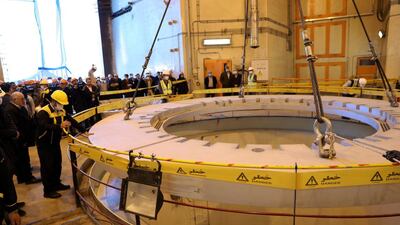
  • Technicians work at the Arak heavy water reactor's secondary circuit, as officials and media visit the site, near Arak, Iran in 2019. Atomic Energy Organization of Iran via AP
    Technicians work at the Arak heavy water reactor's secondary circuit, as officials and media visit the site, near Arak, Iran in 2019. Atomic Energy Organization of Iran via AP
  • Members of the media and officials tour the water nuclear reactor at Arak in 2019. WANA via Reuters
    Members of the media and officials tour the water nuclear reactor at Arak in 2019. WANA via Reuters
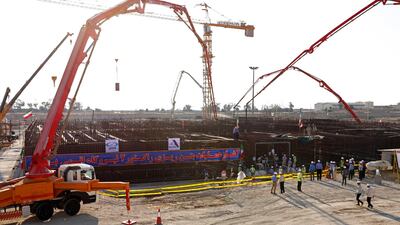
  • Concrete is poured for the base of the second nuclear power reactor at Bushehr plant in 2019. Atomic Energy Organization of Iran via AP
    Concrete is poured for the base of the second nuclear power reactor at Bushehr plant in 2019. Atomic Energy Organization of Iran via AP

Mr Khamenei backed the Joint Comprehensive Plan of Action, commonly known as the nuclear deal, reached in Vienna in 2015.

Centrist conservatives such as Mr Larijani, who at the time was parliamentary speaker, also rallied to support the agreement.

But the withdrawal of the US from the deal and its subsequent reinstatement of sanctions in 2018 reinstatement of sanctions revived support for the ultraconservatives.

As the economic impact of the sanctions bit, ultraconservatives’ criticism of Mr Rouhani’s government grew.

Iran’s parliamentary elections in February last year exposed the growing discontent with the reformist government.

Only 42 per cent of those eligible to vote did so, the lowest turnout of any election in the country, and a hardline majority was elected to Parliament.

Muhammad Sahimi, an expert on Iranian politics, said a low voter turnout often results in the election of hardline politicians, whereas a turnout of more than 60 per cent almost always ushers in reformist candidates.

As polls approach next month, Iran and world powers are once again engaged in talks in Vienna, seeking to revive the nuclear deal.

A file photo of Iranian parliament speaker Ali Larijani. Reuters.

The ultraconservatives continue to push back against Mr Rouhani’s government, but have thus far fallen in line, following the position of Mr Khamenei.

Even Mr Raisi, who won 38 per cent of votes in the 2017 race, says the priority is for US sanctions to be eased. He did not fully support the nuclear agreement but implied that, if he wins, he is likely to keep Iran onboard.

Mr Larijani, speaking to an audience of more than 20,000 people on the social media app Clubhouse, defended the nuclear deal.

He also spoke in support of the Rouhani government’s push for diplomacy with the West, saying: “We should try to reach a deal as soon as possible and all the focus must be on improving economic conditions because the country is in a worrying situation in terms of poverty.”

The presidential elections’ outcome will hinge on Iran’s ailing economy, its role in the world, internet freedom. Mr Raisi and Mr Larijani are expected to clash on a number of these issues in debates on television and on social media platforms such as Clubhouse.

Voter turnout is currently expected to be about 40 per cent, in contrast with Iran’s most recent elections, which attracted about 71 per cent of the electorate.

How will Gen Alpha invest?

Mark Chahwan, co-founder and chief executive of robo-advisory firm Sarwa, forecasts that Generation Alpha (born between 2010 and 2024) will start investing in their teenage years and therefore benefit from compound interest.

“Technology and education should be the main drivers to make this happen, whether it’s investing in a few clicks or their schools/parents stepping up their personal finance education skills,” he adds.

Mr Chahwan says younger generations have a higher capacity to take on risk, but for some their appetite can be more cautious because they are investing for the first time. “Schools still do not teach personal finance and stock market investing, so a lot of the learning journey can feel daunting and intimidating,” he says.

He advises millennials to not always start with an aggressive portfolio even if they can afford to take risks. “We always advise to work your way up to your risk capacity, that way you experience volatility and get used to it. Given the higher risk capacity for the younger generations, stocks are a favourite,” says Mr Chahwan.

Highlighting the role technology has played in encouraging millennials and Gen Z to invest, he says: “They were often excluded, but with lower account minimums ... a customer with $1,000 [Dh3,672] in their account has their money working for them just as hard as the portfolio of a high get-worth individual.”

Who's who in Yemen conflict

Houthis: Iran-backed rebels who occupy Sanaa and run unrecognised government

Yemeni government: Exiled government in Aden led by eight-member Presidential Leadership Council

Southern Transitional Council: Faction in Yemeni government that seeks autonomy for the south

Habrish 'rebels': Tribal-backed forces feuding with STC over control of oil in government territory

The biog

Favourite book: Animal Farm by George Orwell

Favourite music: Classical

Hobbies: Reading and writing


The specs

Engine: 2.0-litre 4-cyl, 48V hybrid

Transmission: eight-speed automatic

Power: 325bhp

Torque: 450Nm

Price: Dh359,000

On sale: now 

The specs

Engine: 2.0-litre 4cyl turbo

Power: 261hp at 5,500rpm

Torque: 405Nm at 1,750-3,500rpm

Transmission: 9-speed auto

Fuel consumption: 6.9L/100km

On sale: Now

Price: From Dh117,059

U19 WORLD CUP, WEST INDIES

UAE group fixtures (all in St Kitts)

  • Saturday 15 January: UAE beat Canada by 49 runs 
  • Thursday 20 January: v England 
  • Saturday 22 January: v Bangladesh 

UAE squad:

Alishan Sharafu (captain), Shival Bawa, Jash Giyanani, Sailles
Jaishankar, Nilansh Keswani, Aayan Khan, Punya Mehra, Ali Naseer, Ronak Panoly,
Dhruv Parashar, Vinayak Raghavan, Soorya Sathish, Aryansh Sharma, Adithya
Shetty, Kai Smith  

In-demand jobs and monthly salaries
  • Technology expert in robotics and automation: Dh20,000 to Dh40,000 
  • Energy engineer: Dh25,000 to Dh30,000 
  • Production engineer: Dh30,000 to Dh40,000 
  • Data-driven supply chain management professional: Dh30,000 to Dh50,000 
  • HR leader: Dh40,000 to Dh60,000 
  • Engineering leader: Dh30,000 to Dh55,000 
  • Project manager: Dh55,000 to Dh65,000 
  • Senior reservoir engineer: Dh40,000 to Dh55,000 
  • Senior drilling engineer: Dh38,000 to Dh46,000 
  • Senior process engineer: Dh28,000 to Dh38,000 
  • Senior maintenance engineer: Dh22,000 to Dh34,000 
  • Field engineer: Dh6,500 to Dh7,500
  • Field supervisor: Dh9,000 to Dh12,000
  • Field operator: Dh5,000 to Dh7,000
Ten tax points to be aware of in 2026

1. Domestic VAT refund amendments: request your refund within five years

If a business does not apply for the refund on time, they lose their credit.

2. E-invoicing in the UAE

Businesses should continue preparing for the implementation of e-invoicing in the UAE, with 2026 a preparation and transition period ahead of phased mandatory adoption. 

3. More tax audits

Tax authorities are increasingly using data already available across multiple filings to identify audit risks. 

4. More beneficial VAT and excise tax penalty regime

Tax disputes are expected to become more frequent and more structured, with clearer administrative objection and appeal processes. The UAE has adopted a new penalty regime for VAT and excise disputes, which now mirrors the penalty regime for corporate tax.

5. Greater emphasis on statutory audit

There is a greater need for the accuracy of financial statements. The International Financial Reporting Standards standards need to be strictly adhered to and, as a result, the quality of the audits will need to increase.

6. Further transfer pricing enforcement

Transfer pricing enforcement, which refers to the practice of establishing prices for internal transactions between related entities, is expected to broaden in scope. The UAE will shortly open the possibility to negotiate advance pricing agreements, or essentially rulings for transfer pricing purposes. 

7. Limited time periods for audits

Recent amendments also introduce a default five-year limitation period for tax audits and assessments, subject to specific statutory exceptions. While the standard audit and assessment period is five years, this may be extended to up to 15 years in cases involving fraud or tax evasion. 

8. Pillar 2 implementation 

Many multinational groups will begin to feel the practical effect of the Domestic Minimum Top-Up Tax (DMTT), the UAE's implementation of the OECD’s global minimum tax under Pillar 2. While the rules apply for financial years starting on or after January 1, 2025, it is 2026 that marks the transition to an operational phase.

9. Reduced compliance obligations for imported goods and services

Businesses that apply the reverse-charge mechanism for VAT purposes in the UAE may benefit from reduced compliance obligations. 

10. Substance and CbC reporting focus

Tax authorities are expected to continue strengthening the enforcement of economic substance and Country-by-Country (CbC) reporting frameworks. In the UAE, these regimes are increasingly being used as risk-assessment tools, providing tax authorities with a comprehensive view of multinational groups’ global footprints and enabling them to assess whether profits are aligned with real economic activity. 

Contributed by Thomas Vanhee and Hend Rashwan, Aurifer

Shubh Mangal Saavdhan
Directed by: RS Prasanna
Starring: Ayushmann Khurrana, Bhumi Pednekar

Company%20profile
%3Cp%3EDate%20started%3A%20January%202022%3Cbr%3EFounders%3A%20Omar%20Abu%20Innab%2C%20Silvia%20Eldawi%2C%20Walid%20Shihabi%3Cbr%3EBased%3A%20Dubai%3Cbr%3ESector%3A%20PropTech%20%2F%20investment%3Cbr%3EEmployees%3A%2040%3Cbr%3EStage%3A%20Seed%3Cbr%3EInvestors%3A%20Multiple%3C%2Fp%3E%0A

Women & Power: A Manifesto

Mary Beard

Profile Books and London Review of Books 

EMERGENCY PHONE NUMBERS

Estijaba – 8001717 –  number to call to request coronavirus testing

Ministry of Health and Prevention – 80011111

Dubai Health Authority – 800342 – The number to book a free video or voice consultation with a doctor or connect to a local health centre

Emirates airline – 600555555

Etihad Airways – 600555666

Ambulance – 998

Knowledge and Human Development Authority – 8005432 ext. 4 for Covid-19 queries

Mercer, the investment consulting arm of US services company Marsh & McLennan, expects its wealth division to at least double its assets under management (AUM) in the Middle East as wealth in the region continues to grow despite economic headwinds, a company official said.

Mercer Wealth, which globally has $160 billion in AUM, plans to boost its AUM in the region to $2-$3bn in the next 2-3 years from the present $1bn, said Yasir AbuShaban, a Dubai-based principal with Mercer Wealth.

Within the next two to three years, we are looking at reaching $2 to $3 billion as a conservative estimate and we do see an opportunity to do so,” said Mr AbuShaban.

Mercer does not directly make investments, but allocates clients’ money they have discretion to, to professional asset managers. They also provide advice to clients.

“We have buying power. We can negotiate on their (client’s) behalf with asset managers to provide them lower fees than they otherwise would have to get on their own,” he added.

Mercer Wealth’s clients include sovereign wealth funds, family offices, and insurance companies among others.

From its office in Dubai, Mercer also looks after Africa, India and Turkey, where they also see opportunity for growth.

Wealth creation in Middle East and Africa (MEA) grew 8.5 per cent to $8.1 trillion last year from $7.5tn in 2015, higher than last year’s global average of 6 per cent and the second-highest growth in a region after Asia-Pacific which grew 9.9 per cent, according to consultancy Boston Consulting Group (BCG). In the region, where wealth grew just 1.9 per cent in 2015 compared with 2014, a pickup in oil prices has helped in wealth generation.

BCG is forecasting MEA wealth will rise to $12tn by 2021, growing at an annual average of 8 per cent.

Drivers of wealth generation in the region will be split evenly between new wealth creation and growth of performance of existing assets, according to BCG.

Another general trend in the region is clients’ looking for a comprehensive approach to investing, according to Mr AbuShaban.

“Institutional investors or some of the families are seeing a slowdown in the available capital they have to invest and in that sense they are looking at optimizing the way they manage their portfolios and making sure they are not investing haphazardly and different parts of their investment are working together,” said Mr AbuShaban.

Some clients also have a higher appetite for risk, given the low interest-rate environment that does not provide enough yield for some institutional investors. These clients are keen to invest in illiquid assets, such as private equity and infrastructure.

“What we have seen is a desire for higher returns in what has been a low-return environment specifically in various fixed income or bonds,” he said.

“In this environment, we have seen a de facto increase in the risk that clients are taking in things like illiquid investments, private equity investments, infrastructure and private debt, those kind of investments were higher illiquidity results in incrementally higher returns.”

The Abu Dhabi Investment Authority, one of the largest sovereign wealth funds, said in its 2016 report that has gradually increased its exposure in direct private equity and private credit transactions, mainly in Asian markets and especially in China and India. The authority’s private equity department focused on structured equities owing to “their defensive characteristics.”

FIRST TEST SCORES

England 458
South Africa 361 & 119 (36.4 overs)

England won by 211 runs and lead series 1-0

Player of the match: Moeen Ali (England)


The smuggler

Eldarir had arrived at JFK in January 2020 with three suitcases, containing goods he valued at $300, when he was directed to a search area.
Officers found 41 gold artefacts among the bags, including amulets from a funerary set which prepared the deceased for the afterlife.
Also found was a cartouche of a Ptolemaic king on a relief that was originally part of a royal building or temple. 
The largest single group of items found in Eldarir’s cases were 400 shabtis, or figurines.

Khouli conviction

Khouli smuggled items into the US by making false declarations to customs about the country of origin and value of the items.
According to Immigration and Customs Enforcement, he provided “false provenances which stated that [two] Egyptian antiquities were part of a collection assembled by Khouli's father in Israel in the 1960s” when in fact “Khouli acquired the Egyptian antiquities from other dealers”.
He was sentenced to one year of probation, six months of home confinement and 200 hours of community service in 2012 after admitting buying and smuggling Egyptian antiquities, including coffins, funerary boats and limestone figures.

For sale

A number of other items said to come from the collection of Ezeldeen Taha Eldarir are currently or recently for sale.
Their provenance is described in near identical terms as the British Museum shabti: bought from Salahaddin Sirmali, "authenticated and appraised" by Hossen Rashed, then imported to the US in 1948.

- An Egyptian Mummy mask dating from 700BC-30BC, is on offer for £11,807 ($15,275) online by a seller in Mexico

- A coffin lid dating back to 664BC-332BC was offered for sale by a Colorado-based art dealer, with a starting price of $65,000

- A shabti that was on sale through a Chicago-based coin dealer, dating from 1567BC-1085BC, is up for $1,950

Griselda
%3Cp%3E%3Cstrong%3EDirector%3A%3C%2Fstrong%3E%C2%A0Andr%C3%A9s%20Baiz%3C%2Fp%3E%0A%3Cp%3E%3Cstrong%3EStarring%3A%C2%A0%3C%2Fstrong%3ESof%C3%ADa%20Vergara%2C%20Alberto%20Guerra%2C%20Juliana%20Aiden%20Martinez%3C%2Fp%3E%0A%3Cp%3E%3Cstrong%3ERating%3A%3C%2Fstrong%3E%204%2F5%3C%2Fp%3E%0A
About Karol Nawrocki

• Supports military aid for Ukraine, unlike other eurosceptic leaders, but he will oppose its membership in western alliances.

• A nationalist, his campaign slogan was Poland First. "Let's help others, but let's take care of our own citizens first," he said on social media in April.

• Cultivates tough-guy image, posting videos of himself at shooting ranges and in boxing rings.

• Met Donald Trump at the White House and received his backing.

MATCH INFO

Uefa Champions League semi-final, first leg

Barcelona v Liverpool, Wednesday, 11pm (UAE).

Second leg

Liverpool v Barcelona, Tuesday, May 7, 11pm

Games on BeIN Sports

Tamkeen's offering
  • Option 1: 70% in year 1, 50% in year 2, 30% in year 3
  • Option 2: 50% across three years
  • Option 3: 30% across five years 
Fixtures:

Wed Aug 29 – Malaysia v Hong Kong, Nepal v Oman, UAE v Singapore
Thu Aug 30 - UAE v Nepal, Hong Kong v Singapore, Malaysia v Oman
Sat Sep 1 - UAE v Hong Kong, Oman v Singapore, Malaysia v Nepal
Sun Sep 2 – Hong Kong v Oman, Malaysia v UAE, Nepal v Singapore
Tue Sep 4 - Malaysia v Singapore, UAE v Oman, Nepal v Hong Kong
Thu Sep 6 – Final

Results

57kg quarter-finals

Zakaria Eljamari (UAE) beat Hamed Al Matari (YEM) by points 3-0.

60kg quarter-finals

Ibrahim Bilal (UAE) beat Hyan Aljmyah (SYR) RSC round 2.

63.5kg quarter-finals

Nouredine Samir (UAE) beat Shamlan A Othman (KUW) by points 3-0.

67kg quarter-finals

Mohammed Mardi (UAE) beat Ahmad Ondash (LBN) by points 2-1.

71kg quarter-finals

Ahmad Bahman (UAE) defeated Lalthasanga Lelhchhun (IND) by points 3-0.

Amine El Moatassime (UAE) beat Seyed Kaveh Safakhaneh (IRI) by points 3-0.

81kg quarter-finals

Ilyass Habibali (UAE) beat Ahmad Hilal (PLE) by points 3-0

Key figures in the life of the fort

Sheikh Dhiyab bin Isa (ruled 1761-1793) Built Qasr Al Hosn as a watchtower to guard over the only freshwater well on Abu Dhabi island.

Sheikh Shakhbut bin Dhiyab (ruled 1793-1816) Expanded the tower into a small fort and transferred his ruling place of residence from Liwa Oasis to the fort on the island.

Sheikh Tahnoon bin Shakhbut (ruled 1818-1833) Expanded Qasr Al Hosn further as Abu Dhabi grew from a small village of palm huts to a town of more than 5,000 inhabitants.

Sheikh Khalifa bin Shakhbut (ruled 1833-1845) Repaired and fortified the fort.

Sheikh Saeed bin Tahnoon (ruled 1845-1855) Turned Qasr Al Hosn into a strong two-storied structure.

Sheikh Zayed bin Khalifa (ruled 1855-1909) Expanded Qasr Al Hosn further to reflect the emirate's increasing prominence.

Sheikh Shakhbut bin Sultan (ruled 1928-1966) Renovated and enlarged Qasr Al Hosn, adding a decorative arch and two new villas.

Sheikh Zayed bin Sultan (ruled 1966-2004) Moved the royal residence to Al Manhal palace and kept his diwan at Qasr Al Hosn.

Sources: Jayanti Maitra, www.adach.ae

'Cheb%20Khaled'
%3Cp%3E%3Cstrong%3EArtist%3A%20%3C%2Fstrong%3EKhaled%3Cbr%3E%3Cstrong%3ELabel%3A%20%3C%2Fstrong%3EBelieve%3Cbr%3E%3Cstrong%3ERating%3A%3C%2Fstrong%3E%204%2F5%3C%2Fp%3E%0A

Cracks in the Wall

Ben White, Pluto Press 

Dengue%20fever%20symptoms
%3Cp%3EHigh%20fever%20(40%C2%B0C%2F104%C2%B0F)%3Cbr%3ESevere%20headache%3Cbr%3EPain%20behind%20the%20eyes%3Cbr%3EMuscle%20and%20joint%20pains%3Cbr%3ENausea%3Cbr%3EVomiting%3Cbr%3ESwollen%20glands%3Cbr%3ERash%26nbsp%3B%3C%2Fp%3E%0A