The screen shot of a young woman’s Facebook Messenger account showed an all-too-familiar monologue playing out starting with a man sending a direct message saying “Slm” (hi). No reply. A month later, “slm,” then “slm” again the next day. When that opening gambit failed to provoke a response, the man sent a photo of him exposing himself to the woman.
Those messages, along with two similar salvos sent to the same recipient, are among the thousands of first hand accounts of sexual harassment and violence Tunisian women and LGBTQ people have shared on the #EnaZeda or #MeToo Facebook page in recent months.
In 2019, Facebook helped usher in what feminists and women’s rights activists hoped would be the next great revolution in North Africa: holding men to account for sexual harassment and violence. But two years later, the platforms where women have turned most often to share their stories have become the leading tool for sexual harassment.
The #EnaZeda movement was born shortly after a newly-elected legislator was caught on video performing an obcene act outside a girls’ school in the autumn of 2019 (a charge he denied). After the video was posted online, personal testimonies of sexual harassment and violence from women around the country streamed onto social media.
Several feminist activists and organisations saw the need to corral those stories into a public forum where they could be amplified, and took to Facebook to do so.
A group was set up to discuss topics ranging from street harassment to sexism in politics, and a page dedicated to publishing the personal testimonies of physical, psychological, digital, verbal and financial abuse suffered by Tunisian women now has more than 65,000 followers.
A recent study carried out by the Centre of Research, Studies, Documentation and Information About Women (Crédif) found that 80 per cent of Tunisian women had suffered online harassment, usually in the form of explicit, badgering or violent messages on Facebook. Nearly one in seven women have been called a "whore`”.
The deluge of stories from women across the country has instigated a sea change in the discourse around women's rights and safety in Tunisia. But a recent surge in online harassment has made Facebook increasingly dangerous for women.
"They receive unwanted, harassing messages or photos,” explained Sonia Ben Miled, one of the founders of the #EnaZeda Facebook group and member of Aswaat Nissa, a women’s rights organisation.
The #EnaZeda page has published hundreds of screenshots of harassing Facebook Messenger interactions, often leaving the perpetrator’s name and profile in full view of its large and active audience.

The page does not independently verify the reports, and only redacts the names of the victims, and any graphic images.
Tunisia’s women are not alone in their struggle to access social networks safely.
A recent survey in 22 countries showed an alarming surge in online abuse against girls and women.
The survey, conducted by Plan International, found that 58 per cent of the more than 14,000 young women and teens they followed had been victims of cyber harassment.
Facebook was the leading platform for those attacks, with 39 per cent of respondents saying they’d encountered harassment on the platform.
Covid-19 has only amplified the situation.
Tunisia went through months of lockdown last spring; the 8pm curfew, which has been in place since the lockdown lifted, will be moved to 10pm beginning on Monday. With movement restricted, women are spending more time online to stay connected with their friends and families, but so are their attackers.
“We see more girls and women who are harassed on social media, because everyone is trapped in their house," explained Ben Miled. Abusers follow a similar pattern online as they do offline, seeking to isolate and humiliate women.
International Women's Day in pictures
-
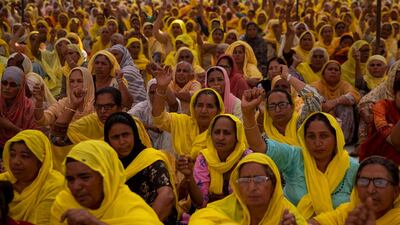
Female farmers protest against farming laws on International Women's Day at Bahadurgarh, India. Reuters -

Afghan women attend an event to mark International Women's Day in Kabul, Afghanistan. AP Photo -

Women's group Gabriela protests on International Women's Day near the presidential palace in Manila, the Philippines. AFP -

A woman waves the national flag of Kenya as female human rights defenders from 26 community-based organisations march to commemorate International Women's Day in Kibera, Nairobi. AFP -

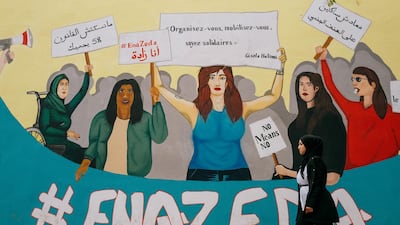
A woman walks past a feminist mural vandalised on International Women's Day in Madrid, Spain. The original mural celebrated pioneering women, such as Rosa Parks, Frida Khalo, Angela Davis and Valentina Tereshkova, among others. AP Photo -
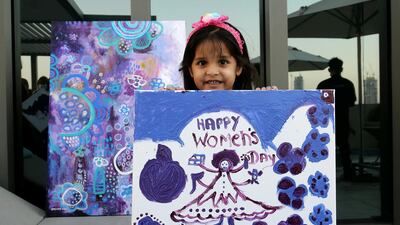
Jessika Sharma (4 years old) shows the art work done by her and her mother at ZeeArts organised event “The Women’s Art Therapy" on International Women’s day at the Element hotel in Al Jadaf in Dubai. Pawan Singh / The National -
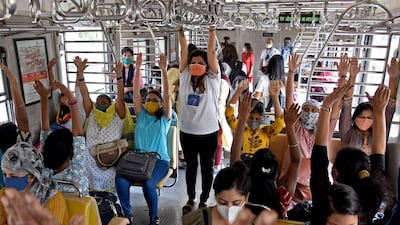
A yoga instructor teaches female passengers on a Mumbai train basic moves to celebrate International Women's Day. AFP -

A woman spreads red paint in front of the Ecuadorian Police during a march as part of International Women's Day in Quito, Ecuador. EPA -

On the eve of International Women's Day, in Lebanon's capital city, the governor of Beirut, Judge Marwan Abboud, and relatives of the late Lebanese paramedic Sahar Fare, release doves in front of a commemorative portrait to honour the first female victim in the military corps. EPA -
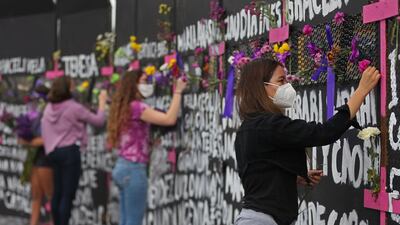
Women place flowers and posters adorned with the names of victims of femicide on metal fences during a protest against sex-based hate crimes in Mexico City, Mexico. EPA -
![Ines Louihik, 26, takes part in a welding workshop in Tunis, Tunisia. She says: 'In 2019 I passed the welding exam. I was the only woman [along with] 35 men. It is very difficult to be accepted as a woman. Many people think that welding is hard work exclusively for men, but I have proven that women can be welders too and I am very proud of myself." EPA](https://www.thenationalnews.com/resizer/v2/G34RW6NH4PF776QWJXME5GPBXI.jpg?auth=d8c6fe1f1b0554a775f2b967fb96cc8ef7617e8285edacc3ce2fc460d8f7b614&smart=true&width=400&height=225)
Ines Louihik, 26, takes part in a welding workshop in Tunis, Tunisia. She says: 'In 2019 I passed the welding exam. I was the only woman [along with] 35 men. It is very difficult to be accepted as a woman. Many people think that welding is hard work exclusively for men, but I have proven that women can be welders too and I am very proud of myself." EPA -

Young people celebrated International Women's Day in Moscow, Russia, by taking part in a flashmob. EPA -
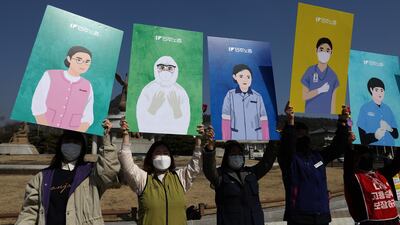
South Korean activists hold up portraits depicting the roles of female workers during a protest to mark International Women's Day in Seoul. The protesters called for an equal society free from institutional discrimination so that women can enjoy equal rights and live with dignity and pride, and build a democratic society where everyone's political, economic, social and cultural rights are fully guaranteed. Getty Images -

A woman prepares a traditional Emirati pastry on the eve of International Women's Day in Dubai, United Arab Emirates. EPA -

Women ride bikes as they participate in the Women Leadership Rally in Karachi, Pakistan. EPA -

Female Indian labourers work at a construction site on the eve of International Women's Day in Bhopal, India. EPA -
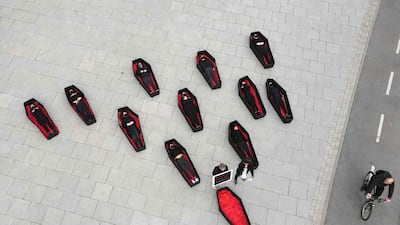
Ahead of International Women's day, Israeli women 'buried themselves' in mock coffins outside the District Court in Tel Aviv to represent those killed as a result of domestic violence. AFP -
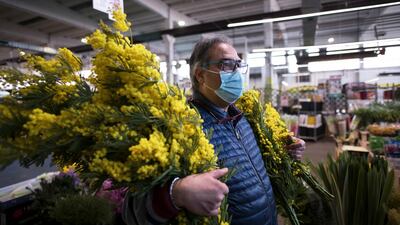
In Italy, International Women's Day, or la Festa della Donna, is celebrated by men give mimosas to the women in their lives, and women gifting them to other women. Getty Images


![Ines Louihik, 26, takes part in a welding workshop in Tunis, Tunisia. She says: 'In 2019 I passed the welding exam. I was the only woman [along with] 35 men. It is very difficult to be accepted as a woman. Many people think that welding is hard work exclusively for men, but I have proven that women can be welders too and I am very proud of myself." EPA](https://www.thenationalnews.com/resizer/v2/G34RW6NH4PF776QWJXME5GPBXI.jpg?auth=d8c6fe1f1b0554a775f2b967fb96cc8ef7617e8285edacc3ce2fc460d8f7b614&smart=true&width=800&height=450)


That isolation is felt particularly by women who are already struggling through lockdown, and often unemployment. With the lockdown stressing an already flagging economy, nearly a quarter of Tunisian women are currently unemployed.
While some of the women who share their stories with #EnaZeda receive messages from men they don’t know, many are harassed by acquaintances, neighbours or even relations. Those messages can often turn into threats of physical violence when the recipient ignores the sender.
“It’s a dangerous situation because it is difficult to do anything about it,” Ben Miled said.
In 2017, Tunisia’s parliament passed Law 58, a landmark piece of legislation on violence against women. The sweeping law covers everything from street harassment to marital rape, a first in the Arab world. But one component is conspicuously absent: online harassment.

The absence of an explicit clause on cyber violence leaves cases to be assessed at a judge’s discretion. As a result, some 95 per cent of those who have been abused do not press charges in Tunisia, according to the Crédif study.
Najima Kousri Labidi, a founder of the #EnaZeda Facebook page and a women’s rights activist hopes pressure will work to change the attitudes around the law and the role it could play in combating digital harassment.
“We haven’t heard about any cases of harassment being condemned, even though the law has existed for three years now,” she explained. “We want to put pressure on judges so they will use the law.”
Though sexual harassment is in clear violation of Facebook’s community standards, the company, which did not respond to a request for comment, has long struggled to combat sexual harassment on its platforms (Facebook owns Instagram and Whatsapp, two other leading platforms for harassment, according to the Plan International Study).
For Ikram Ben Said, another member of Aswaat Nissa, Facebook’s drawbacks don’t outweigh its advantages. She notes that while women often feel isolated and invisible when they are harassed online, “the sense of solidarity that we have witnessed during this movement resists invisibility”.

