The nuclear enrichment plant at Natanz, in central Iran. EPA

Experts say Iran’s response to Natanz sabotage could cause regional crisis


  • English
  • Arabic

Iran's promise of revenge for the Natanz nuclear sabotage incident on Sunday could risk serious escalation, but Tehran will probably seek to avoid casualties, analysts told The National after the latest in a string of incidents.

Any lethal response against Israel, which Iran blames for the sabotage, could cause a new crisis, they said.

Iran knows that it can't afford to get itself into an all out conflict with Israel under sanctions

Iran has so far said it will begin enriching uranium to 60 per cent purity in response to the attack, while maritime risk analysts at Dryad Global said an Israeli ship had been attacked in the Gulf of Oman on Tuesday evening.

The report could not be verified and the ship's owner, Ray Shipping, said the vessel had suffered no damage.

Natanz is Iran’s primary uranium enrichment facility, housing its advanced IR-9 centrifuges.

It was seriously damaged on Sunday when its power supply was destroyed by what Iran says was an explosive device.

It is thought that the attack set back Iran’s “breakout time” – the time required to enrich enough weapons-grade uranium for a nuclear bomb – by nine months.

Iran's next move

“In terms of a counter move, Iran has options in the Strait of Hormuz,” said Dean Mikkelsen, a cyber and maritime security analyst who has worked with oil companies in Iraq.

“Iran does repeat things – potentially a limpet mine attack again in the Arabian Sea, the confiscation of another ship in the Strait or near disputed islands,” he said.

“Cyber attacks are also possible. Iran and Israel have done tit-for-tat cyber attacks against each other in the past,” Mr Mikkelsen said.

  • Iranian President Hassan Rouhani, right, and the head of Atomic Energy Organization of Iran Ali Akbar Salehi inspect the nuclear technology on the occasion of Iran National Nuclear Technology Day in Tehran in 2019. EPA
    Iranian President Hassan Rouhani, right, and the head of Atomic Energy Organization of Iran Ali Akbar Salehi inspect the nuclear technology on the occasion of Iran National Nuclear Technology Day in Tehran in 2019. EPA
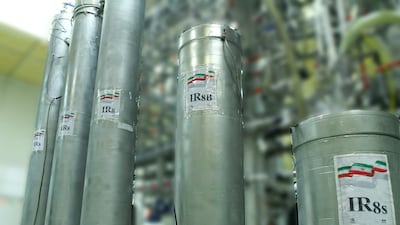
  • IR-8 centrifuges at Natanz nuclear power plant, some 300 kilometres south of capital Tehran. AFP
    IR-8 centrifuges at Natanz nuclear power plant, some 300 kilometres south of capital Tehran. AFP
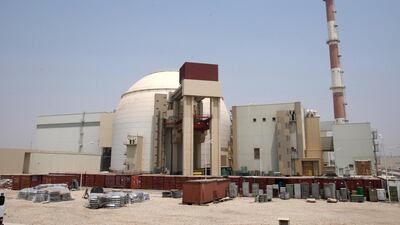
  • The Iranian nuclear power plant in Bushehr in 2010. EPA
    The Iranian nuclear power plant in Bushehr in 2010. EPA
  • Salehi speaks with media while visiting Natanz enrichment facility, in central Iran in 2019. Atomic Energy Organization of Iran via AP
    Salehi speaks with media while visiting Natanz enrichment facility, in central Iran in 2019. Atomic Energy Organization of Iran via AP
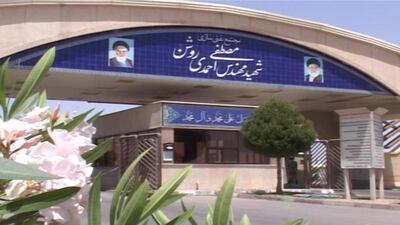
  • The gate of Natanz nuclear power plant in Natanz , Isfahan province, in 2019. EPA
    The gate of Natanz nuclear power plant in Natanz , Isfahan province, in 2019. EPA
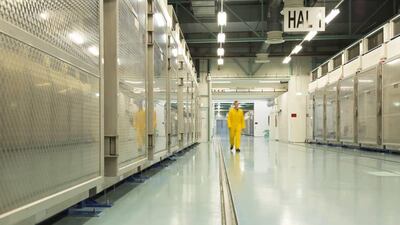
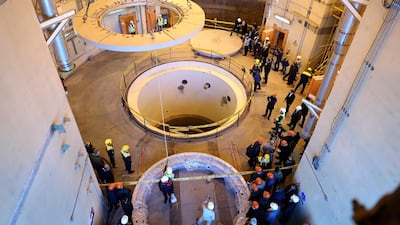
  • Inside of the Iran's Fordow nuclear facility, in Fordow, Qom province in 2019. EPA
    Inside of the Iran's Fordow nuclear facility, in Fordow, Qom province in 2019. EPA
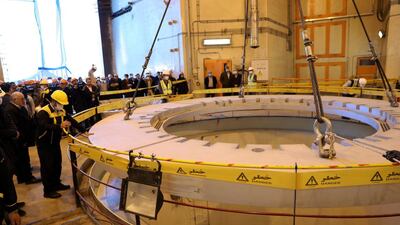
  • Technicians work at the Arak heavy water reactor's secondary circuit, as officials and media visit the site, near Arak, Iran in 2019. Atomic Energy Organization of Iran via AP
    Technicians work at the Arak heavy water reactor's secondary circuit, as officials and media visit the site, near Arak, Iran in 2019. Atomic Energy Organization of Iran via AP
  • Members of the media and officials tour the water nuclear reactor at Arak in 2019. WANA via Reuters
    Members of the media and officials tour the water nuclear reactor at Arak in 2019. WANA via Reuters
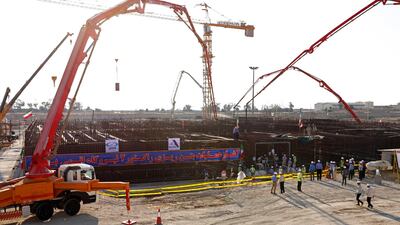
  • Concrete is poured for the base of the second nuclear power reactor at Bushehr plant in 2019. Atomic Energy Organization of Iran via AP
    Concrete is poured for the base of the second nuclear power reactor at Bushehr plant in 2019. Atomic Energy Organization of Iran via AP

Samuel Ramani, a commentator and Middle East specialist at the University of Oxford, agreed.

"Iran could respond with a cyber attack on Israel's water system. In that scenario, Israel [could] urge US officials to delay a swift return to the nuclear deal negotiations," he said.

Naval war

Iran was accused of placing limpet mines on the Israeli commercial vessel Helios Ray on February 28.

Israel was accused of retaliating by damaging Iran's "spy ship" the Saviz, in the busy Bab El Mandeb strait.

Neither side admitted to carrying out either incident.

Joe Truzman, an analyst with the Foundation for Defence of Democracies, said past Iranian actions showed calculated caution.

"They likely could have sunk the ships targeted in previous months, like the Helios. But they chose not to. Perhaps they don't want to get into a conflict with Israel because they've already estimated such an attack would spur the Israelis into retaliating strongly," he said.

In May 2018, Iranian operatives were blamed for firing missiles into Israel over the disputed Golan Heights.

Israel's retaliation in Syria produced some of the heaviest air strikes of the conflict.

"Iran knows that it can't afford to get itself into an all-out conflict with Israel under sanctions," Mr Truzman said.

But there are still unknowns, Mr Truzman said.

“Think of the embassy bombing in India ... it didn't do much but that's the type of attack I think keeps the Israelis worried.”

On January 29, a small explosive detonated near the Israeli embassy in New Delhi but there were no casualties. Indian media cited security officials who pointed the finger at Iran but, again, there was no confirmation.

Sima Shine, head of the Iran programme at Israel's Institute for National Security Studies, said Tehran's poor economic situation may hamper its ability to retaliate.

But, she said, this incident could still lead to escalation.

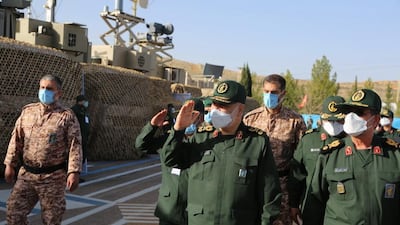
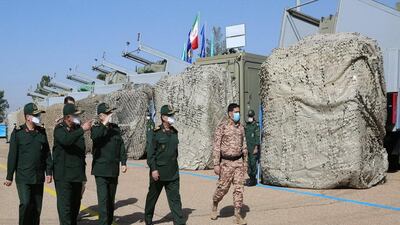
  • Islamic Revolutionary Guard Corps leader Maj Gen Hossein Salami visits an IRGC naval unit's new 'missile city', at an undisclosed location in Iran. EPA
    Islamic Revolutionary Guard Corps leader Maj Gen Hossein Salami visits an IRGC naval unit's new 'missile city', at an undisclosed location in Iran. EPA
  • Iran claims the missile city is equipped with cruise and ballistic missiles and electronic warfare equipment. EPA
    Iran claims the missile city is equipped with cruise and ballistic missiles and electronic warfare equipment. EPA
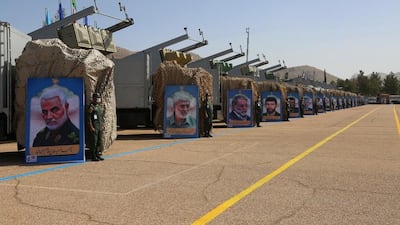
  • Military equipment on display at the Islamic Revolutionary Guard Corps' new missile city in Iran. In the foreground is a portrait of Maj Gen Qassem Suleimani, commander of the IRGC's Quds Force, who was killed in a US drone strike in 2020. EPA
    Military equipment on display at the Islamic Revolutionary Guard Corps' new missile city in Iran. In the foreground is a portrait of Maj Gen Qassem Suleimani, commander of the IRGC's Quds Force, who was killed in a US drone strike in 2020. EPA
  • Missiles on display at a new Islamic Revolutionary Guard Corps' missile city, at an undisclosed location in Iran. EPA
    Missiles on display at a new Islamic Revolutionary Guard Corps' missile city, at an undisclosed location in Iran. EPA
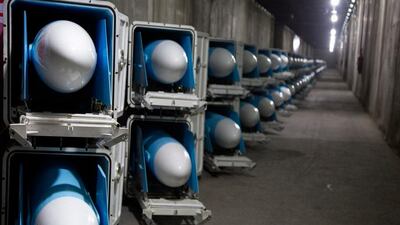
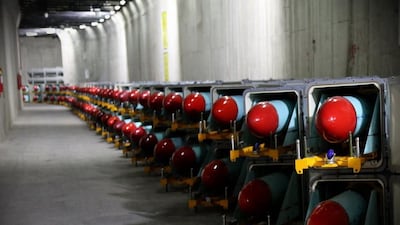
  • Missiles stored in an underground facility in an undisclosed location, Iran. Tehran claims its new equipment has 'advanced operational capabilities', including firing from underground launchers. AP
    Missiles stored in an underground facility in an undisclosed location, Iran. Tehran claims its new equipment has 'advanced operational capabilities', including firing from underground launchers. AP
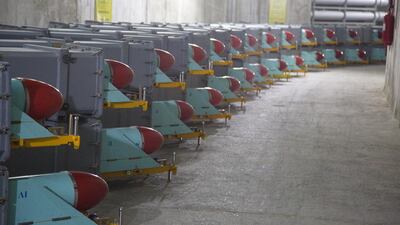
  • Missiles lined up at a new Islamic Revolutionary Guard Corps' missile city in Iran. EPA
    Missiles lined up at a new Islamic Revolutionary Guard Corps' missile city in Iran. EPA

"If it's direct, vis-a-vis Israel, will there be any casualties? Because if that happens, probably Israel will retaliate, this can start a slippery slope of escalation between the two countries," Ms Shine said on Sunday.

Ms Shine was previously head of research at Israel's Mossad intelligence agency.

Nuclear deal moves

Israel’s supporters and others see the attack as an effort to weaken Iran’s hand and strengthen the US bargaining position at nuclear deal talks in Vienna, said Hussien Ibish, a senior resident scholar at the Arab Gulf States Institute in Washington.

"The recent attacks certainly delivered significant short-term damage to Iran's key nuclear facilities. I think we can expect Iran to certainly try to retaliate in some fashion soon," Mr Ibish said.

“The shadow war that has developed in a deniable 'grey zone' between Israel and Iran is clearly driven by regional competition and conflicts,” he said.

Despite this hostility, Mr Ibish believes that tensions between Tehran and Tel Aviv may come to an end “insofar as successful talks between the US and Iran would make the Iranian-Israeli shadow war unnecessary and undesirable. Otherwise, it’s going to continue, though it will intensify and ease, based on many factors”, he said.

"The current flare-up is strongly linked to the effort to renew talks between Washington and Tehran. Israel’s critics, especially Iran, accuse Israel of trying to sabotage negotiations, even though Iranian clients in Iraq, Yemen and elsewhere have also been on the attack recently," he said.

US President Joe Biden's administration seems determined to proceed with nuclear talks and will probably not take Israeli objections as seriously as former president Donald Trump did, the University of Oxford's Mr Ramani said.

The end result may “resemble the Mohsen Fakhrizadeh assassination", in which Israel was accused of shooting dead one of Iran's top nuclear scientists near Tehran in November last year.

The response "featured tensions and sabre-rattling but no real escalation of tensions, or change in Biden's views on renegotiating with Tehran”, Mr Ramani said.


Game Changer

Director: Shankar 

Stars: Ram Charan, Kiara Advani, Anjali, S J Suryah, Jayaram

Rating: 2/5

Results

5pm: Maiden (PA) Dh80,000 (Turf) 2,200m; Winner: Gurm, Antonio Fresu (jockey), Eric Lemartinel (trainer)

5.30pm: Handicap (PA) Dh80,000 (T) 1,600m; Winner: Al Nafece, Al Muatasm Al Balushi, Mohammed Ramadan

6pm: Wathba Stallions Cup Handicap (PA) Dh70,000 (T) 1,200m; Winner: Ashton Tourettes, Adrie de Vries, Ibrahim Aseel

6.30pm: Arabian Triple Crown – Group 3 (PA) Dh300,000 (T) 2,200m; Winner: Ottoman, Adrie de Vries, Abdallah Al Hammadi

7pm: Liwa Oasis – Group 2 (PA) 300,000 (T) 1,400m; Winner: Hakeemat Muscat, Szczepan Mazur, Ibrahim Al Hadhrami

7.30pm: Handicap (TB) Dh80,000 (T) 1,600m; Winner: Ganbaru, Antonio Fresu, Musabah Al Muhairi

UAE players with central contracts

Rohan Mustafa, Ashfaq Ahmed, Chirag Suri, Rameez Shahzad, Shaiman Anwar, Adnan Mufti, Mohammed Usman, Ghulam Shabbir, Ahmed Raza, Qadeer Ahmed, Amir Hayat, Mohammed Naveed and Imran Haider.

HWJN
%3Cp%3EDirector%3A%20Yasir%20Alyasiri%3C%2Fp%3E%0A%3Cp%3EStarring%3A%20Baraa%20Alem%2C%20Nour%20Alkhadra%2C%20Alanoud%20Saud%3C%2Fp%3E%0A%3Cp%3ERating%3A%203%2F5%3C%2Fp%3E%0A%3Cp%3E%3C%2Fp%3E%0A
ARGYLLE
%3Cp%3EDirector%3A%20Matthew%20Vaughn%3C%2Fp%3E%0A%3Cp%3EStarring%3A%20Bryce%20Dallas%20Howard%2C%20Sam%20Rockwell%2C%20John%20Cena%3C%2Fp%3E%0A%3Cp%3ERating%3A%203%2F5%3C%2Fp%3E%0A
Jetour T1 specs

Engine: 2-litre turbocharged

Power: 254hp

Torque: 390Nm

Price: From Dh126,000

Available: Now

Benefits of first-time home buyers' scheme
  • Priority access to new homes from participating developers
  • Discounts on sales price of off-plan units
  • Flexible payment plans from developers
  • Mortgages with better interest rates, faster approval times and reduced fees
  • DLD registration fee can be paid through banks or credit cards at zero interest rates
%E2%80%98White%20Elephant%E2%80%99
%3Cp%3E%3Cstrong%3EDirector%3A%3C%2Fstrong%3E%20Jesse%20V%20Johnson%3Cbr%3E%3Cstrong%3EStars%3A%3C%2Fstrong%3E%20Michael%20Rooker%2C%20Bruce%20Willis%2C%20John%20Malkovich%2C%20Olga%20Kurylenko%3Cbr%3E%3Cstrong%3ERating%3A%3C%2Fstrong%3E%203%2F5%3C%2Fp%3E%0A
How to protect yourself when air quality drops

Install an air filter in your home.

Close your windows and turn on the AC.

Shower or bath after being outside.

Wear a face mask.

Stay indoors when conditions are particularly poor.

If driving, turn your engine off when stationary.

The%20Roundup
%3Cp%3EDirector%3A%20Lee%20Sang-yong%3Cbr%3EStars%3A%20Ma%20Dong-seok%2C%20Sukku%20Son%2C%20Choi%20Gwi-hwa%3Cbr%3ERating%3A%204%2F5%3C%2Fp%3E%0A
MATCH INFO

World Cup qualifier

Thailand 2 (Dangda 26', Panya 51')

UAE 1 (Mabkhout 45 2')

Founders: Abdulmajeed Alsukhan, Turki Bin Zarah and Abdulmohsen Albabtain.

Based: Riyadh

Offices: UAE, Vietnam and Germany

Founded: September, 2020

Number of employees: 70

Sector: FinTech, online payment solutions

Funding to date: $116m in two funding rounds  

Investors: Checkout.com, Impact46, Vision Ventures, Wealth Well, Seedra, Khwarizmi, Hala Ventures, Nama Ventures and family offices

In-demand jobs and monthly salaries
  • Technology expert in robotics and automation: Dh20,000 to Dh40,000 
  • Energy engineer: Dh25,000 to Dh30,000 
  • Production engineer: Dh30,000 to Dh40,000 
  • Data-driven supply chain management professional: Dh30,000 to Dh50,000 
  • HR leader: Dh40,000 to Dh60,000 
  • Engineering leader: Dh30,000 to Dh55,000 
  • Project manager: Dh55,000 to Dh65,000 
  • Senior reservoir engineer: Dh40,000 to Dh55,000 
  • Senior drilling engineer: Dh38,000 to Dh46,000 
  • Senior process engineer: Dh28,000 to Dh38,000 
  • Senior maintenance engineer: Dh22,000 to Dh34,000 
  • Field engineer: Dh6,500 to Dh7,500
  • Field supervisor: Dh9,000 to Dh12,000
  • Field operator: Dh5,000 to Dh7,000

Mercer, the investment consulting arm of US services company Marsh & McLennan, expects its wealth division to at least double its assets under management (AUM) in the Middle East as wealth in the region continues to grow despite economic headwinds, a company official said.

Mercer Wealth, which globally has $160 billion in AUM, plans to boost its AUM in the region to $2-$3bn in the next 2-3 years from the present $1bn, said Yasir AbuShaban, a Dubai-based principal with Mercer Wealth.

Within the next two to three years, we are looking at reaching $2 to $3 billion as a conservative estimate and we do see an opportunity to do so,” said Mr AbuShaban.

Mercer does not directly make investments, but allocates clients’ money they have discretion to, to professional asset managers. They also provide advice to clients.

“We have buying power. We can negotiate on their (client’s) behalf with asset managers to provide them lower fees than they otherwise would have to get on their own,” he added.

Mercer Wealth’s clients include sovereign wealth funds, family offices, and insurance companies among others.

From its office in Dubai, Mercer also looks after Africa, India and Turkey, where they also see opportunity for growth.

Wealth creation in Middle East and Africa (MEA) grew 8.5 per cent to $8.1 trillion last year from $7.5tn in 2015, higher than last year’s global average of 6 per cent and the second-highest growth in a region after Asia-Pacific which grew 9.9 per cent, according to consultancy Boston Consulting Group (BCG). In the region, where wealth grew just 1.9 per cent in 2015 compared with 2014, a pickup in oil prices has helped in wealth generation.

BCG is forecasting MEA wealth will rise to $12tn by 2021, growing at an annual average of 8 per cent.

Drivers of wealth generation in the region will be split evenly between new wealth creation and growth of performance of existing assets, according to BCG.

Another general trend in the region is clients’ looking for a comprehensive approach to investing, according to Mr AbuShaban.

“Institutional investors or some of the families are seeing a slowdown in the available capital they have to invest and in that sense they are looking at optimizing the way they manage their portfolios and making sure they are not investing haphazardly and different parts of their investment are working together,” said Mr AbuShaban.

Some clients also have a higher appetite for risk, given the low interest-rate environment that does not provide enough yield for some institutional investors. These clients are keen to invest in illiquid assets, such as private equity and infrastructure.

“What we have seen is a desire for higher returns in what has been a low-return environment specifically in various fixed income or bonds,” he said.

“In this environment, we have seen a de facto increase in the risk that clients are taking in things like illiquid investments, private equity investments, infrastructure and private debt, those kind of investments were higher illiquidity results in incrementally higher returns.”

The Abu Dhabi Investment Authority, one of the largest sovereign wealth funds, said in its 2016 report that has gradually increased its exposure in direct private equity and private credit transactions, mainly in Asian markets and especially in China and India. The authority’s private equity department focused on structured equities owing to “their defensive characteristics.”