Reduced filling of the Grand Ethiopian Renaissance Dam would give Egypt and Sudan more time to resolve their dispute with Ethiopia. AFP

Week of trading barbs on Nile dam drives resolution further away than ever, say experts


Hamza Hendawi
  • English
  • Arabic

The Nile dam dispute is further away from resolution than ever after a flurry of uncompromising comments by officials in Egypt, Sudan and Ethiopia this week, experts say.

The war of words comes less than three months before Addis Ababa is due to press ahead with a second and much larger filling of the Grand Ethiopian Renaissance Dam (GERD) on the Blue Nile despite stern warnings by downstream Egypt and Sudan not to do so before a comprehensive agreement is reached.

Egypt, the most populous Arab nation with 100 million people, says Ethiopia’s hydroelectric dam will cut its share of the Nile’s water, on which it depends for more than 90 per cent of its fresh water needs.

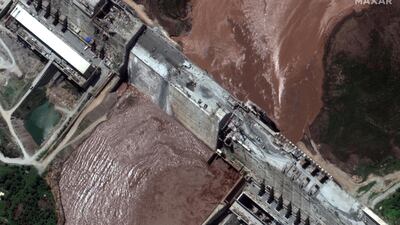
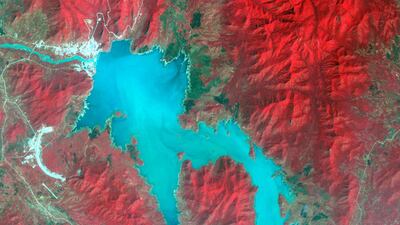
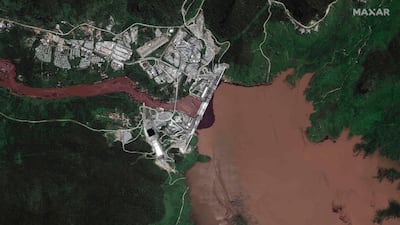
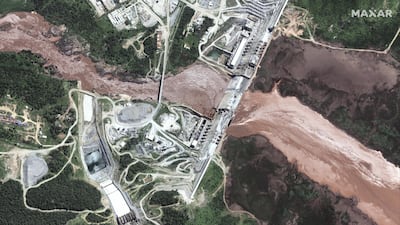
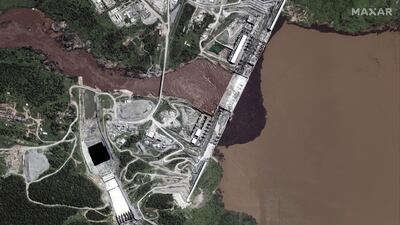
  • A satellite image taken on June 26, 2020 shows a close-up view of the Grand Ethiopian Renaissance Dam on the Blue Nile. Maxar Technologies via Reuters
    A satellite image taken on June 26, 2020 shows a close-up view of the Grand Ethiopian Renaissance Dam on the Blue Nile. Maxar Technologies via Reuters
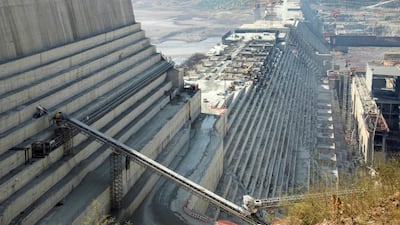
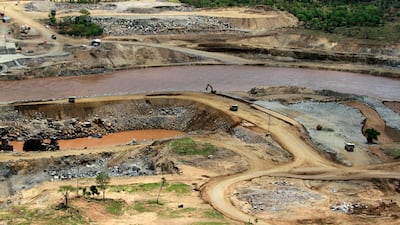
  • The construction site of the Grand Ethiopian Renaissance Dam in Guba in the North West of Ethiopia, seen in November 2017. AP
    The construction site of the Grand Ethiopian Renaissance Dam in Guba in the North West of Ethiopia, seen in November 2017. AP
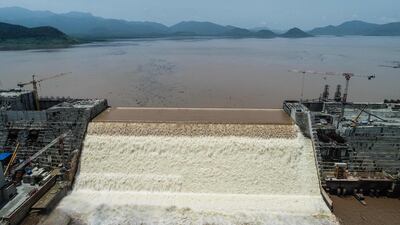
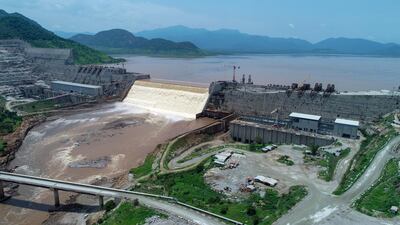
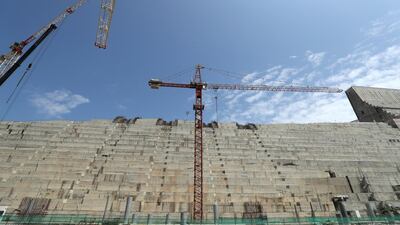
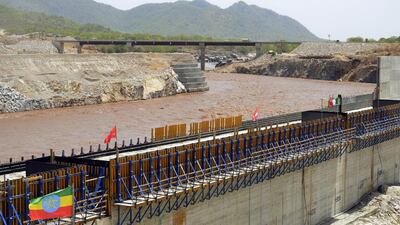
  • The Grand Ethiopian Renaissance Dam on the Blue Nile River in Guba, northwest Ethiopia. AFP
    The Grand Ethiopian Renaissance Dam on the Blue Nile River in Guba, northwest Ethiopia. AFP
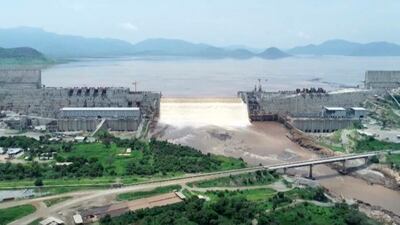
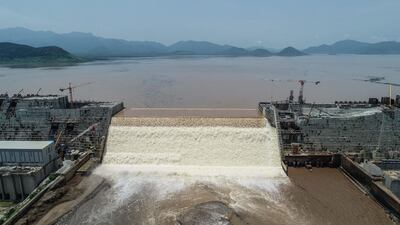
  • An aerial view of water levels at the Grand Ethiopian Renaissance Dam in Guba, Ethiopia, 2020. AFP
    An aerial view of water levels at the Grand Ethiopian Renaissance Dam in Guba, Ethiopia, 2020. AFP
  • The Blue Nile River is seen as the Grand Ethiopian Renaissance Dam reservoir fills near the Ethiopia-Sudan border, in this broad spectral image taken on November 6, 2020. Reuters
    The Blue Nile River is seen as the Grand Ethiopian Renaissance Dam reservoir fills near the Ethiopia-Sudan border, in this broad spectral image taken on November 6, 2020. Reuters
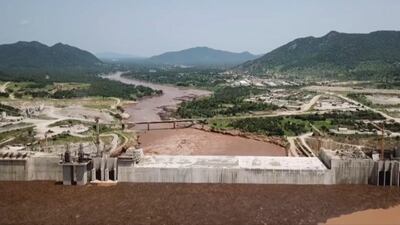
  • The Grand Ethiopian Renaissance Dam has been a source of discord for years. AP
    The Grand Ethiopian Renaissance Dam has been a source of discord for years. AP
  • The GERD dam on the Blue Nile in Ethiopia has been under construction since 2011. EPA/MAXAR TECHNOLOGIES
    The GERD dam on the Blue Nile in Ethiopia has been under construction since 2011. EPA/MAXAR TECHNOLOGIES
  • The Grand Ethiopian Renaissance Dam on the Blue Nile River is considered by Ethiopia to be integral to its energy supply, but neighbouring countries say it jeopardises their own water resources. AFP
    The Grand Ethiopian Renaissance Dam on the Blue Nile River is considered by Ethiopia to be integral to its energy supply, but neighbouring countries say it jeopardises their own water resources. AFP
  • This frame grab from a video obtained from the Ethiopian Public Broadcaster (EBC) on July 20 and July 21, 2020 and released on July 24, 2020 shows an aerial view of water levels at the Grand Ethiopian Renaissance Dam in Guba, Ethiopia. AFP
    This frame grab from a video obtained from the Ethiopian Public Broadcaster (EBC) on July 20 and July 21, 2020 and released on July 24, 2020 shows an aerial view of water levels at the Grand Ethiopian Renaissance Dam in Guba, Ethiopia. AFP
  • A view of northwestern Ethiopia that focuses on the status of the Grand Ethiopian Renaissance Dam (GERD) and the Blue Nile River on July 11, 2020. AFP
    A view of northwestern Ethiopia that focuses on the status of the Grand Ethiopian Renaissance Dam (GERD) and the Blue Nile River on July 11, 2020. AFP
  • A handout satellite image shows a closeup view of the Grand Ethiopian Renaissance Dam (GERD) and the Blue Nile River in Ethiopia June 26, 2020. Maxar Technologies via Reuters
    A handout satellite image shows a closeup view of the Grand Ethiopian Renaissance Dam (GERD) and the Blue Nile River in Ethiopia June 26, 2020. Maxar Technologies via Reuters
  • The foreign ministers of Egypt, Ethiopia and Sudan will return to Washington this week for another round of talks to reach an agreement on the Grand Ethiopian Renaissance Dam after missing the deadline last month. Reuters
    The foreign ministers of Egypt, Ethiopia and Sudan will return to Washington this week for another round of talks to reach an agreement on the Grand Ethiopian Renaissance Dam after missing the deadline last month. Reuters
  • The Blue Nile river flows near the site of the planned Grand Renaissance Dam near Assosa in Ethiopia. AP
    The Blue Nile river flows near the site of the planned Grand Renaissance Dam near Assosa in Ethiopia. AP
  • The Grand Renaissance Dam hydroelectric project in Ethiopia. Egypt belives Adis Abbaba is being deliberatley slow in negotiations. William Lloyd George / AFP
    The Grand Renaissance Dam hydroelectric project in Ethiopia. Egypt belives Adis Abbaba is being deliberatley slow in negotiations. William Lloyd George / AFP
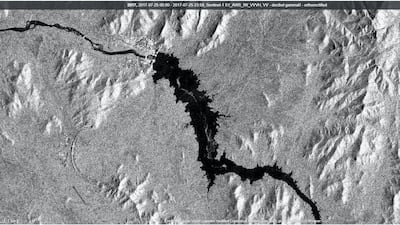
  • A combination picture of handout satellite images shows a view of the Grand Ethiopian Renaissance Dam (GERD) July 25, 2017 (top left), July 20, 2018 (top right), July 3, 2019 (bottom left), July 9, 2020 (bottom right) in Ethiopia, in these Sentinel-1 satellite imageries obtained by Reuters on July 14, 2020.
    A combination picture of handout satellite images shows a view of the Grand Ethiopian Renaissance Dam (GERD) July 25, 2017 (top left), July 20, 2018 (top right), July 3, 2019 (bottom left), July 9, 2020 (bottom right) in Ethiopia, in these Sentinel-1 satellite imageries obtained by Reuters on July 14, 2020.

Sudan has a similar concern about water as well as fears about the impact on its own power-generating Nile dams and the threat of flooding.

Ethiopia has largely dealt with the dispute as a matter of national sovereignty. It also has claimed total ownership of the Blue Nile, whose source is on its highlands and which contributes more the 80 per cent of the Nile’s water. It refuses to enter a legally binding agreement on the operation and filling of the dam, preferring guidelines instead and refusing proposals for international mediation.

Egypt and Sudan have been campaigning to win the support of the international community as Ethiopia, where a civil war has raged since November, tries to rekindle the patriotic fervour and national unity once inspired by the dam.

“The Biden administration’s new special envoy to the Horn of Africa Jeffrey Feltman has a trouble- shooting brief. The question of GERD is high on his list because there is a growing sense in Washington that it’s becoming a real problem,” said Michael Hanna, a Middle East expert from the New York-based Century Foundation.

“But Ethiopians have created facts on the ground and they are not interested in talking to anyone, at least not now,” he said.

Egypt’s prime minister, Mustafa Madbouli this week laid out the facts about how vital the Nile water is to the mainly desert country where more than 90 per cent of the population live on the banks of the river and in its delta.

“To Egypt, the question of water, and specifically the Nile, goes beyond all considerations and is tantamount to an existential issue linked to the life and very existence of Egyptians,” he said on Tuesday.

Arguing his country’s case, he said Egypt’s share of the Nile water – 55.5 billion cubic metres _ remained unchanged for close to a century while the country’s population grew to more than 100 million. Egypt’s per capita share of water currently stood at 600 cubic metres a year, or 400 cubic metres below the 1,000-cubic-metre threshold of water poverty, he told reporters.

While Mr Madbouli’s comments appeared designed to showcase the extent of Egypt’s water predicament, statements recently made by Egyptian President Abdel Fatah El Sisi left no one in doubt that Egypt was prepared to go to great lengths, including military action, to protect its share of water.

He warned on March 30 of “unimaginable instability” in the region if Egypt was denied a single drop of water and that no one should assume that they are beyond the reach of his military.

“Some people don’t seem able to grasp the magnitude of the disaster awaiting Egypt if its water share is cut,” said Hany Raslan, a senior Africa expert with Egypt’s Al Ahram Centre for Political and Strategic Studies.

“All that is needed is a surgical strike to stop the second filling not destroying the dam, but time is not on Egypt’s side and the window for action is getting smaller.”

Sudan, for its part, temporarily threw diplomatic prudence to the wind when its irrigation minister accused the African Union of bias “to some extent” towards Ethiopia during its year-long tenure as a sponsor of negotiations between the three nations.

“The African Union did not bother to respond to Sudan’s complaint about the first filling,” the minister, Yasser Abbas, said in an interview this week on Sudan’s state television. The first filling disrupted some of Sudan’s water-treatment plants, leaving tens of thousands of homes without running water for days.

He said legal teams were preparing cases on what he called the GERD’s structural deficiencies and the environmental damage it’s causing with a view to suing the Ethiopian government and the Italian company it has contracted to build the dam.

“It is tough to market the war option to the people of Sudan. There’s a large segment of the population that remains sympathetic towards Ethiopia,” said Rasha Awad, a Sudanese political analyst. She was alluding to the close cultural, social and economic binding the two countries

“Some in the military are in favour of military action to make political gains at home, but the decision to go to war will not be made by the military alone.”

Besides its quarrel with Ethiopia over the GERD, the pair are also locked in a border dispute that has led to a series of deadly clashes in recent months and the massing of troops on their border.

In Ethiopia, comments by officials in recent days have ranged from accusing unnamed parties of scheming against the country to branding as obsolete Nile water-sharing agreements reached by Egypt and Sudan and their former colonial master Britain in the last century.

The Ethiopian officials have also been seeking to rekindle the nationalism and sense of unity evoked by the GERD before the war against separatist rebels in the Tigray region distracted the ethnically and religiously diverse Horn of Africa nation when it broke out in November.

“It has become clear that there is a conspiracy to foil our efforts and undermine our very existence,” Ethiopia’s water minister, Seleshi Bekele, wrote on his Twitter account this week. “We must all persevere and shoulder our responsibilities.”

Last weekend, Ethiopia’s National Security Council called on Ethiopians to rally behind their government in what it called its drive to lift millions out of poverty through the completion of the GERD.

“The top priority of citizens and the government is filling the GERD and finalising the building of the dam,” according to the statement, carried by the state news agency. “We will realise the second filling of the dam by resisting both internal and external pressures.”


The%C2%A0specs%20
%3Cp%3E%3Cstrong%3EEngine%3A%3C%2Fstrong%3E%204-cylinder%202-litre%3Cbr%3E%3Cstrong%3ETransmission%3A%20%3C%2Fstrong%3E9-speed%20automatic%3Cbr%3E%3Cstrong%3EPower%3A%20%3C%2Fstrong%3E252%20brake%20horsepower%3Cbr%3E%3Cstrong%3ETorque%3A%20%3C%2Fstrong%3E352Nm%3Cbr%3E%3Cstrong%3EPrice%3A%20%3C%2Fstrong%3Efrom%20Dh146%2C700%3Cbr%3E%3Cstrong%3EOn%20sale%3A%20%3C%2Fstrong%3Enow%3C%2Fp%3E%0A
COMPANY%20PROFILE%20
%3Cp%3EName%3A%20DarDoc%3Cbr%3EBased%3A%20Abu%20Dhabi%3Cbr%3EFounders%3A%20Samer%20Masri%2C%20Keswin%20Suresh%3Cbr%3ESector%3A%20HealthTech%3Cbr%3ETotal%20funding%3A%20%24800%2C000%3Cbr%3EInvestors%3A%20Flat6Labs%2C%20angel%20investors%20%2B%20Incubated%20by%20Hub71%2C%20Abu%20Dhabi's%20Department%20of%20Health%3Cbr%3ENumber%20of%20employees%3A%2010%3C%2Fp%3E%0A
Five famous companies founded by teens

There are numerous success stories of teen businesses that were created in college dorm rooms and other modest circumstances. Below are some of the most recognisable names in the industry:

  1. Facebook: Mark Zuckerberg and his friends started Facebook when he was a 19-year-old Harvard undergraduate. 
  2. Dell: When Michael Dell was an undergraduate student at Texas University in 1984, he started upgrading computers for profit. He starting working full-time on his business when he was 19. Eventually, his company became the Dell Computer Corporation and then Dell Inc. 
  3. Subway: Fred DeLuca opened the first Subway restaurant when he was 17. In 1965, Mr DeLuca needed extra money for college, so he decided to open his own business. Peter Buck, a family friend, lent him $1,000 and together, they opened Pete’s Super Submarines. A few years later, the company was rebranded and called Subway. 
  4. Mashable: In 2005, Pete Cashmore created Mashable in Scotland when he was a teenager. The site was then a technology blog. Over the next few decades, Mr Cashmore has turned Mashable into a global media company.
  5. Oculus VR: Palmer Luckey founded Oculus VR in June 2012, when he was 19. In August that year, Oculus launched its Kickstarter campaign and raised more than $1 million in three days. Facebook bought Oculus for $2 billion two years later.
Company%20Profile
%3Cp%3E%3Cstrong%3ECompany%20name%3A%3C%2Fstrong%3E%20Cargoz%3Cbr%3E%3Cstrong%3EDate%20started%3A%3C%2Fstrong%3E%20January%202022%3Cbr%3E%3Cstrong%3EFounders%3A%3C%2Fstrong%3E%20Premlal%20Pullisserry%20and%20Lijo%20Antony%3Cbr%3E%3Cstrong%3EBased%3A%3C%2Fstrong%3E%20Dubai%3Cbr%3E%3Cstrong%3ENumber%20of%20staff%3A%3C%2Fstrong%3E%2030%3Cbr%3E%3Cstrong%3EInvestment%20stage%3A%3C%2Fstrong%3E%20Seed%3C%2Fp%3E%0A
ROUTE%20TO%20TITLE
%3Cp%3E%3Cstrong%3ERound%201%3A%3C%2Fstrong%3E%20Beat%20Leolia%20Jeanjean%206-1%2C%206-2%3Cbr%3E%3Cstrong%3ERound%202%3A%20%3C%2Fstrong%3EBeat%20Naomi%20Osaka%207-6%2C%201-6%2C%207-5%3Cbr%3E%3Cstrong%3ERound%203%3A%20%3C%2Fstrong%3EBeat%20Marie%20Bouzkova%206-4%2C%206-2%3Cbr%3E%3Cstrong%3ERound%204%3A%3C%2Fstrong%3E%20Beat%20Anastasia%20Potapova%206-0%2C%206-0%3Cbr%3E%3Cstrong%3EQuarter-final%3A%20%3C%2Fstrong%3EBeat%20Marketa%20Vondrousova%206-0%2C%206-2%3Cbr%3E%3Cstrong%3ESemi-final%3A%20%3C%2Fstrong%3EBeat%20Coco%20Gauff%206-2%2C%206-4%3Cbr%3E%3Cstrong%3EFinal%3A%3C%2Fstrong%3E%20Beat%20Jasmine%20Paolini%206-2%2C%206-2%3C%2Fp%3E%0A
Jetour T1 specs

Engine: 2-litre turbocharged

Power: 254hp

Torque: 390Nm

Price: From Dh126,000

Available: Now

Company profile

Company name: Dharma

Date started: 2018

Founders: Charaf El Mansouri, Nisma Benani, Leah Howe

Based: Abu Dhabi

Sector: TravelTech

Funding stage: Pre-series A 

Investors: Convivialite Ventures, BY Partners, Shorooq Partners, L& Ventures, Flat6Labs

Who's who in Yemen conflict

Houthis: Iran-backed rebels who occupy Sanaa and run unrecognised government

Yemeni government: Exiled government in Aden led by eight-member Presidential Leadership Council

Southern Transitional Council: Faction in Yemeni government that seeks autonomy for the south

Habrish 'rebels': Tribal-backed forces feuding with STC over control of oil in government territory

COMPANY%20PROFILE
%3Cp%3E%3Cstrong%3EName%3A%20%3C%2Fstrong%3ESmartCrowd%0D%3Cbr%3E%3Cstrong%3EStarted%3A%20%3C%2Fstrong%3E2018%0D%3Cbr%3E%3Cstrong%3EFounder%3A%20%3C%2Fstrong%3ESiddiq%20Farid%20and%20Musfique%20Ahmed%0D%3Cbr%3E%3Cstrong%3EBased%3A%20%3C%2Fstrong%3EDubai%0D%3Cbr%3E%3Cstrong%3ESector%3A%20%3C%2Fstrong%3EFinTech%20%2F%20PropTech%0D%3Cbr%3E%3Cstrong%3EInitial%20investment%3A%20%3C%2Fstrong%3E%24650%2C000%0D%3Cbr%3E%3Cstrong%3ECurrent%20number%20of%20staff%3A%3C%2Fstrong%3E%2035%0D%3Cbr%3E%3Cstrong%3EInvestment%20stage%3A%20%3C%2Fstrong%3ESeries%20A%0D%3Cbr%3E%3Cstrong%3EInvestors%3A%20%3C%2Fstrong%3EVarious%20institutional%20investors%20and%20notable%20angel%20investors%20(500%20MENA%2C%20Shurooq%2C%20Mada%2C%20Seedstar%2C%20Tricap)%3C%2Fp%3E%0A
Schedule:

Sept 15: Bangladesh v Sri Lanka (Dubai)

Sept 16: Pakistan v Qualifier (Dubai)

Sept 17: Sri Lanka v Afghanistan (Abu Dhabi)

Sept 18: India v Qualifier (Dubai)

Sept 19: India v Pakistan (Dubai)

Sept 20: Bangladesh v Afghanistan (Abu Dhabi) Super Four

Sept 21: Group A Winner v Group B Runner-up (Dubai) 

Sept 21: Group B Winner v Group A Runner-up (Abu Dhabi)

Sept 23: Group A Winner v Group A Runner-up (Dubai)

Sept 23: Group B Winner v Group B Runner-up (Abu Dhabi)

Sept 25: Group A Winner v Group B Winner (Dubai)

Sept 26: Group A Runner-up v Group B Runner-up (Abu Dhabi)

Sept 28: Final (Dubai)

Company Profile

Name: JustClean

Based: Kuwait with offices in other GCC countries

Launch year: 2016

Number of employees: 130

Sector: online laundry service

Funding: $12.9m from Kuwait-based Faith Capital Holding

Mercer, the investment consulting arm of US services company Marsh & McLennan, expects its wealth division to at least double its assets under management (AUM) in the Middle East as wealth in the region continues to grow despite economic headwinds, a company official said.

Mercer Wealth, which globally has $160 billion in AUM, plans to boost its AUM in the region to $2-$3bn in the next 2-3 years from the present $1bn, said Yasir AbuShaban, a Dubai-based principal with Mercer Wealth.

Within the next two to three years, we are looking at reaching $2 to $3 billion as a conservative estimate and we do see an opportunity to do so,” said Mr AbuShaban.

Mercer does not directly make investments, but allocates clients’ money they have discretion to, to professional asset managers. They also provide advice to clients.

“We have buying power. We can negotiate on their (client’s) behalf with asset managers to provide them lower fees than they otherwise would have to get on their own,” he added.

Mercer Wealth’s clients include sovereign wealth funds, family offices, and insurance companies among others.

From its office in Dubai, Mercer also looks after Africa, India and Turkey, where they also see opportunity for growth.

Wealth creation in Middle East and Africa (MEA) grew 8.5 per cent to $8.1 trillion last year from $7.5tn in 2015, higher than last year’s global average of 6 per cent and the second-highest growth in a region after Asia-Pacific which grew 9.9 per cent, according to consultancy Boston Consulting Group (BCG). In the region, where wealth grew just 1.9 per cent in 2015 compared with 2014, a pickup in oil prices has helped in wealth generation.

BCG is forecasting MEA wealth will rise to $12tn by 2021, growing at an annual average of 8 per cent.

Drivers of wealth generation in the region will be split evenly between new wealth creation and growth of performance of existing assets, according to BCG.

Another general trend in the region is clients’ looking for a comprehensive approach to investing, according to Mr AbuShaban.

“Institutional investors or some of the families are seeing a slowdown in the available capital they have to invest and in that sense they are looking at optimizing the way they manage their portfolios and making sure they are not investing haphazardly and different parts of their investment are working together,” said Mr AbuShaban.

Some clients also have a higher appetite for risk, given the low interest-rate environment that does not provide enough yield for some institutional investors. These clients are keen to invest in illiquid assets, such as private equity and infrastructure.

“What we have seen is a desire for higher returns in what has been a low-return environment specifically in various fixed income or bonds,” he said.

“In this environment, we have seen a de facto increase in the risk that clients are taking in things like illiquid investments, private equity investments, infrastructure and private debt, those kind of investments were higher illiquidity results in incrementally higher returns.”

The Abu Dhabi Investment Authority, one of the largest sovereign wealth funds, said in its 2016 report that has gradually increased its exposure in direct private equity and private credit transactions, mainly in Asian markets and especially in China and India. The authority’s private equity department focused on structured equities owing to “their defensive characteristics.”

Company%20profile
%3Cp%3E%3Cstrong%3ECompany%3A%20%3C%2Fstrong%3EWafeq%3Cbr%3E%3Cstrong%3EStarted%3A%20%3C%2Fstrong%3EJanuary%202019%3Cbr%3E%3Cstrong%3EFounder%3A%20%3C%2Fstrong%3ENadim%20Alameddine%3Cbr%3E%3Cstrong%3EBased%3A%20%3C%2Fstrong%3EDubai%2C%20UAE%3Cstrong%3E%3Cbr%3EIndustry%3A%20%3C%2Fstrong%3Esoftware%20as%20a%20service%3Cbr%3E%3Cstrong%3EFunds%20raised%3A%20%3C%2Fstrong%3E%243%20million%3Cbr%3E%3Cstrong%3EInvestors%3A%20%3C%2Fstrong%3ERaed%20Ventures%20and%20Wamda%2C%20among%20others%3C%2Fp%3E%0A
Biog

Mr Kandhari is legally authorised to conduct marriages in the gurdwara

He has officiated weddings of Sikhs and people of different faiths from Malaysia, Sri Lanka, Russia, the US and Canada

Father of two sons, grandfather of six

Plays golf once a week

Enjoys trying new holiday destinations with his wife and family

Walks for an hour every morning

Completed a Bachelor of Commerce degree in Loyola College, Chennai, India

2019 is a milestone because he completes 50 years in business


The specs

Engine: 4-litre twin-turbo V8

Transmission: nine-speed

Power: 542bhp

Torque: 700Nm

Price: Dh848,000

On sale: now

Living in...

This article is part of a guide on where to live in the UAE. Our reporters will profile some of the country’s most desirable districts, provide an estimate of rental prices and introduce you to some of the residents who call each area home.

Muslim Council of Elders condemns terrorism on religious sites

The Muslim Council of Elders has strongly condemned the criminal attacks on religious sites in Britain.

It firmly rejected “acts of terrorism, which constitute a flagrant violation of the sanctity of houses of worship”.

“Attacking places of worship is a form of terrorism and extremism that threatens peace and stability within societies,” it said.

The council also warned against the rise of hate speech, racism, extremism and Islamophobia. It urged the international community to join efforts to promote tolerance and peaceful coexistence.

Other acts on the Jazz Garden bill

Sharrie Williams
The American singer is hugely respected in blues circles due to her passionate vocals and songwriting. Born and raised in Michigan, Williams began recording and touring as a teenage gospel singer. Her career took off with the blues band The Wiseguys. Such was the acclaim of their live shows that they toured throughout Europe and in Africa. As a solo artist, Williams has also collaborated with the likes of the late Dizzy Gillespie, Van Morrison and Mavis Staples.
Lin Rountree
An accomplished smooth jazz artist who blends his chilled approach with R‘n’B. Trained at the Duke Ellington School of the Arts in Washington, DC, Rountree formed his own band in 2004. He has also recorded with the likes of Kem, Dwele and Conya Doss. He comes to Dubai on the back of his new single Pass The Groove, from his forthcoming 2018 album Stronger Still, which may follow his five previous solo albums in cracking the top 10 of the US jazz charts.
Anita Williams
Dubai-based singer Anita Williams will open the night with a set of covers and swing, jazz and blues standards that made her an in-demand singer across the emirate. The Irish singer has been performing in Dubai since 2008 at venues such as MusicHall and Voda Bar. Her Jazz Garden appearance is career highlight as she will use the event to perform the original song Big Blue Eyes, the single from her debut solo album, due for release soon.

UAE currency: the story behind the money in your pockets