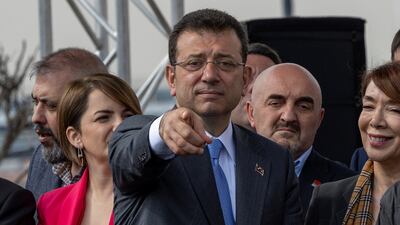
As Turkey prepares for local elections this Sunday, Istanbul mayor Ekrem Imamoglu addressed crowds packed into a small square in the city’s working-class Kasimpasa neighbourhood.
“Leader again! My leader is here,” shouted members of the crowd, wrapped up against the cold in scarves and hats. Against a backdrop of political party flags, many queued afterwards for free meals distributed from a van.
There is fierce competition for the position of the mayor of Istanbul, which President Recep Tayyip Erdogan, 70, and his Justice and Development Party (AKP) are determined to win back after losing it to Mr Imamoglu, 52, and the opposition Republican People’s Party (CHP) in the last local elections in 2019.
The mayor of Istanbul has one of the most important roles in Turkey, responsible for the country’s cultural and financial centre and a multibillion-dollar budget.
In recent weeks, there has been a slate of new museum, park, and metro line openings, and promotional banners promising firmer action on everything from bus services to combating domestic violence plaster every public space.
Mr Imamoglu, who is running for a second term, and the AKP’s candidate, former government minister Murat Kurum, are competing to claim responsibility for improving services for the urban centre’s 16 million residents, at a time of double-digit inflation and widespread economic hardship.
Istanbul’s importance means that whoever runs the city can establish a significant power base, observers say. If Mr Imamoglu is re-elected as mayor, he may well run in Turkey’s next presidential election scheduled for 2028.
“The person that rules Istanbul is generally able to establish himself a political base, which then translates into power at the national scale,” said Sinan Ulgen, a former Turkish diplomat and director of Edam, an Istanbul-based think tank.
The vote has consequences on the national level for whoever wins. Yet both the mayoral candidates and those competing for smaller, local district municipalities are campaigning on local issues.
In the Fatih district, which includes Istanbul’s tourist-packed historical peninsula, CHP candidate Mahir Polat has pledged to build more earthquake-resistant homes and renovate a local bazaar.
“So far, we have been carrying out an election campaign that is unconventional but very simple, focusing only on local government problems in Fatih,” said Mr Polat, at an interview in his campaign office last week.
“This has had a serious impact, in contrast with the AKP’s policies, which no longer give society much hope.”
The National approached Mr Polat’s main competitor from the AKP for an interview but did not receive a response.
For the position of Istanbul mayor, Mr Kurum and Mr Imamoglu are almost neck and neck in pollsters’ predictions, and few are willing to call the vote for Istanbul publicly.
The electorate is polarised and an increasing number of disillusioned young people are disengaging from the vote in a country where politics is almost a national sport, observers say.
“The problem of young voters usually, unfortunately, in today's Turkey is that they either go far left or far right, or they are disinterested in politics,” said Gulsen Ergun, a board member of Vote and Beyond, a civil society group encouraging participation in democratic processes.
Voters in Istanbul cite high levels of immigration, traffic congestion and fears that the city is not prepared for a long-predicted major earthquake as their main concerns.
Among issues is western nations funding refugee aid programmes in Turkey to stop them crossing into Europe.
“They [refugees] get free medicine and free aid. Now we can’t even buy an aspirin from the pharmacy if we don’t have money,” said Tuna Ozturk, who attended Mr Imamoglu’s Kasimpasa rally.
Her fears reflect widespread beliefs in Turkey – rarely grounded in truth – that refugees receive better services from authorities than Turkish citizens.
Devotees of Mr Erdogan and the AKP are not happy either. Voters at a rally held by Mr Kurum and Mr Erdogan at Istanbul’s former airport complex at the weekend said they had been left disappointed by five years of opposition rule in the city.
“I will vote for Murat Kurum because I believe he is going to work hard,” said Dorsun Ergun, 51, a leatherworker from Istanbul’s Zeytinburnu district. “The current mayor [Imamoglu] does not work, and he did not keep his promises to us.”
Both candidates face a range of challenges. Mr Imamoglu is part of a divided national opposition to Mr Erdogan and the AKP.
Other parties including the pro-Kurdish DEM Party and the nationalist Good Party are fielding their own candidates in the mayoral election, which may split the anti-AKP vote and lessen Mr Imamoglu's chances at re-election.
Meanwhile, Mr Kurum may suffer from disillusioned AKP voters switching to more conservative parties such as the Islamist New Welfare Party.
He has also faced criticism during the campaign for lacking charisma, and has made gaffes during media interviews, such as admitting to driving a car without a licence.
“What might hurt the AKP is that Erdogan is not on the ballot – he has a unique ability to mobilise people,” said Orcun Selcuk, a political scientist.
“If the opposition loses in Istanbul, it’s because of its fragmentation. If Kurum loses, it could also be because of the New Welfare Party candidate.”
For an election in which he is not even running, Mr Erdogan has campaigned almost non-stop for weeks, addressing rallies across Turkey.
Mr Erdogan attracted attention earlier this month when he claimed that Sunday’s vote will be the last election he will witness as President – suggesting that he will retire from politics within the next five years.
According to the Turkish constitution, a president cannot run for more than two terms, although a loophole allows a third if parliament calls for elections.
The hint at his political career coming to an end may have been a strategy to try to encourage AKP voters to come out to the polls, at a time when it remains unclear who will lead the party when Mr Erdogan eventually steps away from politics.
The President, rather than mayoral candidate Mr Kurum, appeared to be the main draw for many at the AKP’s weekend rally.
“We will stand by President Erdogan until the end; we know that he stands with us, not just today, but always,” said Aisha Koc, 44, a public relations worker. “In other places it’s the case that the people follow their leader, but here he follows us. He does what we want of him.”
Sinan Ulgen, the Turkish analyst, thinks it unlikely that Istanbul will witness a repeat of 2019’s local elections vote, when the AKP disputed Imamoglu’s win at the ballot boxes. That prompted a second round of voting in which Imamoglu won again – with a larger margin.
“I don’t think we will see this again,” Mr Ulgen said. “That mistake was made once.”
Additional reporting by Kerem Yalciner

The Florida Project
Director: Sean Baker
Starring: Bria Vinaite, Brooklynn Prince, Willem Dafoe
Four stars
More from Rashmee Roshan Lall
UK’s AI plan
- AI ambassadors such as MIT economist Simon Johnson, Monzo cofounder Tom Blomfield and Google DeepMind’s Raia Hadsell
- £10bn AI growth zone in South Wales to create 5,000 jobs
- £100m of government support for startups building AI hardware products
- £250m to train new AI models
If you go
The flights
Emirates flies from Dubai to Seattle from Dh5,555 return, including taxes.
The car
Hertz offers compact car rental from about $300 (Dh1,100) per week, including taxes. Emirates Skywards members can earn points on their car hire through Hertz.
The national park
Entry to Mount Rainier National Park costs $30 for one vehicle and passengers for up to seven days. Accommodation can be booked through mtrainierguestservices.com. Prices vary according to season. Rooms at the Holiday Inn Yakima cost from $125 per night, excluding breakfast.
In-demand jobs and monthly salaries
- Technology expert in robotics and automation: Dh20,000 to Dh40,000
- Energy engineer: Dh25,000 to Dh30,000
- Production engineer: Dh30,000 to Dh40,000
- Data-driven supply chain management professional: Dh30,000 to Dh50,000
- HR leader: Dh40,000 to Dh60,000
- Engineering leader: Dh30,000 to Dh55,000
- Project manager: Dh55,000 to Dh65,000
- Senior reservoir engineer: Dh40,000 to Dh55,000
- Senior drilling engineer: Dh38,000 to Dh46,000
- Senior process engineer: Dh28,000 to Dh38,000
- Senior maintenance engineer: Dh22,000 to Dh34,000
- Field engineer: Dh6,500 to Dh7,500
- Field supervisor: Dh9,000 to Dh12,000
- Field operator: Dh5,000 to Dh7,000
Essentials
The flights
Etihad and Emirates fly direct from the UAE to Delhi from about Dh950 return including taxes.
The hotels
Double rooms at Tijara Fort-Palace cost from 6,670 rupees (Dh377), including breakfast.
Doubles at Fort Bishangarh cost from 29,030 rupees (Dh1,641), including breakfast. Doubles at Narendra Bhawan cost from 15,360 rupees (Dh869). Doubles at Chanoud Garh cost from 19,840 rupees (Dh1,122), full board. Doubles at Fort Begu cost from 10,000 rupees (Dh565), including breakfast.
The tours
Amar Grover travelled with Wild Frontiers. A tailor-made, nine-day itinerary via New Delhi, with one night in Tijara and two nights in each of the remaining properties, including car/driver, costs from £1,445 (Dh6,968) per person.
In The Heights
Directed by: Jon M. Chu
Stars: Anthony Ramos, Lin-Manual Miranda
Rating: ****
Killing of Qassem Suleimani
The five pillars of Islam
The specs
Engine: 2.0-litre 4-cyl turbo
Power: 201hp at 5,200rpm
Torque: 320Nm at 1,750-4,000rpm
Transmission: 6-speed auto
Fuel consumption: 8.7L/100km
Price: Dh133,900
On sale: now
Specs
Engine: Dual-motor all-wheel-drive electric
Range: Up to 610km
Power: 905hp
Torque: 985Nm
Price: From Dh439,000
Available: Now
The specs: 2018 Nissan Altima
Price, base / as tested: Dh78,000 / Dh97,650
Engine: 2.5-litre in-line four-cylinder
Power: 182hp @ 6,000rpm
Torque: 244Nm @ 4,000rpm
Transmission: Continuously variable tranmission
Fuel consumption, combined: 7.6L / 100km
COMPANY PROFILE
Name: Qyubic
Started: October 2023
Founder: Namrata Raina
Based: Dubai
Sector: E-commerce
Current number of staff: 10
Investment stage: Pre-seed
Initial investment: Undisclosed
Timeline
2012-2015
The company offers payments/bribes to win key contracts in the Middle East
May 2017
The UK SFO officially opens investigation into Petrofac’s use of agents, corruption, and potential bribery to secure contracts
September 2021
Petrofac pleads guilty to seven counts of failing to prevent bribery under the UK Bribery Act
October 2021
Court fines Petrofac £77 million for bribery. Former executive receives a two-year suspended sentence
December 2024
Petrofac enters into comprehensive restructuring to strengthen the financial position of the group
May 2025
The High Court of England and Wales approves the company’s restructuring plan
July 2025
The Court of Appeal issues a judgment challenging parts of the restructuring plan
August 2025
Petrofac issues a business update to execute the restructuring and confirms it will appeal the Court of Appeal decision
October 2025
Petrofac loses a major TenneT offshore wind contract worth €13 billion. Holding company files for administration in the UK. Petrofac delisted from the London Stock Exchange
November 2025
180 Petrofac employees laid off in the UAE
Secret Pigeon Service: Operation Colomba, Resistance and the Struggle to Liberate Europe
Gordon Corera, Harper Collins
The%20specs
%3Cp%3E%3Cstrong%3EEngine%3A%20%3C%2Fstrong%3E2.0-litre%204-cyl%20turbo%3Cbr%3E%3Cstrong%3EPower%3A%20%3C%2Fstrong%3E190hp%20at%205%2C600rpm%3Cbr%3E%3Cstrong%3ETorque%3A%20%3C%2Fstrong%3E320Nm%20at%201%2C500-4%2C000rpm%3Cbr%3E%3Cstrong%3ETransmission%3A%20%3C%2Fstrong%3E7-speed%20dual-clutch%20auto%3Cbr%3E%3Cstrong%3EFuel%20consumption%3A%20%3C%2Fstrong%3E10.9L%2F100km%3Cbr%3E%3Cstrong%3EPrice%3A%20%3C%2Fstrong%3EFrom%20Dh119%2C900%3Cbr%3E%3Cstrong%3EOn%20sale%3A%20%3C%2Fstrong%3ENow%3C%2Fp%3E%0A
COMPANY%20PROFILE
%3Cp%3E%3Cstrong%3ECompany%20name%3A%20%3C%2Fstrong%3ESupy%0D%3Cbr%3E%3Cstrong%3EStarted%3A%20%3C%2Fstrong%3E2021%0D%3Cbr%3E%3Cstrong%3EFounders%3A%20%3C%2Fstrong%3EDani%20El-Zein%2C%20Yazeed%20bin%20Busayyis%2C%20Ibrahim%20Bou%20Ncoula%0D%3Cbr%3E%3Cstrong%3EBased%3A%20%3C%2Fstrong%3EDubai%0D%3Cbr%3E%3Cstrong%3EIndustry%3A%20%3C%2Fstrong%3EFood%20and%20beverage%2C%20tech%2C%20hospitality%20software%2C%20Saas%0D%3Cbr%3E%3Cstrong%3EFunding%20size%3A%20%3C%2Fstrong%3EBootstrapped%20for%20six%20months%3B%20pre-seed%20round%20of%20%241.5%20million%3B%20seed%20round%20of%20%248%20million%0D%3Cbr%3E%3Cstrong%3EInvestors%3A%20%3C%2Fstrong%3EBeco%20Capital%2C%20Cotu%20Ventures%2C%20Valia%20Ventures%20and%20Global%20Ventures%3C%2Fp%3E%0A
Mercer, the investment consulting arm of US services company Marsh & McLennan, expects its wealth division to at least double its assets under management (AUM) in the Middle East as wealth in the region continues to grow despite economic headwinds, a company official said.
Mercer Wealth, which globally has $160 billion in AUM, plans to boost its AUM in the region to $2-$3bn in the next 2-3 years from the present $1bn, said Yasir AbuShaban, a Dubai-based principal with Mercer Wealth.
“Within the next two to three years, we are looking at reaching $2 to $3 billion as a conservative estimate and we do see an opportunity to do so,” said Mr AbuShaban.
Mercer does not directly make investments, but allocates clients’ money they have discretion to, to professional asset managers. They also provide advice to clients.
“We have buying power. We can negotiate on their (client’s) behalf with asset managers to provide them lower fees than they otherwise would have to get on their own,” he added.
Mercer Wealth’s clients include sovereign wealth funds, family offices, and insurance companies among others.
From its office in Dubai, Mercer also looks after Africa, India and Turkey, where they also see opportunity for growth.
Wealth creation in Middle East and Africa (MEA) grew 8.5 per cent to $8.1 trillion last year from $7.5tn in 2015, higher than last year’s global average of 6 per cent and the second-highest growth in a region after Asia-Pacific which grew 9.9 per cent, according to consultancy Boston Consulting Group (BCG). In the region, where wealth grew just 1.9 per cent in 2015 compared with 2014, a pickup in oil prices has helped in wealth generation.
BCG is forecasting MEA wealth will rise to $12tn by 2021, growing at an annual average of 8 per cent.
Drivers of wealth generation in the region will be split evenly between new wealth creation and growth of performance of existing assets, according to BCG.
Another general trend in the region is clients’ looking for a comprehensive approach to investing, according to Mr AbuShaban.
“Institutional investors or some of the families are seeing a slowdown in the available capital they have to invest and in that sense they are looking at optimizing the way they manage their portfolios and making sure they are not investing haphazardly and different parts of their investment are working together,” said Mr AbuShaban.
Some clients also have a higher appetite for risk, given the low interest-rate environment that does not provide enough yield for some institutional investors. These clients are keen to invest in illiquid assets, such as private equity and infrastructure.
“What we have seen is a desire for higher returns in what has been a low-return environment specifically in various fixed income or bonds,” he said.
“In this environment, we have seen a de facto increase in the risk that clients are taking in things like illiquid investments, private equity investments, infrastructure and private debt, those kind of investments were higher illiquidity results in incrementally higher returns.”
The Abu Dhabi Investment Authority, one of the largest sovereign wealth funds, said in its 2016 report that has gradually increased its exposure in direct private equity and private credit transactions, mainly in Asian markets and especially in China and India. The authority’s private equity department focused on structured equities owing to “their defensive characteristics.”
