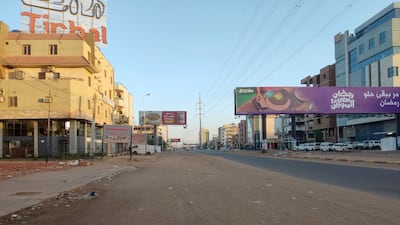
Life for many in Sudan has become intolerable. People have been trapped in their own homes by two weeks of fighting and failed ceasefires. Disruption to power, the internet, water supplies and food have been widely reported.
Little wonder then that since the violence broke out on April 15 between the Rapid Support Forces paramilitary group and the army, many have chosen to flee. Some have been part of the mass evacuations of diplomats and foreigners. But many Sudanese have also fled their homes and escaped to neighbouring Chad and Egypt. The UN Refugee Agency expects the outflow to continue.
On this week’s episode of Beyond the Headlines, host Nada AlTaher explores the refugee crisis created by the violence that has erupted in Sudan.

Scores
Scotland 54-17 Fiji
England 15-16 New Zealand
Saudi National Day
The Sky Is Pink
Director: Shonali Bose
Cast: Priyanka Chopra Jonas, Farhan Akhtar, Zaira Wasim, Rohit Saraf
Three stars
Our legal columnist
Name: Yousef Al Bahar
Advocate at Al Bahar & Associate Advocates and Legal Consultants, established in 1994
Education: Mr Al Bahar was born in 1979 and graduated in 2008 from the Judicial Institute. He took after his father, who was one of the first Emirati lawyers
At a glance
Global events: Much of the UK’s economic woes were blamed on “increased global uncertainty”, which can be interpreted as the economic impact of the Ukraine war and the uncertainty over Donald Trump’s tariffs.
Growth forecasts: Cut for 2025 from 2 per cent to 1 per cent. The OBR watchdog also estimated inflation will average 3.2 per cent this year
Welfare: Universal credit health element cut by 50 per cent and frozen for new claimants, building on cuts to the disability and incapacity bill set out earlier this month
Spending cuts: Overall day-to day-spending across government cut by £6.1bn in 2029-30
Tax evasion: Steps to crack down on tax evasion to raise “£6.5bn per year” for the public purse
Defence: New high-tech weaponry, upgrading HM Naval Base in Portsmouth
Housing: Housebuilding to reach its highest in 40 years, with planning reforms helping generate an extra £3.4bn for public finances
The specs: 2019 Haval H6
Price, base: Dh69,900
Engine: 2.0-litre turbocharged four-cylinder
Transmission: Seven-speed automatic
Power: 197hp @ 5,500rpm
Torque: 315Nm @ 2,000rpm
Fuel economy, combined: 7.0L / 100km
On Women's Day
Shelina Janmohamed: Why shouldn't a spouse be compensated fairly for housework?
Samar Elmnhrawy: How companies in the Middle East can catch up on gender equality
The National Editorial: Is there much to celebrate on International Women's Day 2021?
Justin Thomas: Challenge the notion that 'men are from Mars, women are from Venus'
AUSTRALIA SQUAD
Aaron Finch (captain), Ashton Agar, Alex Carey, Pat Cummins, Glenn Maxwell, Ben McDermott, Kane Richardson, Steve Smith, Billy Stanlake, Mitchell Starc, Ashton Turner, Andrew Tye, David Warner, Adam Zampa
Mercer, the investment consulting arm of US services company Marsh & McLennan, expects its wealth division to at least double its assets under management (AUM) in the Middle East as wealth in the region continues to grow despite economic headwinds, a company official said.
Mercer Wealth, which globally has $160 billion in AUM, plans to boost its AUM in the region to $2-$3bn in the next 2-3 years from the present $1bn, said Yasir AbuShaban, a Dubai-based principal with Mercer Wealth.
“Within the next two to three years, we are looking at reaching $2 to $3 billion as a conservative estimate and we do see an opportunity to do so,” said Mr AbuShaban.
Mercer does not directly make investments, but allocates clients’ money they have discretion to, to professional asset managers. They also provide advice to clients.
“We have buying power. We can negotiate on their (client’s) behalf with asset managers to provide them lower fees than they otherwise would have to get on their own,” he added.
Mercer Wealth’s clients include sovereign wealth funds, family offices, and insurance companies among others.
From its office in Dubai, Mercer also looks after Africa, India and Turkey, where they also see opportunity for growth.
Wealth creation in Middle East and Africa (MEA) grew 8.5 per cent to $8.1 trillion last year from $7.5tn in 2015, higher than last year’s global average of 6 per cent and the second-highest growth in a region after Asia-Pacific which grew 9.9 per cent, according to consultancy Boston Consulting Group (BCG). In the region, where wealth grew just 1.9 per cent in 2015 compared with 2014, a pickup in oil prices has helped in wealth generation.
BCG is forecasting MEA wealth will rise to $12tn by 2021, growing at an annual average of 8 per cent.
Drivers of wealth generation in the region will be split evenly between new wealth creation and growth of performance of existing assets, according to BCG.
Another general trend in the region is clients’ looking for a comprehensive approach to investing, according to Mr AbuShaban.
“Institutional investors or some of the families are seeing a slowdown in the available capital they have to invest and in that sense they are looking at optimizing the way they manage their portfolios and making sure they are not investing haphazardly and different parts of their investment are working together,” said Mr AbuShaban.
Some clients also have a higher appetite for risk, given the low interest-rate environment that does not provide enough yield for some institutional investors. These clients are keen to invest in illiquid assets, such as private equity and infrastructure.
“What we have seen is a desire for higher returns in what has been a low-return environment specifically in various fixed income or bonds,” he said.
“In this environment, we have seen a de facto increase in the risk that clients are taking in things like illiquid investments, private equity investments, infrastructure and private debt, those kind of investments were higher illiquidity results in incrementally higher returns.”
The Abu Dhabi Investment Authority, one of the largest sovereign wealth funds, said in its 2016 report that has gradually increased its exposure in direct private equity and private credit transactions, mainly in Asian markets and especially in China and India. The authority’s private equity department focused on structured equities owing to “their defensive characteristics.”
You might also like
How a groundbreaking soil-less farming inititiave is empowering rural communities across Jordan
Essay: Venice's floods should serve as a wake-up call for the world
UAE ready for innovation in area of water management – this is not a pipe dream
Saudi artist Manal AlDowayan unveils new piece of land art addressing water scarcity in Al Ula
Roll of honour 2019-2020
Dubai Rugby Sevens
Winners: Dubai Hurricanes
Runners up: Bahrain
West Asia Premiership
Winners: Bahrain
Runners up: UAE Premiership
UAE Premiership
Winners: Dubai Exiles
Runners up: Dubai Hurricanes
UAE Division One
Winners: Abu Dhabi Saracens
Runners up: Dubai Hurricanes II
UAE Division Two
Winners: Barrelhouse
Runners up: RAK Rugby
LEADERBOARD
SPEC%20SHEET%3A%20APPLE%20M3%20MACBOOK%20AIR%20(13%22)
The%20specs
Whiile you're here
Damien McElroy: Anti-science attitudes in America are proving lethal
Editorial: What makes the UAE such a good place to test vaccines?
Editorial: The fight against Covid-19 should be guided by science
On Women's Day
Dr Nawal Al-Hosany: Why more women should be on the frontlines of climate action
Shelina Janmohamed: Why shouldn't a spouse be compensated fairly for housework?
Justin Thomas: Challenge the notion that 'men are from Mars, women are from Venus'
The National Editorial: Is there much to celebrate on International Women's Day 2021?
While you're here
David Frum: How President Joe Biden is already showing he's an old man in a hurry
Patrick deHahn: Amtrak reveals US rail expansion goals after Biden's $2 trillion bill
Rashmee Roshan Lall: Biden should avoid copying the Swiss wealth tax model
The biog
Born: High Wycombe, England
Favourite vehicle: One with solid axels
Favourite camping spot: Anywhere I can get to.
Favourite road trip: My first trip to Kazakhstan-Kyrgyzstan. The desert they have over there is different and the language made it a bit more challenging.
Favourite spot in the UAE: Al Dhafra. It’s unique, natural, inaccessible, unspoilt.
The biog
Name: Salem Alkarbi
Age: 32
Favourite Al Wasl player: Alexandre Oliveira
First started supporting Al Wasl: 7
Biggest rival: Al Nasr
More on Coronavirus in France
The five new places of worship
Church of South Indian Parish
St Andrew's Church Mussaffah branch
St Andrew's Church Al Ain branch
St John's Baptist Church, Ruwais
Church of the Virgin Mary and St Paul the Apostle, Ruwais
Ads on social media can 'normalise' drugs
A UK report on youth social media habits commissioned by advocacy group Volteface found a quarter of young people were exposed to illegal drug dealers on social media.
The poll of 2,006 people aged 16-24 assessed their exposure to drug dealers online in a nationally representative survey.
Of those admitting to seeing drugs for sale online, 56 per cent saw them advertised on Snapchat, 55 per cent on Instagram and 47 per cent on Facebook.
Cannabis was the drug most pushed by online dealers, with 63 per cent of survey respondents claiming to have seen adverts on social media for the drug, followed by cocaine (26 per cent) and MDMA/ecstasy, with 24 per cent of people.
Babumoshai Bandookbaaz
Director: Kushan Nandy
Starring: Nawazuddin Siddiqui, Bidita Bag, Jatin Goswami
Three stars
What is a Ponzi scheme?
A fraudulent investment operation where the scammer provides fake reports and generates returns for old investors through money paid by new investors, rather than through ligitimate business activities.
Nepotism is the name of the game
Salman Khan’s father, Salim Khan, is one of Bollywood’s most legendary screenwriters. Through his partnership with co-writer Javed Akhtar, Salim is credited with having paved the path for the Indian film industry’s blockbuster format in the 1970s. Something his son now rules the roost of. More importantly, the Salim-Javed duo also created the persona of the “angry young man” for Bollywood megastar Amitabh Bachchan in the 1970s, reflecting the angst of the average Indian. In choosing to be the ordinary man’s “hero” as opposed to a thespian in new Bollywood, Salman Khan remains tightly linked to his father’s oeuvre. Thanks dad.

