
Paris Fashion Week is often a battle for attention, but this season’s strongest collections were less concerned with spectacle than with identity. Across the spring/summer 2027 shows, designers engaged with the codes that make their houses distinctive, whether through couture craftsmanship, archival references, eccentric styling or a renewed focus on clothes people might actually want to wear.
That meant lightness at Hermes and Dior, romanticism at Elie Saab, everyday couture at Balenciaga and a celebration of individuality at Valentino and Dries Van Noten. Elsewhere, Schiaparelli explored a more practical side, Saint Laurent doubled down on unapologetic glamour and Matieres Fecales turned the runway into a platform for social commentary. The approaches differed, but the question running through Paris was much the same: what should a fashion house stand for now?
Hermes

At Hermes, Nadège Vanhée embraced lightness for spring/summer. Taking her cue from the long, rectangular blades of ceiling fans, she worked swooping pleats into a black leather blazer, a chocolate-suede skirt lined in yellow silk and an orange dress cinched with a double-buckle belt. Sporty dresses made from narrow strips of leather laid over silk mesh brought further graphic lightness.
Airiness ran throughout the collection. Perforated suede jackets and open-knit dresses, some resembling fishing nets, revealed flashes of skin and were layered over statement underwear. Wide-leg trousers and jackets in featherweight denim and printed silk kept silhouettes loose and breezy.
Accessories were equally pared back: flat leather boots with delicate side stitching, barely-there strappy sandals, small bucket bags with fishnet details, cross-body styles and slim leather clutches.
Elie Saab

This season, Elie Saab looked to the languid glamour of 1930s film star Jean Harlow, mixing it with the house’s early-2000s codes. Sheer layers, intricate embroidery and soft shades of blush, powder blue, sage and sand came together in a deeply romantic collection of slip dresses, featuring appliqué flowers and delicate straps slipping from shoulders.
Familiar floating silhouettes, bustiers and floral embellishments returned with a lighter, more contemporary hand. Backstage, Saab said the team had been exploring the house archive held at the Elie Saab Foundation in Beirut. The brand will also bring its couture-inflected codes to a younger audience this month with the launch of its H&M collaboration.
Celine

Michael Rider’s Celine has a knack for making clothes feel considered yet unforced and this collection resisted fashion’s usual grandstanding.
The clothes were relaxed: creamy whites, hay tones and tomato red; collarless leather capes, off-the-shoulder tops, delicate knits and slouchy trousers cinched at the ankle. A floor-length sundial-print dress brought a flower child element, while beaded knitwear and satin shirts added artisanal polish.
Rider’s strength lies in the details. A skinny belt, oversized bangle, awkward fit or scuffed sneaker can push an otherwise polished look somewhere more interesting. His Celine moves between Parisian chic, sportswear and bohemia without settling into any one of them. The result feels spontaneous, but never accidental.
Balenciaga

At Balenciaga, Pierpaolo Piccioli applied atelier techniques to decidedly more democratic clothes: T-shirts, jeans and leather jackets.
Craftsmanship was deliberately visible. Stitching used to structure couture corsets appeared externally on ready-to-wear, shaping shoulders, narrowing waists and exaggerating hips. Jeans were cut on the bias for a slouchier fit, tailoring lost its rigidity, and handbags were draped, twisted and knotted by hand.
A pale-pink taffeta ballgown worn over jeans captured the idea best: on closer inspection, it was an enormous T-shirt. Piccioli’s proposition was clear: couture need not remain behind glass. At Balenciaga, it can be worn, altered and taken on to the street.
Schiaparelli

After spending the summer driving around the US East Coast with social media deleted, Daniel Roseberry returned to essentials for Schiaparelli’s spring collection: sharp separates, a largely monochrome palette and the house’s unmistakable appetite for drama.
A backward tuxedo dress opened the show, reshaped with hourglass boning. Elsewhere, bodysuits plunged dramatically, frills framed little black dresses and oversized tuxedo shirts were softened with moulded satin bibs. A laminated-jersey top could be paired with a skirt or dressed down with trousers.
Roseberry also broadened Schiaparelli beyond its gilded occasionwear. Broderie anglaise and spiral knits brought warmer-weather ease, while final jackets nodded to Elsa Schiaparelli through archival embroidery. The result remained unmistakably Schiaparelli, but with enough practicality to suggest clothes intended to be worn.
Valentino

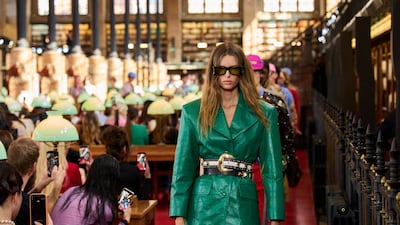
Alessandro Michele turned Valentino’s spring show into a celebration of books beneath the iron arches of Paris’s Bibliotheque Sainte-Genevieve. Guests were asked to donate a book, while Michele created a fictional library of imagined titles and authors, inspired by the “antilibrary” – books that remain unread, but whose potential still matters.
Michele rarely settles for the obvious. Double-pleated jeans, plaid shirts and baseball caps offered glimpses of everyday dressing amid fuchsia satin, oversized rosettes, lace cycling shorts, jewel-toned bustiers and embroidered skirts.
His unease with technology added another layer. He has spoken about preserving the human impulse behind fashion rather than reducing it to numbers, reflected here in deliberately improbable combinations: mohair with knobbly wool, harem trousers with sequins and gold-tipped shoes. In an increasingly algorithmic world, eccentricity may be one of fashion’s last human signatures.
Tom Ford

Haider Ackermann loosened the metaphorical tie at Tom Ford. For spring/summer 2027, the designer introduced racy swimwear to the runway, setting barely-there pieces against the house’s familiar armoury of sharp tailoring, cashmere, leather and silk. The mood was about freedom, he said, with a dash of danger and decadence, and the unabashed glamour of Tom Ford’s own era.
Suits came in baby blue, black, olive and white, worn bare-chested or with plunging swimsuits, bras and open shirts. Sultry evening dresses slipped off the shoulder to reveal leather or satin bras, while silk robes and bathrobe-style trench coats nodded to Hugh Hefner.
Ackermann has clearly understood that at Tom Ford, seduction is not a historical footnote; it is the house code.
Stella McCartney

Stella McCartney took her spring/summer 2027 collection to the sea, opening with David Attenborough’s voice reminding us that the ocean, covering 70 per cent of the planet, is more than a backdrop to human life.
Her childhood fascination with marine life surfaced in dolphin graphics, wave motifs and a rock-pool palette of washed greens, coral, cream and deep brown. Clear fishing line ran through knitwear, edges curled like oyster shells and recycled denim glittered with crystals. Drawstring-waist jackets, sheer-legged trousers, pastel windbreakers and utility pieces kept things sporty.
Deadstock fabrics, recycled polyester, lab-grown wool and protein-based materials challenged others to rethink their supply chains. Fresh from launching her Climate Pledge Fashion Coalition, McCartney is in a fighting mood. Her talent lies in making that argument desirable, bringing wearability to planet-friendly dressing.
A dolphin T-shirt may be nostalgic, but it also asks what we choose to protect – and what we will do to protect it.
Balmain

A year into his role at Balmain, creative director Antonin Tron unearthed Mark Shaw’s backstage photographs from 1954, recasting their mid-century silhouette as something darker, glossier and more louche.
For his second show, animal prints, eel skin, snakeskin-effect leather, viscose and silk lamé exuded cinematic elegance. His strong-shouldered pilot jacket returned, while corsetry, garter belts, plunging necklines and cocktail dresses, barely more substantial than swimsuits, kept silhouettes close to the body.
The setting was the Left Bank mansion once occupied by Karl Lagerfeld, a Balmain apprentice in the 1950s. Sunglasses, wet-look fabrics and clinging silhouettes gave the house fresh bite, charged with sensual, unapologetic glamour.
Dries Van Noten

For Julian Klausner, glamour lies in the pleasure of dressing for yourself. His spring/summer 2027 collection for Dries Van Noten imagined an actress leaving the set and slipping back into her everyday clothes.
Taxi horns and sirens accompanied models in looks that captured the peculiar logic of a wardrobe assembled over time. A sequinned blouse sat over a casual button-down, a slinky cocktail dress over a rugby shirt, and a plunging silk dress over a graphic T-shirt. Nothing was quite where you expected it.
Mismatched jewellery, an enamel brooch, a flouncy sheer skirt and, wonderfully, a single hot-pink racing glove added to the eccentricity. Bright red lipstick seemed as plausible at noon as after dark. Personal, slightly strange and instinctive, Klausner’s glamour requires no particular occasion.
Maison Margiela
Having just given his final show for Diesel, creative director Glen Martens is now focused solely on Maison Margiela and, for this latest collection, took a more commercial turn.
While earlier shows established just how far he was willing to push the house’s theatrical codes, this time the exercise was more forensic and focused on stripping Margiela back to the contradictions on which it was founded in the 1980s.

The result was familiar yet disrupted. Contrasting hard and soft, 1960s-style brocades became column skirts tied with Margiela’s signature cotton ribbon, and tailoring arrived with concertina-like construction, with knife-edge lapels folding inward or out for a more conventional silhouette. Trenches, T-shirts and jersey dresses, meanwhile, were given rigid, balcony-like inserts.
There was an appealing return to Margiela’s secret language of quietly intelligent clothes as well: a stiff-fronted white coat, checked shirt and high-waisted tailored ski trousers. But opulence remains his instinct, seen in elaborate metal-fronted gowns, crushed silver and baroque draping.
Dior

For spring/summer 2027, Jonathan Anderson looked to something lighter at Dior – quite literally. Air became a material in its own right, worked through lace, silk mousseline and organza, while tailoring softened into fluid, almost weightless forms. Transparency drifted between sheer and opaque, giving the collection a sense of constant movement.
The Dior ateliers supplied technical virtuosity, with pleats layered upon pleats, asymmetric florals, voluminous hems and a softer evolution of last season’s Marie Antoinette-inspired tutus. Anderson’s signatures were becoming clearer, too, via flowerlike silhouettes, iridescence, cropped proportions and deliberately off-kilter details. Long scarves, cascading earrings and draped fabrics reinforced the collection’s interest in asymmetry.

Accessories supplied the wit. Flower photographs appeared on square-toe heels; the new Dior Bow Sandal and petal-soled Cigale played with familiar codes, while bags moved from updated Double and Initial Hobo shapes to a biker-inspired Cannage style. Most playful was a silver minaudiere shaped like the wenwan walnut featured on the invitation. After a year of historical references, Anderson’s Dior is beginning to speak in its own unmistakable language.
Saint Laurent

It seems the rumours swirling around Saint Laurent are, in fact, true and that after a decade leading the brand, Anthony Vaccarello is leaving.
He presented an extraordinary, gilded collection, steeped in the house’s history and charged with the atmosphere of a finale where Charlotte Gainsbourg performed, the song chorused with the words “You are so much, Yves Saint Laurent.”
If this was a farewell, it was impeccably orchestrated. Under giant golden chandeliers, most looks were gilt, a deliberate reference to Yves Saint Laurent’s 1991 Rive Gauche collection, whose finale was entirely gilded.
Metallic trenches, cocktail dresses, gilt brocades and metal-thread lace caught the light, while mousseline scarves in absinthe, amber and cognac added colour. There were enormous earrings, vertiginous stilettos and snake-shaped heels, but interestingly, not a single handbag.
The Eiffel Tower glittered as the show began and ended, reinforcing the sense of occasion. Vaccarello has always resisted fashion’s drift towards accessibility and trend-chasing. Here, he made a case for something rarer, for glamour with no interest in apology.
Matieres Fecales

Designers Hannah Rose Dalton and Steven Raj Bhaskaran staged a deeply political outing. For their biggest show to date, the Matieres Fecales founders took over Place de la Republique – a symbolic site of protest – for a show called The 99 Per Cent, and the second chapter of a story that began last season with a collection focused on the world’s wealthiest one per cent.
The Canadian duo has since moved further into the mainstream, dressing the likes of Demi Moore and Zendaya on the red carpet, and attracting Rihanna, who held up proceedings by arriving to the show over an hour late.
This season, Dalton and Bhaskaran sent out 99 looks on 99 models of colour, drawing on Bhaskaran’s journey from poverty to the upper reaches of Paris fashion. The message was explicit: if the one per cent represented the villains of the previous chapter, the 99 per cent were now its heroes.
It was activism translated into fashion spectacle – provocative, theatrical and deliberately difficult to ignore. The question is no longer whether Matieres Fecales can attract attention, but what it chooses to do with it.


FOLLOW TN MAGAZINE