For something we are meant to spend a third of our lives doing, plenty of us aren’t very good about sleep. Whether we underdo it, overdo it or simply don’t do it effectively, as many as a third of adults struggle with shut-eye, according to the Centres of Disease Control and Prevention in the US.
If you've tried all the textbook solutions – avoiding caffeine, setting a bedtime and wake-up routine, and exercising regularly – to no avail, then perhaps, in light of World Sleep Day, which falls on Friday, aligning your home lighting design with your circadian rhythm is the solution you've been seeking for better rest.
"We respond very much to light," says Dr Neil Stanley, who is a sleep expert and author of How to Sleep Well. "We evolved on this planet, where the sun comes up and goes down, meaning our circadian rhythm exists whether we like it or not."
Brighter surfaces and lighter colours help to increase the light reflected back into an interior space
More commonly referred to as the internal body clock, our circadian rhythm tells us when to wake up, unwind, release hormones and so on, and it is controlled by exposure to light. However, humankind's relationship with light has changed dramatically over the past 200 years, primarily owing to our ability to manipulate it.
Given the new research on how crucial our circadian rhythm is to our overall health, let alone our sleep, journalist Linda Geddes centred her groundbreaking 2019 book, Chasing the Sun, on the connection between sleep and light.
She set out to do some testing of her own. Working with the University of Surrey, Geddes set herself a six-week challenge to maximise her exposure to natural light in the day and limit or avoid all artificial light exposure after 6pm.
"I definitely was sleepy earlier in the evenings. I wanted to go to bed at sort of 9pm or 10pm rather than 11pm or midnight," she told Dr Rangan Chatterjee on his podcast Feel Better, Live More.
Once a week, a reading was taken of Geddes's melatonin levels. A crucial hormone that works within our 24-hour cycles, it signals to the body that sleep is approaching. The release of melatonin is blocked by an exposure to light and is encouraged by darkness.
“What we found is that I started secreting melatonin about two hours earlier than normal. My body was saying: ‘It’s night-time,’” said Geddes.
Harnessing the power of light and dark doesn't have to be a dramatic lifestyle change; it could start with simple updates to your interiors.
Jonathan Ashmore, founder of Anarchitect, and Alina Bokhari, founder of the eponymous interior design company, share their expert home lighting tips that could promote a better night's sleep.
Chase the sun in the layout
If Geddes’s book title is anything to go by, it’s that we should all be following the path paved by the sun. It’s something Ashmore is also passionate about. “It’s essential to understand the orientation of the property and the sun path, and how natural light enters your home. Then you can rearrange furniture or uses for each space to where you might be at various times of the day.”
If we replace sunlight with a screen or anything with a blue light, that still will have an effect on our sleep
For spaces where you spend the majority of the time in the evening – your living room and bedroom – aim to face west, towards the direction of sunset. Being in line with the sun's natural cycle can keep your circadian rhythm in tune and let you know when to unwind.
Seek darkness by design
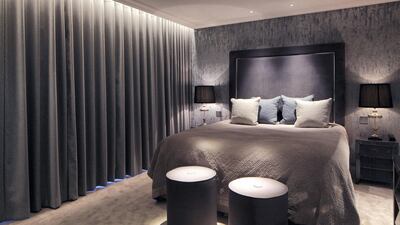
Lighting in any given space is not simply about the light source itself, but how it interacts with the environment. Ashmore says: "Brighter surfaces and lighter colours help to increase the light reflected back into an interior space." This is why, while bright colours might be ideal for the office, muted hues are better for the bedroom. Bokhari advises "dark moody colours, soft drapey fabrics and blackouts for the windows, which can work a charm for promoting deep sleep".
In her own home, she says: “I had the walls painted a green-grey-undertoned midnight blue – almost like the colour of the deepest part of the ocean – a plush rug underfoot in tones of charcoal grey, deep burgundy and mustard, and deep grey velvet curtains that fall dramatically to the floor.”
Match lights to activities
"A room's purpose dictates what role lighting should play in the overall design, be it functional, decorative or to create ambience," says Bokhari. When it comes to the bedroom, she recommends ditching the overhead lighting, a main takeaway from Geddes's experiment, too.
Check the colour temperature of your lamps and use dimming control to suit a more ambient light level
Make soft lighting sources such as bedside tables and candles your go-to. Elsewhere, install a low-level lighting option in every room, such as spotlights, floor lamps and desk lamps. By evening, “only use these key task lights for specific tasks where bright light is required”, says Ashmore.
Avoiding all-consuming light after sunset should ensure your circadian rhythm is not confused into staying alert.
Set the tone with warm hues
Unless you intend on living by candlelight, artificial light is generally unavoidable. But making sure your light sources are complementary in tone to the sun’s natural cycle can make all the difference.
"For artificial light, check the [white] colour temperature of the lamps you are using and consider using a dimming light control or reducing the colour temperatures to suit a more ambient light level, such as 2,700K in the evenings," says Ashmore.
Opt for warm, orange-toned lighting for bedroom and relaxation spaces, and shop for light bulbs with a low lux (measure of illuminance) level.
Design a ‘night mode’ routine
There’s no way to avoid that “any light at night is essentially a symbol to be awake”, says Dr Stanley. “If we replace the sunlight with some other device, like a screen or a Kindle or anything with a blue light, that still will have an effect on our sleep.”
We all know this, but it's worth reminding ourselves when redesigning a space for better sleep: keeping blue-light emitting technology out of the room is essential.
Because steering clear of technology isn't always realistic, Geddes found employing each gadget's night mode made a noteworthy difference.
However, if you are determined to elevate the quality of your shut-eye this World Sleep Day, take these measures in your bedroom: fill a bookshelf with paperback novels over digital readers, buy an alarm clock to avoid sharing a bed with a phone, and try audio mediums rather than being glued to Netflix in bed.

UK's plans to cut net migration
Under the UK government’s proposals, migrants will have to spend 10 years in the UK before being able to apply for citizenship.
Skilled worker visas will require a university degree, and there will be tighter restrictions on recruitment for jobs with skills shortages.
But what are described as "high-contributing" individuals such as doctors and nurses could be fast-tracked through the system.
Language requirements will be increased for all immigration routes to ensure a higher level of English.
Rules will also be laid out for adult dependants, meaning they will have to demonstrate a basic understanding of the language.
The plans also call for stricter tests for colleges and universities offering places to foreign students and a reduction in the time graduates can remain in the UK after their studies from two years to 18 months.
Best Foreign Language Film nominees
Capernaum (Lebanon)
Cold War (Poland)
Never Look Away (Germany)
Roma (Mexico)
Shoplifters (Japan)
FFP EXPLAINED
What is Financial Fair Play?
Introduced in 2011 by Uefa, European football’s governing body, it demands that clubs live within their means. Chiefly, spend within their income and not make substantial losses.
What the rules dictate?
The second phase of its implementation limits losses to €30 million (Dh136m) over three seasons. Extra expenditure is permitted for investment in sustainable areas (youth academies, stadium development, etc). Money provided by owners is not viewed as income. Revenue from “related parties” to those owners is assessed by Uefa's “financial control body” to be sure it is a fair value, or in line with market prices.
What are the penalties?
There are a number of punishments, including fines, a loss of prize money or having to reduce squad size for European competition – as happened to PSG in 2014. There is even the threat of a competition ban, which could in theory lead to PSG’s suspension from the Uefa Champions League.
CHELSEA SQUAD
Arrizabalaga, Bettinelli, Rudiger, Christensen, Silva, Chalobah, Sarr, Azpilicueta, James, Kenedy, Alonso, Jorginho, Kante, Kovacic, Saul, Barkley, Ziyech, Pulisic, Mount, Hudson-Odoi, Werner, Havertz, Lukaku.
THE%20HOLDOVERS
%3Cp%3E%3Cstrong%3EDirector%3A%20%3C%2Fstrong%3EAlexander%20Payne%3C%2Fp%3E%0A%3Cp%3E%3Cstrong%3EStarring%3A%3C%2Fstrong%3E%20Paul%20Giamatti%2C%20Da'Vine%20Joy%20Randolph%2C%20Dominic%20Sessa%3C%2Fp%3E%0A%3Cp%3E%3Cstrong%3ERating%3A%3C%2Fstrong%3E%204.5%2F5%3C%2Fp%3E%0A
Your Guide to the Home
- Level 1 has a valet service if you choose not to park in the basement level. This level houses all the kitchenware, including covetable brand French Bull, along with a wide array of outdoor furnishings, lamps and lighting solutions, textiles like curtains, towels, cushions and bedding, and plenty of other home accessories.
- Level 2 features curated inspiration zones and solutions for bedrooms, living rooms and dining spaces. This is also where you’d go to customise your sofas and beds, and pick and choose from more than a dozen mattress options.
- Level 3 features The Home’s “man cave” set-up and a display of industrial and rustic furnishings. This level also has a mother’s room, a play area for children with staff to watch over the kids, furniture for nurseries and children’s rooms, and the store’s design studio.
BUNDESLIGA FIXTURES
Friday (all kick-offs UAE time)
Hertha Berlin v Union Berlin (10.30pm)
Saturday
Freiburg v Werder Bremen (5.30pm)
Paderborn v Hoffenheim (5.30pm)
Wolfsburg v Borussia Dortmund (5.30pm)
Borussia Monchengladbach v Bayer Leverkusen (5.30pm)
Bayern Munich v Eintracht Frankfurt (5.30pm)
Sunday
Schalke v Augsburg (3.30pm)
Mainz v RB Leipzig (5.30pm)
Cologne v Fortuna Dusseldorf (8pm)
Hydrogen: Market potential
Hydrogen has an estimated $11 trillion market potential, according to Bank of America Securities and is expected to generate $2.5tn in direct revenues and $11tn of indirect infrastructure by 2050 as its production increases six-fold.
"We believe we are reaching the point of harnessing the element that comprises 90 per cent of the universe, effectively and economically,” the bank said in a recent report.
Falling costs of renewable energy and electrolysers used in green hydrogen production is one of the main catalysts for the increasingly bullish sentiment over the element.
The cost of electrolysers used in green hydrogen production has halved over the last five years and will fall to 60 to 90 per cent by the end of the decade, acceding to Haim Israel, equity strategist at Merrill Lynch. A global focus on decarbonisation and sustainability is also a big driver in its development.
What are NFTs?
Are non-fungible tokens a currency, asset, or a licensing instrument? Arnab Das, global market strategist EMEA at Invesco, says they are mix of all of three.
You can buy, hold and use NFTs just like US dollars and Bitcoins. “They can appreciate in value and even produce cash flows.”
However, while money is fungible, NFTs are not. “One Bitcoin, dollar, euro or dirham is largely indistinguishable from the next. Nothing ties a dollar bill to a particular owner, for example. Nor does it tie you to to any goods, services or assets you bought with that currency. In contrast, NFTs confer specific ownership,” Mr Das says.
This makes NFTs closer to a piece of intellectual property such as a work of art or licence, as you can claim royalties or profit by exchanging it at a higher value later, Mr Das says. “They could provide a sustainable income stream.”
This income will depend on future demand and use, which makes NFTs difficult to value. “However, there is a credible use case for many forms of intellectual property, notably art, songs, videos,” Mr Das says.
Name: Colm McLoughlin
Country: Galway, Ireland
Job: Executive vice chairman and chief executive of Dubai Duty Free
Favourite golf course: Dubai Creek Golf and Yacht Club
Favourite part of Dubai: Palm Jumeirah
Key figures in the life of the fort
Sheikh Dhiyab bin Isa (ruled 1761-1793) Built Qasr Al Hosn as a watchtower to guard over the only freshwater well on Abu Dhabi island.
Sheikh Shakhbut bin Dhiyab (ruled 1793-1816) Expanded the tower into a small fort and transferred his ruling place of residence from Liwa Oasis to the fort on the island.
Sheikh Tahnoon bin Shakhbut (ruled 1818-1833) Expanded Qasr Al Hosn further as Abu Dhabi grew from a small village of palm huts to a town of more than 5,000 inhabitants.
Sheikh Khalifa bin Shakhbut (ruled 1833-1845) Repaired and fortified the fort.
Sheikh Saeed bin Tahnoon (ruled 1845-1855) Turned Qasr Al Hosn into a strong two-storied structure.
Sheikh Zayed bin Khalifa (ruled 1855-1909) Expanded Qasr Al Hosn further to reflect the emirate's increasing prominence.
Sheikh Shakhbut bin Sultan (ruled 1928-1966) Renovated and enlarged Qasr Al Hosn, adding a decorative arch and two new villas.
Sheikh Zayed bin Sultan (ruled 1966-2004) Moved the royal residence to Al Manhal palace and kept his diwan at Qasr Al Hosn.
Sources: Jayanti Maitra, www.adach.ae
Saudi Cup race day
Schedule in UAE time
5pm: Mohamed Yousuf Naghi Motors Cup (Turf), 5.35pm: 1351 Cup (T), 6.10pm: Longines Turf Handicap (T), 6.45pm: Obaiya Arabian Classic for Purebred Arabians (Dirt), 7.30pm: Jockey Club Handicap (D), 8.10pm: Samba Saudi Derby (D), 8.50pm: Saudia Sprint (D), 9.40pm: Saudi Cup (D)
The%20specs
%3Cp%3E%0D%3Cstrong%3EEngine%3A%20%3C%2Fstrong%3E4.0-litre%20twin-turbo%20V8%0D%3Cbr%3E%3Cstrong%3EPower%3A%20%3C%2Fstrong%3E666hp%20at%206%2C000rpm%0D%3Cbr%3E%3Cstrong%3ETorque%3A%20%3C%2Fstrong%3E850Nm%20at%202%2C300-4%2C500rpm%0D%3Cbr%3E%3Cstrong%3ETransmission%3A%20%3C%2Fstrong%3E8-speed%20auto%0D%3Cbr%3E%3Cstrong%3EOn%20sale%3A%20%3C%2Fstrong%3EQ1%202023%0D%3Cbr%3E%3Cstrong%3EPrice%3A%20%3C%2Fstrong%3Efrom%20Dh1.15%20million%20(estimate)%3C%2Fp%3E%0A
500 People from Gaza enter France
115 Special programme for artists
25 Evacuation of injured and sick
'Worse than a prison sentence'
Marie Byrne, a counsellor who volunteers at the UAE government's mental health crisis helpline, said the ordeal the crew had been through would take time to overcome.
“It was worse than a prison sentence, where at least someone can deal with a set amount of time incarcerated," she said.
“They were living in perpetual mystery as to how their futures would pan out, and what that would be.
“Because of coronavirus, the world is very different now to the one they left, that will also have an impact.
“It will not fully register until they are on dry land. Some have not seen their young children grow up while others will have to rebuild relationships.
“It will be a challenge mentally, and to find other work to support their families as they have been out of circulation for so long. Hopefully they will get the care they need when they get home.”
Other acts on the Jazz Garden bill
Sharrie Williams
The American singer is hugely respected in blues circles due to her passionate vocals and songwriting. Born and raised in Michigan, Williams began recording and touring as a teenage gospel singer. Her career took off with the blues band The Wiseguys. Such was the acclaim of their live shows that they toured throughout Europe and in Africa. As a solo artist, Williams has also collaborated with the likes of the late Dizzy Gillespie, Van Morrison and Mavis Staples.
Lin Rountree
An accomplished smooth jazz artist who blends his chilled approach with R‘n’B. Trained at the Duke Ellington School of the Arts in Washington, DC, Rountree formed his own band in 2004. He has also recorded with the likes of Kem, Dwele and Conya Doss. He comes to Dubai on the back of his new single Pass The Groove, from his forthcoming 2018 album Stronger Still, which may follow his five previous solo albums in cracking the top 10 of the US jazz charts.
Anita Williams
Dubai-based singer Anita Williams will open the night with a set of covers and swing, jazz and blues standards that made her an in-demand singer across the emirate. The Irish singer has been performing in Dubai since 2008 at venues such as MusicHall and Voda Bar. Her Jazz Garden appearance is career highlight as she will use the event to perform the original song Big Blue Eyes, the single from her debut solo album, due for release soon.
Eyasses squad
Charlie Preston (captain) – goal shooter/ goalkeeper (Dubai College)
Arushi Holt (vice-captain) – wing defence / centre (Jumeriah English Speaking School)
Olivia Petricola (vice-captain) – centre / wing attack (Dubai English Speaking College)
Isabel Affley – goalkeeper / goal defence (Dubai English Speaking College)
Jemma Eley – goal attack / wing attack (Dubai College)
Alana Farrell-Morton – centre / wing / defence / wing attack (Nord Anglia International School)
Molly Fuller – goal attack / wing attack (Dubai College)
Caitlin Gowdy – goal defence / wing defence (Dubai English Speaking College)
Noorulain Hussain – goal defence / wing defence (Dubai College)
Zahra Hussain-Gillani – goal defence / goalkeeper (British School Al Khubairat)
Claire Janssen – goal shooter / goal attack (Jumeriah English Speaking School)
Eliza Petricola – wing attack / centre (Dubai English Speaking College)
The specs
Engine: 2.0-litre 4-cyl turbo
Power: 201hp at 5,200rpm
Torque: 320Nm at 1,750-4,000rpm
Transmission: 6-speed auto
Fuel consumption: 8.7L/100km
Price: Dh133,900
On sale: now
The specs
Engine: 3.0-litre six-cylinder MHEV
Power: 360bhp
Torque: 500Nm
Transmission: eight-speed automatic
Price: from Dh282,870
On sale: now
