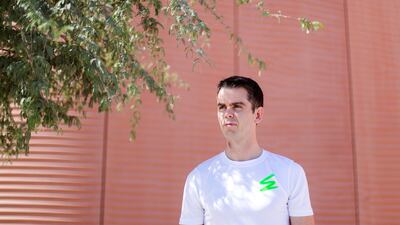

Liam Kelly was 13 when he developed an eating disorder. It all started after a school friend made a throwaway comment about how his T-shirt looked "tight". "There was no malice intended, but I took it very personally," Kelly, now a teacher at Abu Dhabi's Diyafah International School, tells The National.
“At this stage I was very conscious about my image. I’m only 13 and I’m already beginning to please other people before myself.”
That night, he went home and decided to go for a run. Instead, he threw up his dinner. And so began a 25-year journey to overcoming bulimia nervosa, a serious and potentially life-threatening disorder in which sufferers tend to binge eat and then purge.

It’s only been two years since Kelly, now 40, told another person about his condition and began to truly recover.
Today, he feels healthy, happy and, thankfully, able to deal with the current coronavirus pandemic without having to worry about his condition. “My outlook on life is different and my body is full of nutrients that weren’t there before,” he says.
But, as someone who understands the mentality behind bulimia, he worries for anyone who may still be suffering from an eating disorder during these trying times.
The psychological impact of Covid-19
Nadia Brooker, counselling psychologist and a specialist in eating disorders at the Priory Wellbeing Centre in Dubai, shares Kelly’s fear.
“The current Covid-19 pandemic is having a significant impact on our daily lives,” she says. “There is so much uncertainty and change happening right now that it can be really hard to keep track and manage our physical and emotional well-being.
"As a result, it’s likely we are all experiencing numerous, difficult emotions, which can often lead to changes in appetite that can eventually lead to disordered eating patterns.”
Brooker says changes to our daily routine – a lack of structure, increased isolation and any financial or relationship pressures, for example – can potentially make a person’s condition worse.
Over-eating, in particular, could become an issue. "Utilising food as a means to [cope] has a strong physiological underpinning and therefore it's unsurprising that over-eating or compulsive eating is being used by many as a coping mechanism, as opposed to simply attending to hunger cues."

Kelly, as a teacher, is particularly concerned for teenagers and young people. “Now children are staying at home more, they’re eating more, their eating habits are out of control, they’re sleeping more and their sleeping patterns are out of control,” he says.
“We’re watching movies, we can have popcorn, ice cream and candy, and it’s all those things that can add up. Parents need to be mindful of that balance. We don’t want our children to overindulge.”
Brooker agrees, adding that this type of behaviour can affect everyone. “During times of stress, our cortisol levels are elevated, which can also increase our appetite.
As a result, our body will often crave feel-good foods such as chocolate, crisps, sweets and carbohydrate-rich items that are considered a treat but are highly calorific and often full of sugar.
"These types of foods provide energy bursts and encourage the production of serotonin and dopamine – the ‘happy chemicals’,” Brooker says.
This activates our brain's pleasure centre and can distract us from uncomfortable emotions we might be feeling.
While Brooker says it’s unlikely that someone will develop an eating disorder based solely on the pandemic, the crisis may exacerbate disordered eating behaviours or preoccupations for those who may already have a predisposition to a condition.
This goes for all eating disorders, including bulimia, binge-eating disorders and anorexia nervosa, which is often characterised by food restriction and a strong fear of gaining weight.
“Individuals who already struggle with over or under-eating may find these behaviours increasing, particularly as lockdown has seen numerous changes in day to day life,” she says.
On the other hand, she has also noted some advantages for people seeking treatment at this time. “They may now be benefitting from increased family support and consistency, along with the potential for reduced external triggers, such as eating in public, at school or managing meals on their own, for example.”
How to treat an eating disorder
The Priory Wellbeing Centre treats people of a wide variety of backgrounds and ages, but there are some trends when it comes to those suffering from eating disorders, Brooker says.
“Generally speaking, those individuals suffering from anorexia nervosa seeking support at the clinic are largely children and adolescents, whereas with bulimia nervosa and binge eating disorder we see a wider range in ages and genders.”
Although statistics show more women will be affected by anorexia and bulimia, research suggests there’s equal prevalence among males and females for binge eating disorders. But it’s important that we don’t get hung up on the numbers. “Eating disorders can affect people of all genders, ages, races, ethnicities, body shapes and weight and socio-economic statuses,” Brooker says.
Although Kelly didn’t seek professional treatment – he says once he found someone to confide in he felt able to recover by himself – he doesn’t necessarily advise this approach to others.
“You have to think about when it started, why it started, why you’ve been hiding it. If you can’t get someone to help you find those answers, you need to find a therapist and get professional help,” he says. “If you don’t answer those questions, it’s going to control you again.”
Today, he manages his condition by planning his meals ahead and eating healthily. "I’m in control of my diet now because I’m happy inside myself," he says. "I'm happy with myself, my body and I’m now not seeking people’s approval. That’s important to me."

Brooker strongly emphasises the need to tackle an eating disorder using evidence-based practice, to give sufferers the best chance of recovery. “Unfortunately, eating disorders are often misunderstood or misdiagnosed. Thus, seeking help from professionals is crucial,” she says.
There are various myths about these conditions that may play a role in perpetuating any underlying issues, she says. For example, that eating disorders are a choice and are about appearance and beauty. “This, however, is false and it is important to be aware that eating disorders are serious, brain-based biological illnesses.”
Knowing this can help families and professionals identify and treat sufferers better and more effectively, she says.
Do you or a loved one have an eating disorder?
So how do you recognise that you are or someone you love is struggling? “It can be extremely difficult to determine whether a friend, family member or colleague is suffering from an eating disorder, as the signs and symptoms can manifest differently in different people,” Brooker explains. “Men in particular are also likely to be far more reluctant to talk about their symptoms or admit they have a problem, given that eating disorders are often seen as a ‘female issue’.”
Being in such close proximity while staying at home may allow concerned family members and friends to notice more obvious symptoms, however.
Brooker says there are some tell-tale signs to look out for. This includes an obsession or preoccupation with food; a loss of control with eating habits; an obsession with physical appearance and other people’s perception of your body; fluctuations in weight; a desire to eat alone or in secret; becoming distressed during mealtimes; low self-esteem; and increased shame, guilt, anxiety or depression.
Early intervention is key, so it is important to stay alert to those around you and remember that “dismissing the idea that an eating disorder is not there or ‘not severe enough’ creates a huge barrier”, Brooker says.
For anyone who might be suffering and attempting to hide their pain, Kelly says it’s crucial to speak up.
“Never feel ashamed of what you’re going through, because it’s not your fault … It happened so easily to me and it can happen to someone else,” he says. “There’s always someone there to talk to.”
And if you're not ready to open up to people you know or seek professional help just yet, Kelly, who is also the author of a children's book about mental health, says to try reaching out to him through social media.
“I’ve been through it, but I’m one of the lucky ones. I don’t have any medical problems. I’m extremely fortunate that I was able to come out the other end and share my story.”
Strategies for coping with an eating disorder during a pandemic
Brooker outlines numerous strategies to improve our eating habits, physical and emotional well-being, which could help you manage an eating disorder.
- Have a clear meal plan. "That includes three main meals, incorporating carbohydrates, protein, vegetables, dairy and fats, and snacks. Ideally, we function best when we eat regularly throughout the day, which means eating every three or so hours."
- Become aware of your feelings. "Take time every day to reflect on how you are coping," says Brooker. "So, simply stop, take a step back, observe and proceed mindfully."
- Recognise and name what makes you feel vulnerable, or what 'triggers' you, to use food as a coping skill. "These may be internal or external triggers."
- Use mindfulness and grounding techniques such as deep breathing and body scans. "Apps such as Calm or Headspace are great for this."
- Notice the positives. "It can be helpful to end your day by noticing one thing you enjoyed, one thing you are grateful for and one thing that you achieved."
- Don't beat yourself up. "If you feel like you engaged in disordered eating, notice what caused this. Use this information in a helpful way and plan how to move forward by identifying these challenges and naming helpful alternatives."
- Look for support. "Surround yourself with people who support you and make you feel good about yourself."
- Be mindful of media and making any comparisons between yourself and the images of people you see portrayed.
- Be mindful when eating. "Be 'present' when eating and not with a backdrop of TV, radio or social media, for example – and participate in regular physical activity."
- Finally, speak up. "If you're struggling, talk to someone about it and access support."

