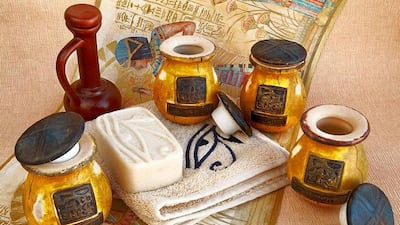
Nefertari creates essential oils, soaps and creams made from 100 per cent natural ingredients

How organic skincare returned home to Egypt: what to know about the natural beauty trend


Kamal Tabikha
  • English
  • Arabic

Much like organic foods and farmers’ markets, natural skincare is a movement that found its roots in the anti-establishment sentiments that put an end to the use of DDT in agriculture. But what started as an alternative method of self-care, practised by a few bohemian beauty seekers, has now become a quintessential cornerstone of the global cosmetics industry.

It’s not just the West that’s going natural, either; organic skincare has found a strong foothold in Egypt – home to the world’s foremost beauty buff, Cleopatra. Millions from the Arab world’s most populous country, spanning a range of ages, genders and socio-economic backgrounds, are now seeking out the benefits of natural skin, hair and make-up products.

Bringing natural skincare back to Egypt

Nefertari, Egypt’s oldest and most prolific natural beauty operation, started in Dr Mona Erian’s kitchen 25 years ago. The brand’s founder and chief executive began her foray into organic beauty in 1996, with an olive oil soap made to alleviate a severe allergic reaction her daughter had to a chemical shampoo that caused her to lose chunks of her hair.

"This was the first time I read about the chemicals in the common shampoos we were using, and I was astonished," Erian tells The National.

Natural skincare products are great, but people need to do a lot of research before they just jump in

Erian, who worked for a pharmaceutical company at the time, became more perturbed as she conducted further research into the various chemicals that were also being used to manufacture soaps, creams and lotions.

"What frightened me the most was the number of carcinogenic ingredients, as well as products that can affect the kidneys, the liver, the lungs. They are really damaging in the long run," says Erian, who became disillusioned with chemical beauty products.

Nefertari now manufactures more than 500 products, from essential oils, soaps and creams to cotton towels and massage equipment, all made from 100 per cent natural ingredients.

Ancient skincare recipes that still exist today

While the small soap-making company has grown to become Egypt’s first large-scale natural skincare brand, the phenomenon predates the 1990s by a few millennia. In many ancient civilisations, people used natural ingredients such as olive oil, milk, honey, cedar oil, aloe vera, salts, clays, grapeseed oil and witch hazel to exfoliate, nourish, cleanse and moisturise their skin.

Nefertari, which relies heavily on ancient Egyptian imagery in its branding – after all, it is named after the first of the "Great Royal Wives" of Ramses II the Great – has also adopted a number of age-old skincare recipes in its range.

One such product is an anti-wrinkle face and neck cream made from sweet almond oil, shea butter and the essential oil of frankincense, all ingredients that would have been part of Cleopatra and, indeed Nefertari’s, vanity chests.

Beware following beauty trends blindly

Nefertari might have been the only player on the scene when it first started out, but today, there are dozens of competitors producing similar products, which is an attestation to how many Egyptians are interested in organic beauty.

"It's a hot trend for sure, and it's currently witnessing its heyday in Egypt," says Dr Sara Qaldas, a Bahraini-Egyptian dermatologist and aesthetician at ZO Skin Centre by Zein Obagi MD (previously Obagi Clinic).

Qaldas is a proponent of organic skincare products and their benefits overall; however, she reveals that there are a few issues with the way people use them, which she blames on the shallow nature of trends.

“Natural skincare products are great, but like everything else with health and wellness, people need to do a lot of research before they just jump in,” she says.

Are chemicals always a bad idea?

Qaldas says she has dealt with many patients with skin conditions that were made worse by the continued misuse of natural skincare products. Often, the solution to more severe conditions can only be found in chemical-based products, she says.

She explains that natural products are great for maintaining one’s skin if it was OK to begin with, but for skin conditions that require more specialised treatment, natural products may do more harm than good.

"If I see a patient with severe cystic acne, which is a common-enough problem, I would not prescribe tea tree oil or witch hazel, which are common and [beneficial] over-the-counter natural treatments for [regular] acne. But for the more severe cases, chemicals such as isotretinoin or benzoyl peroxide are much more effective."

Organic skincare pitfalls

Its thick consistency makes shea butter more suited to the body than the face. Photo: Nefertari

Qaldas singles out two popular natural products that people need to use with caution: shea butter and vitamin C serums. Both are sold as stand-alone items, as well as mixed into many other creams and lotions.

“Shea butter is great, particularly in winter when our skin needs more hydrating. While I recommend that people use it on their bodies to moisturise, I would be wary of using it on my face since it is often too thick, and the skin on the face is more sensitive and prone to irritation,” she explains. “Another popular one is vitamin C products, which are really tricky to get right.”

Before I recommend any of my natural products, I ask my clients to seek medical advice first

Such serums, she says, can cause pigmentation when not used with sunscreen, but they also don’t work without UV rays from the sun, which “activate” the serum.

“Most brands will tell their clients to use vitamin C serums at night, so they don’t cause pigmentation, but that renders them ineffective since they need the sun to be activated. This is vital information that clients need to research before they use these products,” says Qaldas.

Always seek expert advice

Ghada Alaa, 22, a make-up artist who suffered from severe cystic acne when she was younger, reiterates Qaldas’s views as she remembers trying a number of organic treatments for her acne but to no avail.

“After I tried all the natural products under the sun, I finally decided to visit a dermatologist. She prescribed a specific routine that included products with impossibly complicated and scientific names,” says Alaa, whose acne cleared up three months later.

Trends are made all the more potent through rampant social media use, which has resulted in fads being introduced to billions around the world almost simultaneously. While this globalised connection has its benefits, the experts are still in agreement: when it comes to our bodies and what we’re putting in or on them, it is best to consult a doctor first.

It’s why Nefertari’s Erian always urges her clientele to first seek expert counsel to better understand any unique conditions they might be suffering.

“I sometimes get clients with hair loss issues. Before I recommend any of my natural products, I ask them to seek medical advice first. Because perhaps it’s anaemia or a reaction to something the client is eating; we never know.”


Mercer, the investment consulting arm of US services company Marsh & McLennan, expects its wealth division to at least double its assets under management (AUM) in the Middle East as wealth in the region continues to grow despite economic headwinds, a company official said.

Mercer Wealth, which globally has $160 billion in AUM, plans to boost its AUM in the region to $2-$3bn in the next 2-3 years from the present $1bn, said Yasir AbuShaban, a Dubai-based principal with Mercer Wealth.

Within the next two to three years, we are looking at reaching $2 to $3 billion as a conservative estimate and we do see an opportunity to do so,” said Mr AbuShaban.

Mercer does not directly make investments, but allocates clients’ money they have discretion to, to professional asset managers. They also provide advice to clients.

“We have buying power. We can negotiate on their (client’s) behalf with asset managers to provide them lower fees than they otherwise would have to get on their own,” he added.

Mercer Wealth’s clients include sovereign wealth funds, family offices, and insurance companies among others.

From its office in Dubai, Mercer also looks after Africa, India and Turkey, where they also see opportunity for growth.

Wealth creation in Middle East and Africa (MEA) grew 8.5 per cent to $8.1 trillion last year from $7.5tn in 2015, higher than last year’s global average of 6 per cent and the second-highest growth in a region after Asia-Pacific which grew 9.9 per cent, according to consultancy Boston Consulting Group (BCG). In the region, where wealth grew just 1.9 per cent in 2015 compared with 2014, a pickup in oil prices has helped in wealth generation.

BCG is forecasting MEA wealth will rise to $12tn by 2021, growing at an annual average of 8 per cent.

Drivers of wealth generation in the region will be split evenly between new wealth creation and growth of performance of existing assets, according to BCG.

Another general trend in the region is clients’ looking for a comprehensive approach to investing, according to Mr AbuShaban.

“Institutional investors or some of the families are seeing a slowdown in the available capital they have to invest and in that sense they are looking at optimizing the way they manage their portfolios and making sure they are not investing haphazardly and different parts of their investment are working together,” said Mr AbuShaban.

Some clients also have a higher appetite for risk, given the low interest-rate environment that does not provide enough yield for some institutional investors. These clients are keen to invest in illiquid assets, such as private equity and infrastructure.

“What we have seen is a desire for higher returns in what has been a low-return environment specifically in various fixed income or bonds,” he said.

“In this environment, we have seen a de facto increase in the risk that clients are taking in things like illiquid investments, private equity investments, infrastructure and private debt, those kind of investments were higher illiquidity results in incrementally higher returns.”

The Abu Dhabi Investment Authority, one of the largest sovereign wealth funds, said in its 2016 report that has gradually increased its exposure in direct private equity and private credit transactions, mainly in Asian markets and especially in China and India. The authority’s private equity department focused on structured equities owing to “their defensive characteristics.”

INFO

Schools can register for the Abu Dhabi Schools Championships at www.champions.adsc.ae

Florence and the Machine – High as Hope
Three stars

At a glance

- 20,000 new jobs for Emiratis over three years

- Dh300 million set aside to train 18,000 jobseekers in new skills

- Managerial jobs in government restricted to Emiratis

- Emiratis to get priority for 160 types of job in private sector

- Portion of VAT revenues will fund more graduate programmes

- 8,000 Emirati graduates to do 6-12 month replacements in public or private sector on a Dh10,000 monthly wage - 40 per cent of which will be paid by government

Another way to earn air miles

In addition to the Emirates and Etihad programmes, there is the Air Miles Middle East card, which offers members the ability to choose any airline, has no black-out dates and no restrictions on seat availability. Air Miles is linked up to HSBC credit cards and can also be earned through retail partners such as Spinneys, Sharaf DG and The Toy Store.

An Emirates Dubai-London round-trip ticket costs 180,000 miles on the Air Miles website. But customers earn these ‘miles’ at a much faster rate than airline miles. Adidas offers two air miles per Dh1 spent. Air Miles has partnerships with websites as well, so booking.com and agoda.com offer three miles per Dh1 spent.

“If you use your HSBC credit card when shopping at our partners, you are able to earn Air Miles twice which will mean you can get that flight reward faster and for less spend,” says Paul Lacey, the managing director for Europe, Middle East and India for Aimia, which owns and operates Air Miles Middle East.

Company%20profile
%3Cp%3E%3Cstrong%3EName%3A%20%3C%2Fstrong%3EPurpl%3C%2Fp%3E%0A%3Cp%3E%3Cstrong%3ECo-founders%3A%20%3C%2Fstrong%3EKarl%20Naim%2C%20Wissam%20Ghorra%2C%20Jean-Marie%20Khoueir%3C%2Fp%3E%0A%3Cp%3E%3Cstrong%3EBased%3A%20%3C%2Fstrong%3EHub71%20in%20Abu%20Dhabi%20and%20Beirut%3C%2Fp%3E%0A%3Cp%3E%3Cstrong%3EStarted%3A%20%3C%2Fstrong%3E2021%3C%2Fp%3E%0A%3Cp%3E%3Cstrong%3ENumber%20of%20employees%3A%20%3C%2Fstrong%3E12%3C%2Fp%3E%0A%3Cp%3E%3Cstrong%3ESector%3A%20%3C%2Fstrong%3EFinTech%3C%2Fp%3E%0A%3Cp%3E%3Cstrong%3EFunding%3A%20%3C%2Fstrong%3E%242%20million%26nbsp%3B%3C%2Fp%3E%0A
WORLD CUP SEMI-FINALS

England v New Zealand (Saturday, 12pm)

Wales v South Africa (Sunday, 1pm)

Squad

Ali Kasheif, Salim Rashid, Khalifa Al Hammadi, Khalfan Mubarak, Ali Mabkhout, Omar Abdulrahman, Mohammed Al Attas, Abdullah Ramadan, Zayed Al Ameri (Al Jazira), Mohammed Al Shamsi, Hamdan Al Kamali, Mohammed Barghash, Khalil Al Hammadi (Al Wahda), Khalid Essa, Mohammed Shaker, Ahmed Barman, Bandar Al Ahbabi (Al Ain), Al Hassan Saleh, Majid Suroor (Sharjah) Walid Abbas, Ahmed Khalil (Shabab Al Ahli), Tariq Ahmed, Jasim Yaqoub (Al Nasr), Ali Saleh, Ali Salmeen (Al Wasl), Hassan Al Muharami (Baniyas) 

Our legal consultant

Name: Dr Hassan Mohsen Elhais

Position: legal consultant with Al Rowaad Advocates and Legal Consultants.

Lexus LX700h specs

Engine: 3.4-litre twin-turbo V6 plus supplementary electric motor

Power: 464hp at 5,200rpm

Torque: 790Nm from 2,000-3,600rpm

Transmission: 10-speed auto

Fuel consumption: 11.7L/100km

On sale: Now

Price: From Dh590,000

UAE currency: the story behind the money in your pockets
Profile Box

Company/date started: 2015

Founder/CEO: Mohammed Toraif

Based: Manama, Bahrain

Sector: Sales, Technology, Conservation

Size: (employees/revenue) 4/ 5,000 downloads

Stage: 1 ($100,000)

Investors: Two first-round investors including, 500 Startups, Fawaz Al Gosaibi Holding (Saudi Arabia)

Infiniti QX80 specs

Engine: twin-turbocharged 3.5-liter V6

Power: 450hp

Torque: 700Nm

Price: From Dh450,000, Autograph model from Dh510,000

Available: Now

UAE currency: the story behind the money in your pockets
Recycle Reuse Repurpose

New central waste facility on site at expo Dubai South area to  handle estimated 173 tonne of waste generated daily by millions of visitors

Recyclables such as plastic, paper, glass will be collected from bins on the expo site and taken to the new expo Central Waste Facility on site

Organic waste will be processed at the new onsite Central Waste Facility, treated and converted into compost to be re-used to green the expo area

Of 173 tonnes of waste daily, an estimated 39 per cent will be recyclables, 48 per cent  organic waste  and 13 per cent  general waste.

About 147 tonnes will be recycled and converted to new products at another existing facility in Ras Al Khor

Recycling at Ras Al Khor unit:

Plastic items to be converted to plastic bags and recycled

Paper pulp moulded products such as cup carriers, egg trays, seed pots, and food packaging trays

Glass waste into bowls, lights, candle holders, serving trays and coasters

Aim is for 85 per cent of waste from the site to be diverted from landfill 

Important questions to consider

1. Where on the plane does my pet travel?

There are different types of travel available for pets:

  • Manifest cargo
  • Excess luggage in the hold
  • Excess luggage in the cabin

Each option is safe. The feasibility of each option is based on the size and breed of your pet, the airline they are traveling on and country they are travelling to.


2. What is the difference between my pet traveling as manifest cargo or as excess luggage?

If traveling as manifest cargo, your pet is traveling in the front hold of the plane and can travel with or without you being on the same plane. The cost of your pets travel is based on volumetric weight, in other words, the size of their travel crate.

If traveling as excess luggage, your pet will be in the rear hold of the plane and must be traveling under the ticket of a human passenger. The cost of your pets travel is based on the actual (combined) weight of your pet in their crate.


3. What happens when my pet arrives in the country they are traveling to?

As soon as the flight arrives, your pet will be taken from the plane straight to the airport terminal.

If your pet is traveling as excess luggage, they will taken to the oversized luggage area in the arrival hall. Once you clear passport control, you will be able to collect them at the same time as your normal luggage. As you exit the airport via the ‘something to declare’ customs channel you will be asked to present your pets travel paperwork to the customs official and / or the vet on duty. 

If your pet is traveling as manifest cargo, they will be taken to the Animal Reception Centre. There, their documentation will be reviewed by the staff of the ARC to ensure all is in order. At the same time, relevant customs formalities will be completed by staff based at the arriving airport. 


4. How long does the travel paperwork and other travel preparations take?

This depends entirely on the location that your pet is traveling to. Your pet relocation compnay will provide you with an accurate timeline of how long the relevant preparations will take and at what point in the process the various steps must be taken.

In some cases they can get your pet ‘travel ready’ in a few days. In others it can be up to six months or more.


5. What vaccinations does my pet need to travel?

Regardless of where your pet is traveling, they will need certain vaccinations. The exact vaccinations they need are entirely dependent on the location they are traveling to. The one vaccination that is mandatory for every country your pet may travel to is a rabies vaccination.

Other vaccinations may also be necessary. These will be advised to you as relevant. In every situation, it is essential to keep your vaccinations current and to not miss a due date, even by one day. To do so could severely hinder your pets travel plans.

Source: Pawsome Pets UAE

How does ToTok work?

The calling app is available to download on Google Play and Apple App Store

To successfully install ToTok, users are asked to enter their phone number and then create a nickname.

The app then gives users the option add their existing phone contacts, allowing them to immediately contact people also using the application by video or voice call or via message.

Users can also invite other contacts to download ToTok to allow them to make contact through the app.