

People who meander or shuffle instead of briskly walk may be nearly four times more likely to die from Covid-19, new research shows.
This proposition is based on a study done by health researchers at the University of Leicester after they examined more than 400,000 middle-aged UK Biobank participants, attempting to explore links between body mass index, self-reported walking pace and the risk of contracting severe Covid-19, as well as mortality rates.
They also found slow walkers with a "normal" weight were 3.75 times more likely to die from the virus than people who walked at a faster pace, and that those who drag their feet were 2.5 times more likely to develop a severe form of the coronavirus.
A slow walking pace was considered to be a speed of less than 4.8 kilometres per hour, while brisk walkers would need to be going more than 6.4km per hour.
The study, the findings of which were published in the International Journal of Obesity, was run by the National Institute for Health Research Leicester Biomedical Research Centre.
Lead researcher Tom Yates said it was possible to predict whether someone was at a higher risk from the virus based on the findings.

The possible reasons for this is that faster walkers often have healthier cardiovascular systems and therefore may be more resilient.
Researchers did note, however, that self-reported walking pace could be biased and so no definitive causal conclusions could be made from the results of the study.
"We know already that obesity and frailty are key risk factors for Covid-19 outcomes," said Yates. "This is the first study to show that slow walkers have a much higher risk of contracting severe Covid-19 outcomes, irrespective of their weight.
"With the pandemic continuing to put unprecedented strain on healthcare services and communities, identifying individuals at greatest risk and taking preventative measures to protect them is crucial."
The analysis took place only in England and outcomes assessed during the pandemic's first wave.
Yates continued: "While large routine database studies have reported the association of obesity and fragility with Covid-19 outcomes, routine clinical databases do not currently have data on measures of physical function or fitness.
"It is my view that ongoing public health and research surveillance studies should consider incorporating simple measures of physical fitness, such as self-reported walking pace, in addition to BMI, as potential risk predictors of Covid-19 outcomes that could ultimately enable better prevention methods that save lives."
Coronavirus around the world – in pictures
-
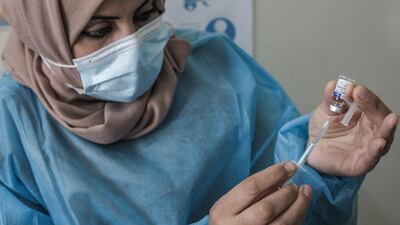
A health worker prepares an injection of the Sputnik V Covid-19 vaccine at Sabha Al-Harazin Clinic in Gaza City. Getty Images -
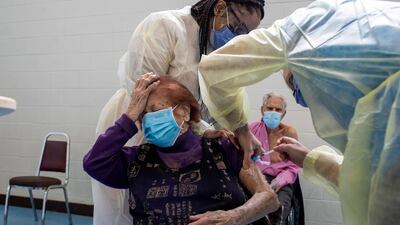
Nurses from Humber River Hospital administer the Pfizer-BioNTech Covid-19 vaccine to Maria DiStefano as her husband Vince DiStefano looks on, at St Fidelis Parish in Toronto, Ontario, Canada. Reuters -
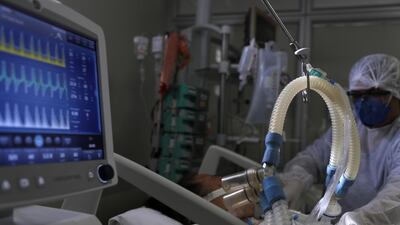
A health worker treats a Covid-19 patient at the Intensive Care Unit of Hospital Sao Paulo in Sao Paulo, Brazil. Reuters -
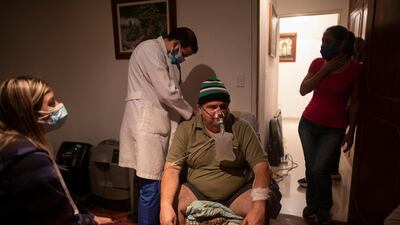
Doctor Leonardo Acosta, left, listens to the lungs of Carlos Perez, a Covid-19 patient, at his home in Caracas, Venezuela. AP Photo -
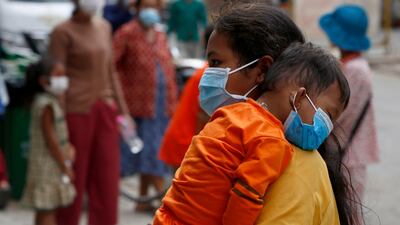
A woman walks outside a hospital in Phnom Penh, Cambodia. EPA -
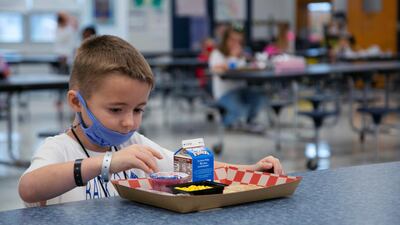
Students eat individually due to social distancing on the first day back to school in Louisville, Kentucky, USA. Reuters -
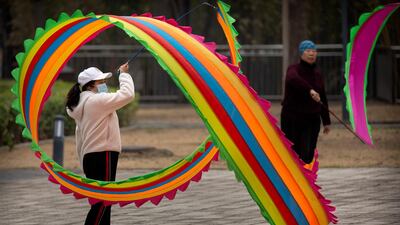
A woman twirls a flag at a public park in Beijing, China. AP Photo -
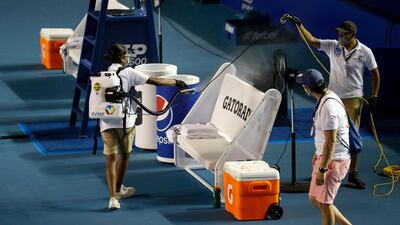
Workers spray disinfectant onto the players' benches, between second round matches at the Mexican Open tennis tournament in Acapulco. AP Photo -
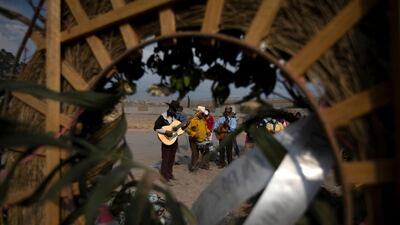
Hired musicians perform as family members attend the burial service of a relative who died from Covid-19 in the Chalco cemetery just outside Mexico City. AP Photo -
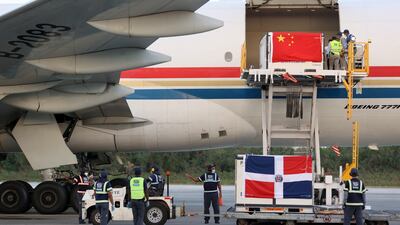
Airport operators unload a batch of Sinovac Covid-19 vaccine at the Santo Domingo International Airport, Dominican Republic. EPA



