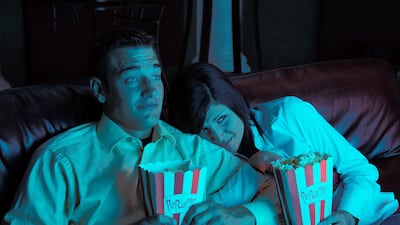
Picture this: your heart is racing, your palms are sweaty; there are butterflies fluttering in the pit of your stomach and goosebumps are springing up across your skin. Are you in the iron grip of fear or are you falling in love - who can tell? Your body certainly can’t.
In both situations your brain is busy producing floods of dopamine, a neurotransmitter that raises your heart rate, tenses your muscles and then tells your parasympathetic nervous system: "That was exciting. Let’s do it again!"
It's a physiological state that goes some way to explain why, for some people, the thrill of watching a scary movie drives them on to seek out the next, bigger, scarier cinematic thrill, even while wondering if that shadow behind the door is an axe-wielding murderer. The same goes for people who have their hearts broken, but jump back into the dating game.
What they're both chasing is the dopamine high. "Our bodies release chemicals that cause our heart rate, energy, blood pressure and breathing to increase," says Christine Kritzas, counselling psychologist at The Lighthouse Arabia. "After we experience the fearful event, our bodies remain in an excited state, which enhances overall emotions."
The dopamine high
Johanna Richmond, a psychologist at Cognitive Behaviour Therapy Dubai, says of the dopamine high: “We push ourselves to the limit and experience that buzz of being absolutely terrified. The sympathetic nervous system gets activated during this dopamine high. This is the ‘fight or flight’ path that causes anxiety. When you’re scared, the sympathetic nervous system is working overtime, tensing your muscles and increasing your heart rate and blood pressure in preparation for what’s to come.
“Then there’s the excitement when you come down. It activates the parasympathetic nervous system, sending a message to the brain to say: ‘This is exciting. Scary but exciting.’”
Horror film fan Iktimal Daneshvar from Dubai admits she loves the feeling of being scared. “I love the adrenalin rush. It’s like being on a really scary ride. You’re at the top and you know it’s going to drop, but you don’t know when, and there’s this build-up of excitement. Then when you do drop, there’s a rush. I love the feeling that I know something’s going to happen, but I don’t know when, or how scared I’m going to be, or what reaction I’ll have.”
Chasing the feeling
Often, the feelings that horror film buffs are chasing don't live up to the first time the thrill is experienced, and they often speak about the hunt for the next high. "It's rare that a horror film affects me," says Jed Shepherd, writer and co-producer of horror flick Host, dubbed the "defining film of any genre from 2020" by The Telegraph.
“I compartmentalise what I see. I’m so desensitised by now that it’s difficult to be scared by anything. I can happily watch the scariest film and then just go about my day.”
“It’s like those people who chase tornadoes,” he adds. “Once you chase one, you need it again and again, but you want bigger and better each time, both for the chemicals that get released in your brain, and for the relief you feel afterwards. It’s very addictive.”
Kritzas says: "Research suggests that the reason some individuals enjoy thrill-seeking activities comes down to differences in brain chemistry. When experiencing a thrilling event, there are increased levels of the hormone cortisol, known to spike when people experience stress.
"However, not all stress is bad. Eu-Stress, which is derived from euphoria, is the pleasant stimulation that people seek. Some people need to be exposed to more threatening situations to experience the same thrills as others. The bigger the threat, the bigger the thrill for some, meaning they are more attracted to being scared.
“Individuals who are known to be sensation-seekers tend to have higher levels of dopamine in their brains,” she adds.
This neurotransmitter is released not only during activities you enjoy, but also at the anticipation of doing something. And what are scary films if not paeans to suspense?
So, putting it in horror film perspective: the brain releases more dopamine at the thought of what might be causing the shadow to move silently across the wall. This is followed by another flood when it turns out to be a silhouette caused by a passing car's tail lights rather than Nosferatu himself. The process reinforces the craving and focus on satisfaction in the future, creating a cycle of motivation, reward and reinforcement.
“As I’ve grown in my appreciation for the horror genre, it’s harder to get scared, and that’s something I’m always looking for, something that spooks and unsettles me,” says film critic William Mullally. “Finding that place where something unsettles you is a pleasing emotion to experience as it makes you feel things differently. I’d say this is why diehard fans of the genre are insatiable and always on the hunt for the next new film.”
The thrill of ‘safe’ fear
Kritzas says the purpose of fear "is to promote survival. From an evolutionary perspective, the fight or flight stress response was first adapted to increase an animal's survival when confronted with immediate danger".
However, these days the threat of physical fear – being attacked by an animal competing for the same food source – has been replaced by mental fears, such as job loss, coronavirus or bills to pay.
So, whether you are hurtling along in the fastest roller coaster or find yourself alone in haunted house of an amusement park, your brain tends to know that, physically, you are safe.
"I'm quite a scared person, but I enjoy horror movies. The kicks I get are maybe because I know that they're not real," says The National's Weekend editor, Katy Gillett. "I know that just because I'm watching a movie, some crazy psycho is not going to come and get me that night, because that would be a massive coincidence."
Kritzas says: “For some people, the experience of watching a horror film creates physiological feelings that are interpreted as playful. There are multiple perceptions of one reality. Thrill-seekers perceive their reality to be safe, fun and exciting to explore. Given that they understand that these thrills are safe, they get to enjoy that feeling of being pumped up rather than running away.
“People need to know they’re in a safe environment to really enjoy a scary situation … they can let their guard down and immerse themselves in that thrill-seeking experience.”
The British ghost writer M R James called it "pleasing terror", says Mullally.
"A good example is the stage play Woman in Black. In the play, she jumps out, the audience screams and laughs. That's pleasing terror, a safe place to feel scared. To experience the thrill without ever feeling you're truly in danger."

